
Sunspot 1513 generated M1.0 solar flare
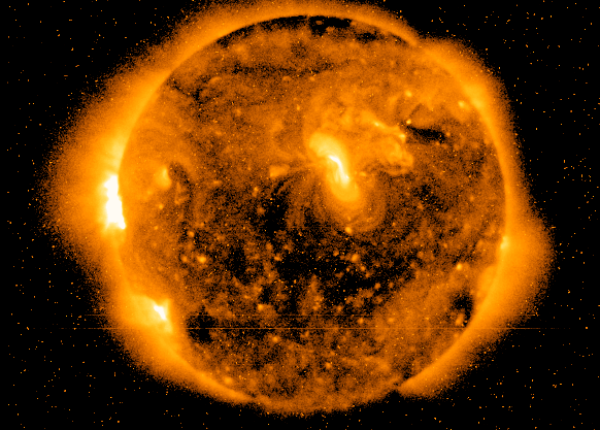
Image credit: TW
Sunspot 1513 produced a quick M1.0 solar flare at 12:52 UTC on June 30. Sunspots 1513 and 1515 have Beta-Gamma magnetic configurations that harbors energy for strong solar flares. NOAA forecasters estimate a 40% chance of continued M-flares during the next 24 hours and 5% chances of X-class event.


The solar wind is currently at higher levels due to a Solar Sector Boundary Crossing and is expected to remain high due to an incoming solar wind stream flowing from a Coronal Hole. As the solar wind flows away from the Sun, the IMF is carried with it and has a spiral shape. Along the ecliptic plane, the IMF generally has 2 or 4 sectors per solar rotation (27 days) where it is pointed toward or away from the Sun. The surface separating the polarities is called the heliospheric current sheet. A sector boundary crossing occurs when the polarity of the IMF reverses. A well-defined sector boundary crossing has a uniform field direction for about 4 days before and after the crossing. Minor geomagnetic storming at high latitudes is possible.


Amateur astronomers around the world are monitoring a massive, active prominence dancing along the sun’s southeastern limb. The latest images suggest an eruption might be in the offing.
Ultraviolet telescopes onboard NASA’s Solar Dynamics Observatory are monitoring a vast coronal hole in the sun’s upper atmosphere. It has just turned directly toward Earth. Coronal holes are places where the sun’s magnetic field opens up and allows the solar wind to escape. A stream of solar wind flowing from this particular gap is en route to Earth, due to arrive on July 2nd or 3rd. The impact could spark geomagnetic storms and auroras.


More ionization waves and solar radio bursts are in the offing.
CURRENT CONDITIONS:
Solar wind
speed: 667.9 km/sec
density: 2.9 protons/cm3
The Radio Sun
10.7 cm flux: 117 sfu
Planetary K-index
Now: Kp= 4 unsettled
24-hr max: Kp= 4 unsettled
Interplanetary Mag. Field
Btotal: 5.7 nT
Bz: 2.3 nT south
Stay tuned for more information and stay updated via our Space Weather Station!
Sources: SolarHam, SpaceWeather, NOAA/SWPC

Published in the last 24 hours
- High Risk of excessive rainfall covers Florida’s Space Coast as St. Johns River near Cocoa reaches 5.67 m
- Asteroid 2026 WJ to pass Earth at 1.7 lunar distances at 04:20 UTC on November 22, with 2026 WD following at 4.4 lunar distances on November 23
- Cyclone Akvan crossed the north Andhra Pradesh and south Odisha coasts close to Gopalpur on November 20 with 70-80 km/h winds gusting to 90, and has weakened into a deep depression
- A broad low over southeastern Florida and the northwestern Bahamas has a 30 percent chance of subtropical or tropical development within 48 hours and a 50 percent chance within 7 days, the National Hurricane Center says

[…] The Watchers – Sunspot 1513 generated M1.0 solar flare Sunspot 1513 produced a quick M1.0 solar flare at 12:52 UTC on June 30. Sunspots 1513 and 1515 have Beta-Gamma magnetic configurations that harbors …thewatchers.adorraeli.com/…/sunspot-1513-generated-m1-0-so… […]
[…] The Watchers – Sunspot 1513 generated M1.0 solar flare […]