
Returning Sunspot 1431 produced moderate M1 solar flare
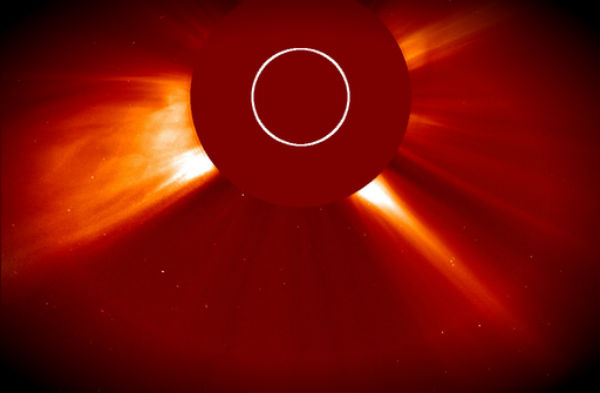
Image credit: TW
Old Sunspot 1431 is now rotating back into view off the southeast limb and is also producing solar flares. So far this afternoon it produced a minor C6.5 flare, followed by a moderate M1.0 event at 19:40 UTC. Various small sunspots did form including regions 1441, 1442 and 1443, but each are magnetically simple and stable. There is now a chance for further M-Class flares around returning sunspot 1431. Stay Tuned as solar activity looks to be increasing. (SolarHam)


Joint USAF/NOAA Report of Solar and Geophysical Activity (22 Mar 2012)
Solar activity was low. Region 1440 (S25W38) produced todays only C-class flare at 22/1750Z. This region appears to be decaying and currently shows a beta-gamma configuration. Three new sunspot groups were numbered today: Region 1441 (S27W56), Region 1442 (N13E49) and Region 1443 (N16E62). All of these regions were small, quiet, and stable. Solar activity is expected to be very low with a chance for an isolated C-flare from Region 1440.
The geomagnetic field was quiet with an isolated unsettled period from 22/1800Z to 22/2100Z. Solar wind data appeared to indicate a solar sector boundary crossing at about 22/1930Z. The greater than 2 MeV electron flux at geosynchronous orbit was at high levels throughout the period. The geomagnetic field is expected to be quiet for the next three days (23-25 March).

Auroras continue to flicker around the Arctic Circle despite waning solar wind speeds. For reasons that are still not fully understood, equinoxes favor auroras.


Published in the last 24 hours
- Male toads abandoned a pond in Italy five days before a deadly 2009 earthquake, while a scientist was counting them Epicenter
- An asteroid was spotted 19 hours before it exploded over Sudan in 2008, and students picked its pieces off the desert Epicenter
- A wave up to 3 m (10 feet) high rose out of Lake Michigan on a sunny June morning in 1954 and swept fishermen off Chicago’s piers, and when a second came 10 days later, warnings had cleared the shore Epicenter
- Just 12 inches of rushing water can carry away most cars, and more than half of US flood drownings happen to people who drive into flood water Epicenter
