
Double coronal hole spewing high speed stream toward Earth
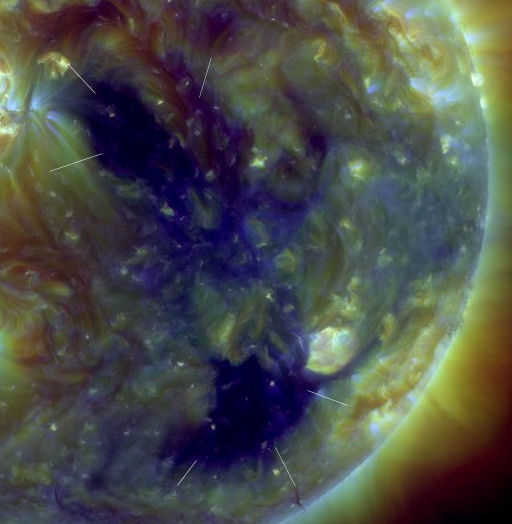
Image credit: TW
A double-barreled hole has opened up in the sun’s atmosphere and it is spewing a split-stream of solar wind toward Earth. NASA’s Solar Dynamics Observatory captured this composite UV image of the double coronal hole on August 20th:
Sky watchers should be alert for auroras when the solar wind arrives on August 22-24. NOAA forecasters estimate a 35% to 50% chance of high-latitude geomagnetic activity. (SpaceWeather)
Solar activity continues at very low levels with only minor C-Class activity taking place. Sunspot 1272 in the southern hemisphere did show some growth over the past 24 hours. Sunspot 1271 remains a large area, but otherwise has been quiet. There will be a chance for C-Class flares and perhaps a low risk of an M-Class event. (SolarHam)

The geomagnetic field was quiet to unsettled due to the arrival of a favorably positioned negative polarity coronal hole. The geomagnetic field is expected to be unsettled with a chance for active conditions at high latitudes on Days 1 and 2 (22-23 Aug) with the arrival of a second coronal hole high speed stream (HSS). Day 3 (24 Aug) is expected to decrease to quiet conditions as effects from the HSS subside. (NOAA SWPC Solar report)

CORONAL HOLES AND THE SOLAR WIND

Published in the last 24 hours
- High Risk of excessive rainfall covers Florida’s Space Coast as St. Johns River near Cocoa reaches 5.67 m
- Asteroid 2026 WJ to pass Earth at 1.7 lunar distances at 04:20 UTC on November 22, with 2026 WD following at 4.4 lunar distances on November 23
- Cyclone Akvan crossed the north Andhra Pradesh and south Odisha coasts close to Gopalpur on November 20 with 70-80 km/h winds gusting to 90, and has weakened into a deep depression
- A broad low over southeastern Florida and the northwestern Bahamas has a 30 percent chance of subtropical or tropical development within 48 hours and a 50 percent chance within 7 days, the National Hurricane Center says
