
Sun produced a series of strong shortwave radio bursts
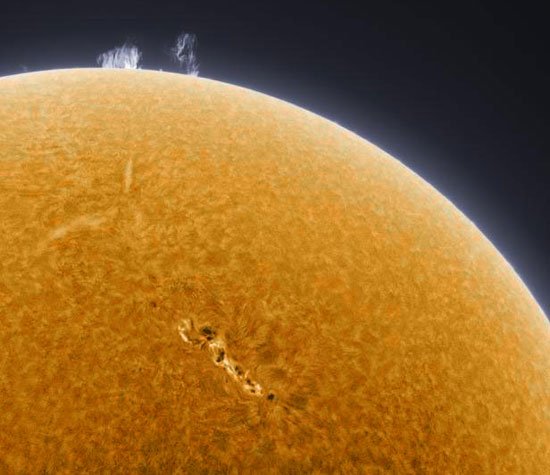
Image credit: TW
On July 7th, the sun produced a series of strong shortwave radio bursts. Click on the dynamic spectrum below to play a 21 MHz sample recorded by amateur radio astronomer Thomas Ashcraft in rural New Mexico. The action begins about 18 seconds into the 2-minute recording:

The roaring-static sound you just heard was a combo Type III-Type V solar radio burst caused by electron beams moving through the sun's outer atmosphere. The source of the electrons could be an newly-emerging sunspot group in the sun's southeastern quadrant, although this is not certain. The active region is crackling with C-class solar flares, and it could produce more radio sounds in the days ahead. (SpaceWeather)
The solar X-Rays have been fairly quiet since the C-Class activity on Friday. Sunspots 1245 and 1247 persist and there could be a chance for a further C-Class flare on Saturday. The STEREO Behind images show atleast 3 regions in the norhtern hemisphere that will begin to rotate into view during the upcoming week. (SolarHam)

Published in the last 24 hours
- High Risk of excessive rainfall covers Florida’s Space Coast as St. Johns River near Cocoa reaches 5.67 m
- Asteroid 2026 WJ to pass Earth at 1.7 lunar distances at 04:20 UTC on November 22, with 2026 WD following at 4.4 lunar distances on November 23
- Cyclone Akvan crossed the north Andhra Pradesh and south Odisha coasts close to Gopalpur on November 20 with 70-80 km/h winds gusting to 90, and has weakened into a deep depression
- A broad low over southeastern Florida and the northwestern Bahamas has a 30 percent chance of subtropical or tropical development within 48 hours and a 50 percent chance within 7 days, the National Hurricane Center says

Enjoy your material as it appears on Spaceweather,com.
What minumum equipment would be required for an amateur like me to monitor 21 MHz for solar noise? Could you point me to any basic equipment designs or requirements. I am president of the Satellite ARC on Vandenberg AFB in CA and we could easily do something at our large club facility on the base in this vein. Any guidande would be appreciated. The club’s Web Site, which I maintain, is satellitearc.com.
73 John