
Earth-grazer fireball with radio reflections recorded over New Mexico
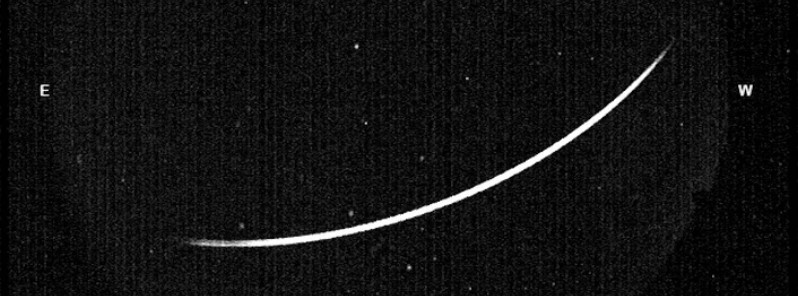
Featured image: Earth-grazer fireball over New Mexico on October 25, 2017. Credit: Thomas Ashcraft
An Earth-grazer fireball flew over New Mexico, US at 09:42 UTC (03:42 MDT) on October 25, 2017 and was recorded by amateur radio astronomer Thomas Ashcraft.
Ashcraft recorded it over his personal observatory "Heliotown" in Lamy, New Mexico.
"Earth-grazing fireballs are bright meteors that enter Earth’s atmosphere at a very shallow angle and skim along the top of the atmosphere. Some actually re-enter space," Vicent Perlerin of the American Meteor Society explained.
Ashcraft combines all-sky video camera observations with a forward-scatter radar array that is tuned to the plasma and ionization produced by meteors (Channel A 76.309 MHz CW – Channel B 54.309 MHz CW), Perlerin added.
Whenever a meteor passes through the upper atmosphere it creates an elongated paraboloid of ionized air behind it. Occurring at an atmospheric height of about 85 to 105 km (50 to 65 miles), this ionized trail is capable of reflecting radio waves from transmitters below on the Earth’s surface. This type of reflection behaves very similar to light reflecting from a mirrored surface, and is called a specular reflection.

Teo Blašković founded The Watchers in 2011 and edited it until 2026, covering seismic and volcanic activity, extreme weather, space weather and near-Earth objects. Articles on this page are his archive.
Published in the last 24 hours
- The storms drenching California this week are fed by a river in the sky, a band of water vapor that can carry up to 15 times the flow of the Mississippi River, and this winter’s near-record El Niño could keep aiming more of them at the West Coast
- Malawi continues Bris AI weather forecasting tests ahead of operational integration Epicenter
- Right about now, Voyager 1 is crossing a line no human-made object has ever reached, a full light-day from Earth, which means a message NASA sends tonight won't arrive until tomorrow night, and the spacecraft's answer won't make it home until the night after that
- G1 geomagnetic storm watch remains in effect as NOAA forecasts Kp 4.67 late on November 17 and early on November 18
