
Thin atmosphere detected around small plutino beyond Neptune
Astronomers have reported evidence of a thin atmosphere around the small plutino (612533) 2002 XV93 after observing the object pass in front of a distant star on January 10, 2024. The finding, published in Nature Astronomy this month, identifies evidence of a gaseous envelope around a trans-Neptunian object far smaller than Pluto. The object is so small that it should not have a sustainable atmosphere, raising questions about when and how the atmosphere formed.
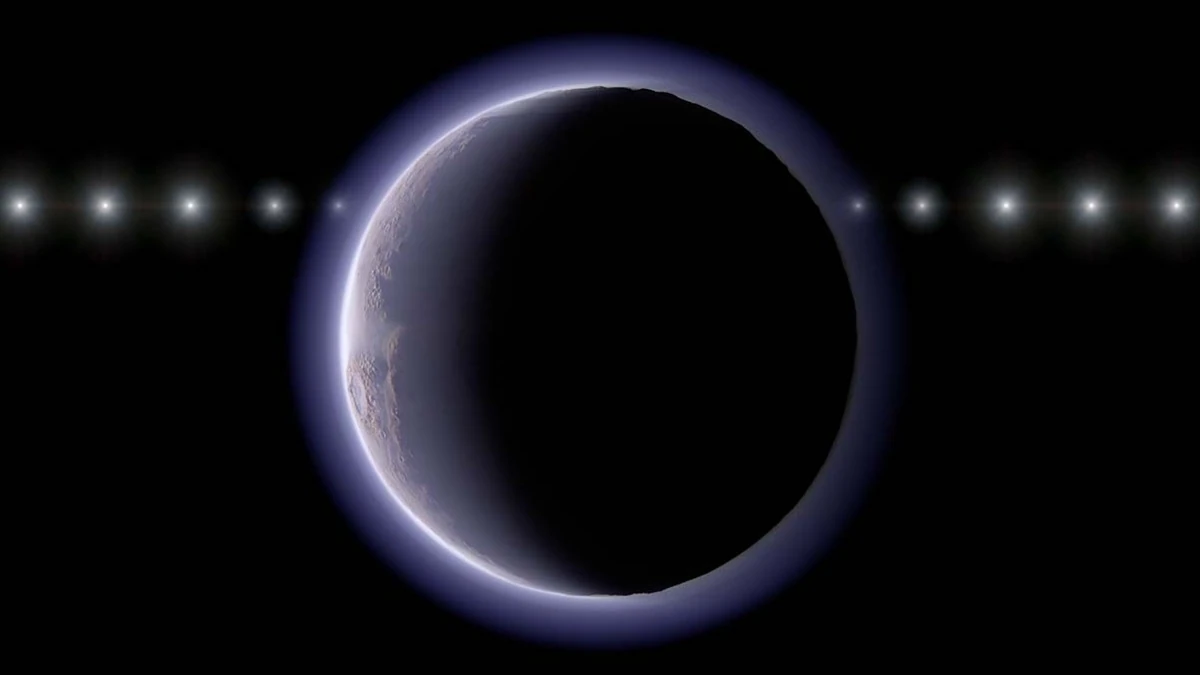
Artist’s conception of this research showing an imagined time sequence as a star passes behind a trans-Neptunian object with an atmosphere. Credit: NAOJ
Researchers detected the atmospheric signature during a stellar occultation campaign conducted from Japan. As 2002 XV93 crossed the line of sight to the background star, the starlight dimmed gradually rather than disappearing abruptly, a pattern consistent with refraction and attenuation by gas surrounding the object.
Ko Arimatsu and colleagues derived a surface pressure of 100–200 nbar from the occultation data. Pluto, the only trans-Neptunian object previously confirmed to host an atmosphere, has an average surface pressure of about 10 μbar, while earlier searches around other large trans-Neptunian objects had produced upper limits of 1–100 nbar.
2002 XV93 has a radius of about 250 km (155 miles) and is about 500 km (310 miles) wide. The object belongs to the plutino population, a group of icy bodies in Pluto-like orbital resonance with Neptune.
From a volatile-retention standpoint, 2002 XV93 is unexpectedly small to host an atmosphere. Bodies of this size are generally thought to lose gases efficiently over time, implying that any atmosphere would either be transient or actively replenished.
The National Astronomical Observatory of Japan (NAOJ) said the atmosphere would dissipate in less than 1 000 years unless replenished and concluded it must have been created or replenished recently.
Researchers proposed ongoing cryovolcanic activity or the aftermath of a recent impact by a small icy object as possible explanations for the gas, although neither mechanism has been confirmed.
The finding follows recent near-infrared observations that detected methane emission from Makemake, another large trans-Neptunian object. Researchers said the origin of that methane also remains unresolved.
Additional occultation observations of 2002 XV93 could help determine whether the atmospheric signature persists or varies over time.
References:
1 Arimatsu, K., Yoshida, F., Hayamizu, T., Takita, S., Hosoi, K., Ootsubo, T., & Watanabe, J. (2026). Detection of an atmosphere on a trans-Neptunian object beyond Pluto. Nature Astronomy. DOI: 10.1038/s41550-026-02846-1

I'm a dedicated researcher, journalist, and editor at The Watchers. With over 20 years of experience in the media industry, I specialize in hard science news, focusing on extreme weather, seismic and volcanic activity, space weather, and astronomy, including near-Earth objects and planetary defense strategies. You can reach me at teo /at/ watchers.news.

So interesting, and the methane generation from Makemake, production of that molecule itself fascinating. I would like to see a little more on this subject of TNOs, because Earth and solar system conditions insights. Absolutely send a Watchers News probe to orbit maybe land, study!
Methane itself, its existence, it feels like its telling us the nature of synthesis.
Why is terrestrial thermogenic methane and what does this speak to?
Siberian deposits another unfortunate ECDO hypothesis suspicion link but again the organic-matter-methane energetic equilibrium signature, noting the anoxic-involvements therein which incidentally, one might consider nucleonically, not electron-environment, and how that notion might apply in more distant, somewhat differing solar-system field conditions such as mentioned here?
How interesting would a matrix map of discovered methane deposits in solar-system order be.