
Evidence of new subduction zone found offshore Southwest Iberia
Seismic imaging and computer models reveal that oceanic plate delamination is occurring offshore Southwest Iberia, suggesting the early stages of subduction initiation and a potential source of future high-magnitude earthquakes, according to a study published in Nature Geoscience on August 30, 2025.
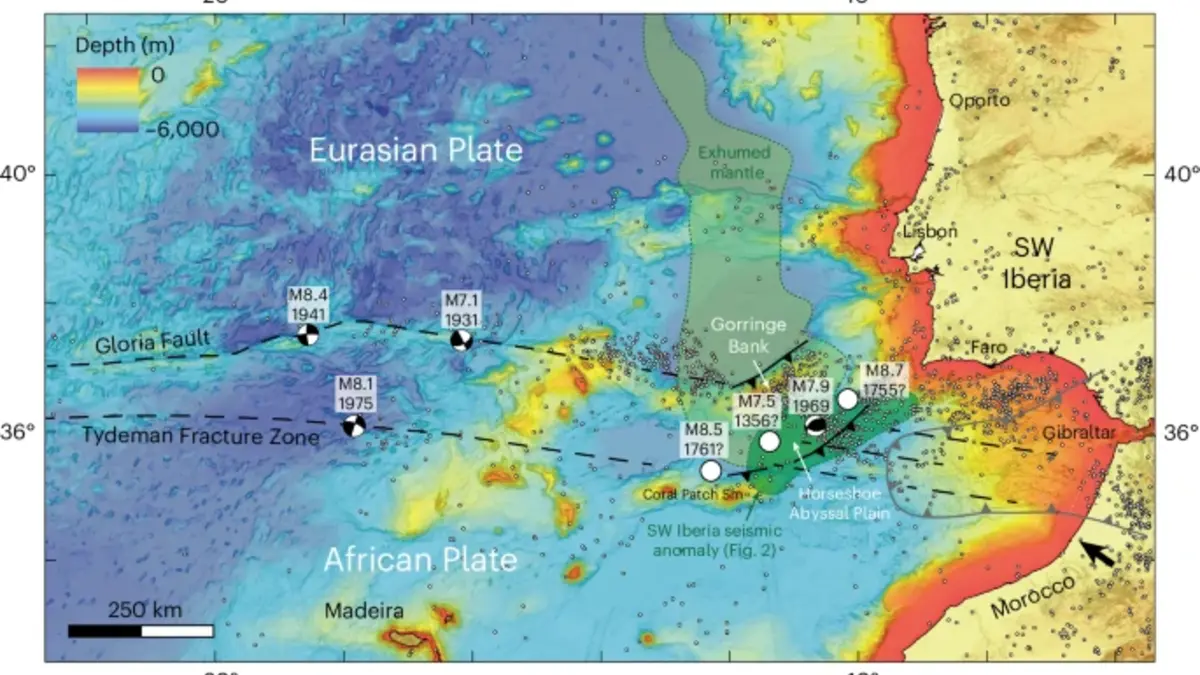
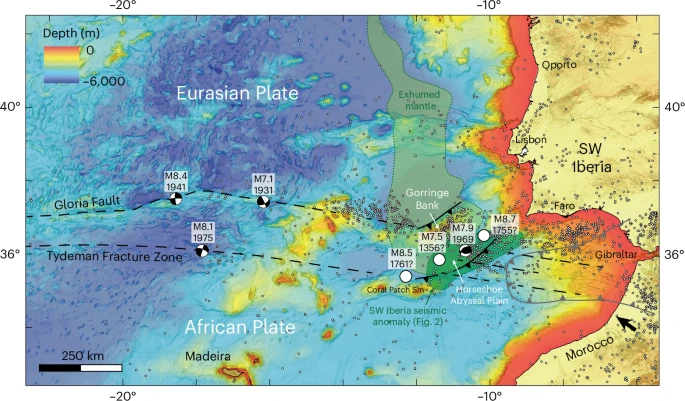
Simplified map of the Southwest Iberia segment of the Africa–Eurasia plate boundary. Credit: João C. Duarte, Nicolas Riel, Seismic evidence for oceanic plate delamination offshore Southwest Iberia. Credit: Jao C. Duarte et al./Nature Geoscience
Authors suggest oceanic delamination may enable subduction initiation—a long-standing question in plate tectonic theory—and potentially explain high-magnitude earthquakes in the region, including the M8.5–8.7 Lisbon earthquake of 1755 and the M7.9 San Vicente earthquake of 1969.
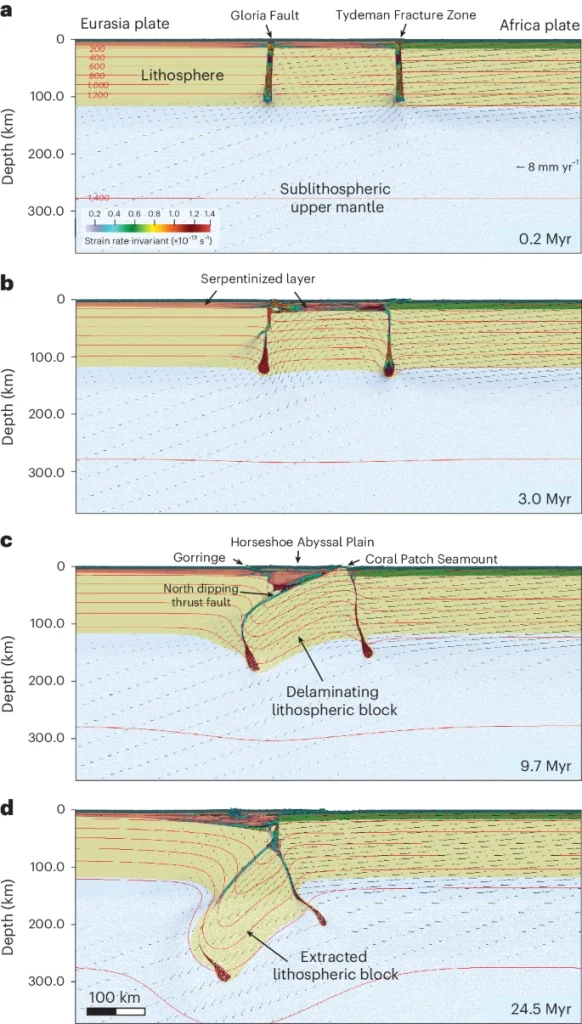
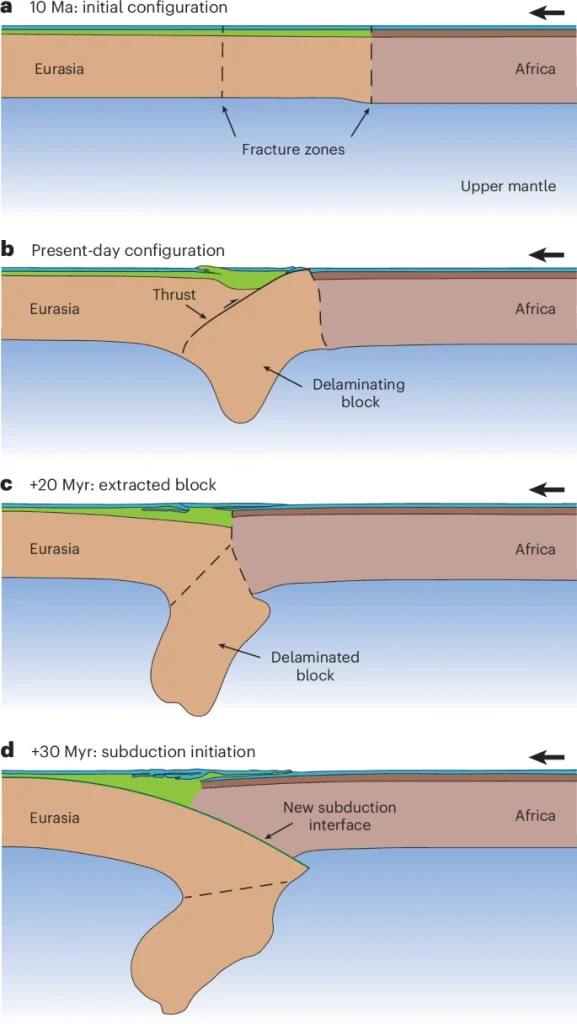
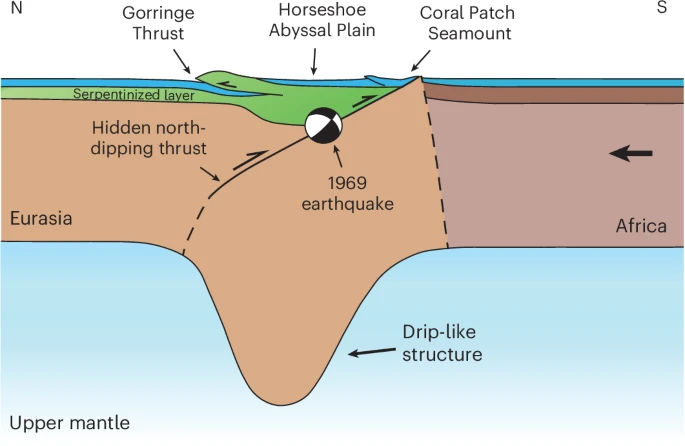
Seismic tomography and numerical models show that a block of old oceanic lithosphere is detaching and sinking beneath the Horseshoe Abyssal Plain, southwest of Portugal. The process, known as delamination, has long been considered unlikely in oceanic lithosphere, which is typically too rigid to peel away from the crust above.
The study, led by João C. Duarte of the University of Lisbon, indicates that chemical weakening of the oceanic mantle by serpentinization allowed the lithosphere to decouple from the overlying crust. This mechanism, combined with slow plate convergence between Africa and Eurasia of about 4 mm (0.15 inches) per year, appears to be driving the phenomenon.
The Southwest Iberian Margin is a tectonically complex area. It has produced some of Europe’s most destructive earthquakes, including the Great Lisbon Earthquake of November 1, 1755. Estimated at magnitude M8.5–8.7, it generated powerful ground shaking and a transatlantic tsunami that affected parts of North Africa, the British Isles, and the Caribbean.
Another major event, the M7.9 San Vicente earthquake of 1969, struck approximately 200 km (120 miles) southwest of Cape St. Vincent. Despite originating far from mapped active faults, it exhibited characteristics consistent with subduction-related earthquakes, including a hypocentral depth of about 30 km (18 miles).
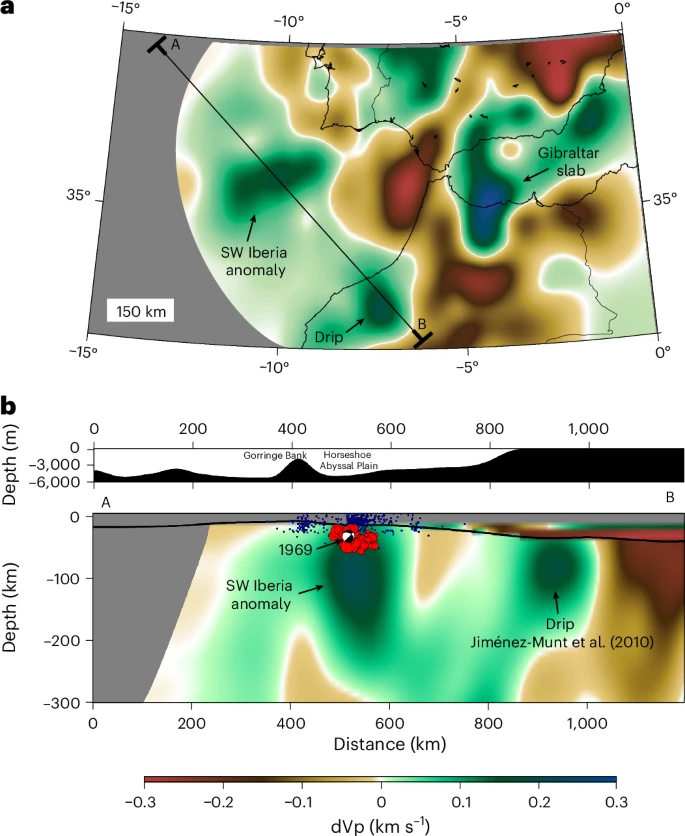
 Tomography model offshore southwest Iberia showing a high-velocity anomaly interpreted as a delaminating lithospheric block. Credit: João C. Duarte, Nicolas Riel, Seismic evidence for oceanic plate delamination offshore Southwest Iberia
- Simplified map of the Southwest Iberia segment of the Africa–Eurasia plate boundary. Credit: João C. Duarte, Nicolas Riel, Seismic evidence for oceanic plate delamination offshore Southwest Iberia
- Results of the numerical model with two plate boundaries showing the delamination and extraction of a lower lithospheric block. Credit: João C. Duarte, Nicolas Riel, Seismic evidence for oceanic plate delamination offshore Southwest Iberia
- Evolutionary model. Credit: João C. Duarte, Nicolas Riel, Seismic evidence for oceanic plate delamination offshore Southwest Iberia
- Conceptual model of the present day, integrating insights from both the natural prototype and the results of numerical modelling. Credit: João C. Duarte, Nicolas Riel, Seismic evidence for oceanic plate delamination offshore Southwest Iberia


Delamination in this area may explain these events and suggests that a new subduction zone is developing in the Atlantic Ocean. Subduction zones are responsible for Earth’s largest earthquakes and tsunamis, including the 2004 Indian Ocean (M9.1) and 2011 Tōhoku (M9.0) disasters.
These events have long puzzled scientists because of the apparent absence of an active subduction zone in the region. The new findings suggest that a subduction zone may, in fact, be forming, deep beneath the flat-lying seafloor of the Horseshoe Abyssal Plain. This has major implications for seismic hazard assessment across the western European margin and even across the wider Atlantic basin.
The study combined seismic tomography with numerical modeling to simulate the evolution of oceanic plate structure beneath the Southwest Iberian Margin. Tomographic imaging revealed a high-velocity anomaly interpreted as a delaminating block of lithosphere sinking into the mantle.
The numerical simulations, based on geodynamic principles, showed that a thick serpentinized layer at the base of the lithosphere can act as a mechanical decoupling zone, enabling delamination to initiate and propagate. These results challenge long-held assumptions about the rigidity of oceanic lithosphere and suggest that, under specific conditions, oceanic delamination may precede and facilitate subduction initiation.
If a subduction zone fully develops here, it could represent one of the few modern examples of spontaneous intra-oceanic subduction initiation, a phenomenon that remains rare and challenging to document. Most known subduction zones are ancient and inherited from earlier tectonic cycles. The formation of a new one offers a unique window into how Earth’s plate tectonic engine regenerates itself.
For the near term, researchers emphasize seismic hazard.
Duarte warned that large earthquakes will occur again in the region and that coastal communities across the Atlantic must prepare for the possibility of damaging ground shaking and tsunamis.
References:
1 Seismic evidence for oceanic plate delamination offshore Southwest Iberia – João C. Duarte, Nicolas Riel – Nature Geoscience – August 27, 2025 – https://doi.org/10.1038/s41561-025-01781-6 – OPEN ACCESS

I’m a science journalist and researcher at The Watchers, contributing to the Epicenter edition, where I cover peer-reviewed scientific research and emerging discoveries across Earth and space sciences. With a background in astronomy and a passion for environmental science, I’ve worked in shark and coral conservation in Fiji, conducting reef and shark-behavior research, contributing to mangrove restoration, and earning PADI Open Water and Coral Reef Certifications. I bring a blend of scientific rigor and storytelling to illuminate the discoveries shaping our planet and beyond.

Commenting rules and guidelines
We value the thoughts and opinions of our readers and welcome healthy discussions on our website. In order to maintain a respectful and positive community, we ask that all commenters follow these rules.