
Subducting slabs steer earthquake waves in unexpected ways
A new study in Geophysical Research Letters published on October 21, 2025, shows that most shear wave splitting in Alaska’s subduction zone originates inside the sinking slab itself, overturning the long-held view that mantle flow is the main cause.
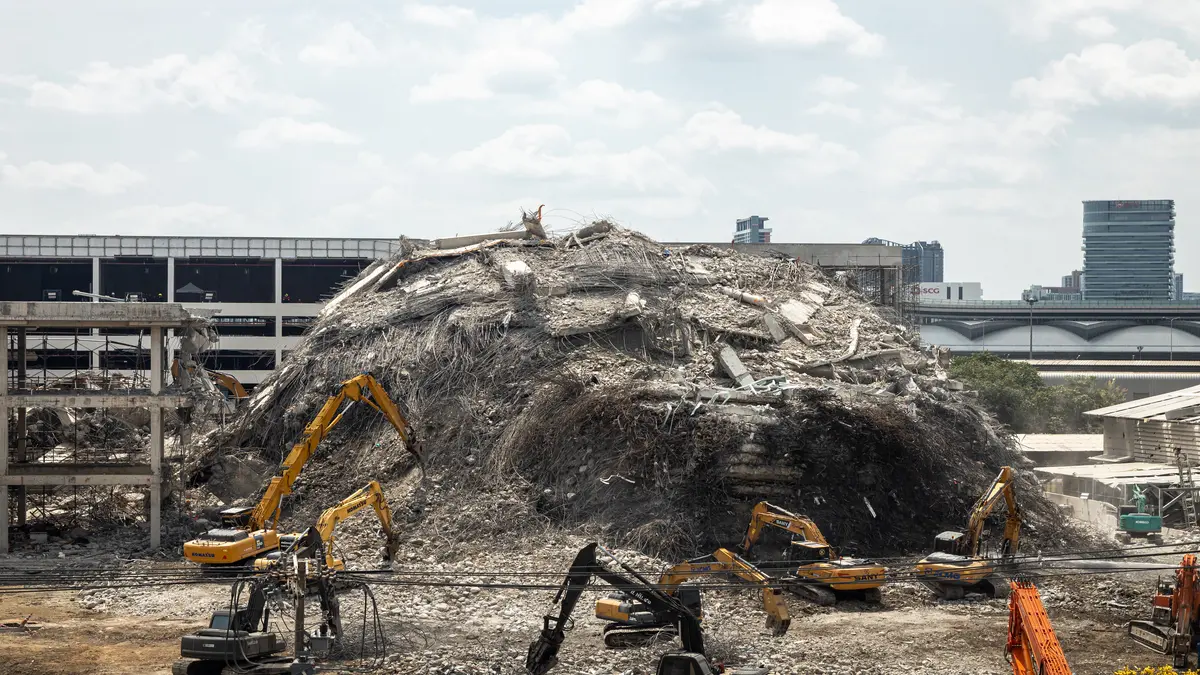
Collapse of New Headquarters of the State Audit Office (Thailand) after the 2025 Myanmar earthquake, pictured from JJ Mall, Bangkok. Credit: Supanut Arunoprayote
A fresh look beneath Alaska suggests that the deep engine of earthquakes may not lie above or below subducting slabs but within them. Seismic recordings from 195 broadband stations across Alaska revealed that shear waves passing through the Pacific plate behaved differently depending on the location of earthquakes.
The variations matched the slab’s geometry, pointing to internal structure rather than external flow as the key influence.
The research team, led by Sharmila Appini at the University of Houston, analyzed 2 567 shear-wave-splitting measurements collected between 2004 and 2020. They found that the timing difference between the fast and slow waves ranged from 0.5 to 1.5 seconds, consistent with a strongly anisotropic material. When the waves came from different directions, the polarization of the fast component rotated systematically, a hallmark of a structured medium rather than random mantle turbulence.
To test this, the team built a forward model of the Alaska-Aleutian subduction zone. Using a digital representation of the slab known as Slab2 geometry, they modeled a layer about 20–60 km (12–37 miles) thick with 30% shear anisotropy.
This layer had a tilted transverse isotropy, meaning its crystal alignment was perpendicular to the slab surface. The model accurately reproduced both the observed delay times and the shifting wave directions, confirming that the slab itself could be responsible.
The results show that the subducting plate is not simply a passive conveyor of stress but a dynamic structure that shapes the way seismic energy moves through the planet. The finding challenges decades of research that attributed splitting patterns to mantle circulation above or beneath the slab.
How minerals and fluids make rocks directionally strong
Anisotropy means that a material’s physical properties change with direction. In wood, the grain guides how easily it splits; in rock, microscopic crystals or cracks do the same. Minerals such as olivine, serpentine, and clay can align under pressure, giving rock a preferred orientation that controls its strength and elasticity.
Inside a subducting slab, these alignments form as the plate bends, heats, and dehydrates as it sinks into the mantle. Repeated cycles of hydration and dehydration produce thin layers of serpentine or other hydrous minerals that act like fibers running through the rock. Even a small fraction of trapped water, around 1% by volume, can greatly amplify anisotropy by creating aligned pores that distort seismic waves.
Laboratory experiments show that serpentine can reach shear anisotropies of more than 30%, strong enough to explain the behavior seen in Alaska. These conditions are most common between depths of 70–220 km (43–137 miles), where temperature and pressure promote the breakdown of hydrous minerals. Such processes mean that anisotropy is both a mechanical and a chemical fingerprint of slab evolution.
This internal “grain” in the slab not only alters wave speeds but also affects how stress accumulates and releases during deep earthquakes. By influencing both the direction and intensity of seismic radiation, anisotropy helps explain why some deep quakes exhibit unusual, non-double-couple patterns that do not match typical fault-slip geometry.
What makes the Alaska subduction zone ideal for testing
The Alaska-Aleutian arc stretches about 4 000 km (2 485 miles) along the boundary where the Pacific plate dives beneath North America. It features steeply dipping segments beneath the central Aleutians and shallower angles toward south-central Alaska. This variation in geometry provided a natural laboratory to test how wave paths change when cutting across different slab orientations.
Appini’s team divided their dataset into three main azimuthal zones based on the direction from which earthquakes arrived. For each zone, they averaged polarization directions and delay times across all stations, revealing clear backazimuth-dependent trends. In some areas, fast waves aligned parallel to the trench; in others, they were perpendicular or even curved around slab edges.
Previous models attributed these patterns to toroidal mantle flow or layered anisotropy beneath the slab. However, the new intra-slab model reproduced the same effects without invoking complex circulation. Residual differences around 0.1–0.3 seconds could still arise from crustal or mantle contributions, but these are secondary.
By matching both delay times and directional changes, the intra-slab hypothesis explains first-order seismic features with fewer assumptions. This simplicity, combined with consistency across hundreds of events, strengthens the case that the subducting plate itself governs shear wave behavior.
Why this discovery matters for earthquake science
If most shear wave splitting occurs within the slab, many interpretations of mantle flow based on these signals must be reconsidered. Seismologists often use polarization patterns to infer circulation in the mantle wedge, assuming the slab contributes little because of its short wave path. The Alaska results show that even a thin anisotropic layer can dominate the signal if its internal structure is strong enough.
This insight changes how scientists model stress fields and deformation within subduction zones. Accounting for slab anisotropy could refine estimates of earthquake rupture direction, stress orientation, and even slab strength over time. It may also explain why deep earthquakes, those deeper than 70 km (43 miles), occur in specific zones rather than being randomly distributed.
The study further implies that anisotropy strength does not depend on slab age, dip, or subduction rate. Instead, it arises from mineral alignment and fluid redistribution processes common to all subduction environments. Future research in regions like Tonga, Japan, and Chile will test whether similar patterns hold globally.
Recognizing the slab as an active, anisotropic medium turns it from a passive participant into a key architect of Earth’s seismic signature. That shift will influence how scientists interpret data from global seismic networks for years to come.
Reframing Earth’s interior: from flow to fabric
This study invites a rethinking of how geodynamic models describe the planet’s interior. For decades, mantle flow patterns were inferred from shear-wave splitting, with fast directions marking circulation paths. If those signals mostly arise within slabs, then what seismologists have been mapping is not the flow of the mantle but the internal fabric of the plates themselves.
In this view, the slab’s anisotropy becomes a historical record of its deformation. Each layer, mineral alignment, and hydration cycle writes a new line in that record as the plate descends. By correctly interpreting it, scientists can reconstruct the plate’s mechanical evolution and better understand how stresses accumulate before deep earthquakes.
This approach could bridge seismology with mineral physics and rock mechanics. Models combining laboratory data on anisotropic minerals with field observations of splitting may yield a unified picture of subduction dynamics. Ultimately, it shows that the Earth’s interior is textured, not homogeneous, and that the patterns of those textures govern how seismic energy travels to the surface.
The Alaska model thus represents more than a regional discovery. It marks a conceptual shift toward seeing subducting slabs as the sculptors of Earth’s seismic landscape, shaping not only where earthquakes occur but how we perceive them.
References:
1 New Earthquake Model Goes Against the Grain – EOS – October 27, 2025
2 Analysis of Shear Wave Splitting Patterns in Alaska: Evidence for Strong Intra-Slab Anisotropy – Sharmila Appini et al. – Geophysical Research Letters – October 21, 2025 – https://doi.org/10.1029/2025GL116411 – OPEN ACCESS

I’m a science journalist and researcher at The Watchers, contributing to the Epicenter edition, where I cover peer-reviewed scientific research and emerging discoveries across Earth and space sciences. With a background in astronomy and a passion for environmental science, I’ve worked in shark and coral conservation in Fiji, conducting reef and shark-behavior research, contributing to mangrove restoration, and earning PADI Open Water and Coral Reef Certifications. I bring a blend of scientific rigor and storytelling to illuminate the discoveries shaping our planet and beyond.

Commenting rules and guidelines
We value the thoughts and opinions of our readers and welcome healthy discussions on our website. In order to maintain a respectful and positive community, we ask that all commenters follow these rules.