
Solar radio bursts reveal possible magnetic switchbacks near the Sun, Parker Solar Probe data suggest
Type III solar radio bursts observed by NASA’s Parker Solar Probe may reveal large-scale magnetic-field disturbances and switchback-like structures near the Sun, according to a study published in The Astrophysical Journal in 2026. The study may help scientists remotely map hidden magnetic structures near the Sun, improving how the solar wind is studied and eventually strengthening space weather physics.
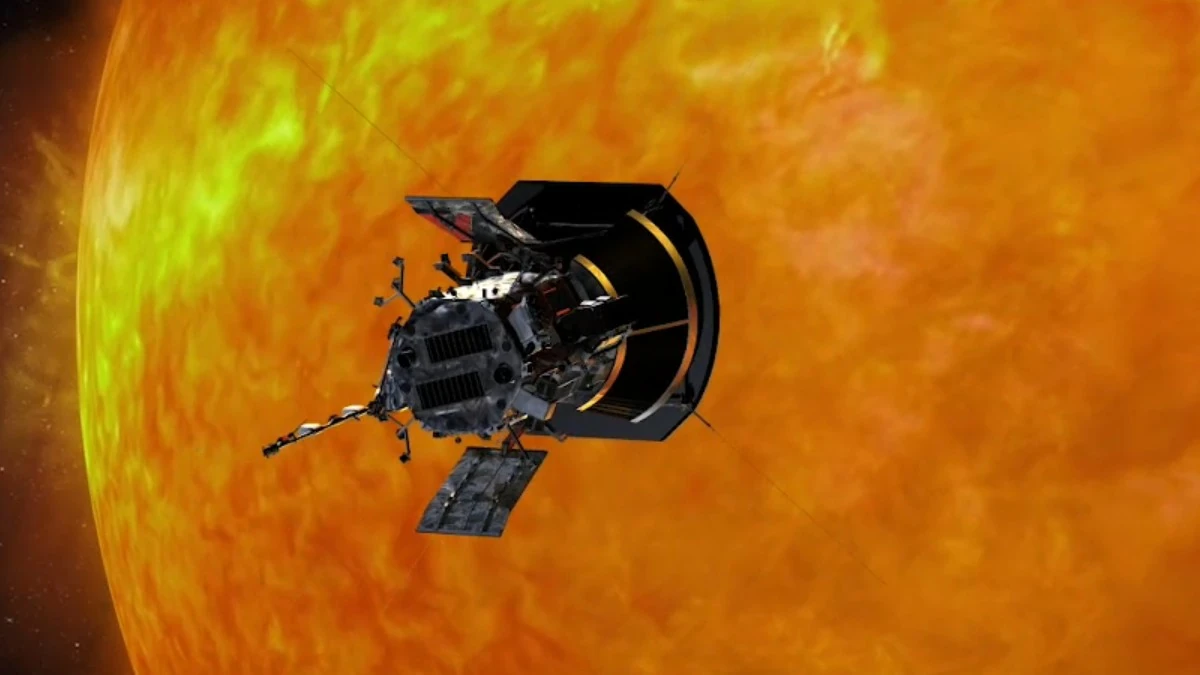
Parker Solar Probe. Image credit: NASA
Researchers analyzing 24 interplanetary radio bursts recorded over one week found that half exhibited deviations exceeding the estimated noise threshold, with several events more consistent with magnetic deflections than plasma density fluctuations alone. The research examined how the drift rates of type III radio bursts changed as electron beams propagated through the corona and inner heliosphere.
Type III bursts occur when energetic electrons travel along magnetic field lines at a substantial fraction of the speed of light and generate radio emission through plasma processes. Because the emission frequency depends on local plasma density, variations in drift rates can provide information about plasma and magnetic conditions along the beam path.
Electron beams moving outward along radial magnetic field lines normally produce drift rates that gradually decrease with time, but smaller-scale plasma density fluctuations can also generate fine spectral structures known as striae.
Clarkson and Kontar investigated whether larger deviations in drift rate behavior could instead reflect major disturbances in magnetic geometry, including switchback-like structures or large-scale field deflections.
To test that possibility, the researchers modeled electron beams propagating along perturbed magnetic field lines and compared the resulting radio signatures with Parker Solar Probe observations. The analysis relied on measurements from the spacecraft’s FIELDS instrument package, which records electric and magnetic field variations in the solar wind environment.
Peak emission frequencies from the observed bursts were converted into radial distance estimates and compared with polynomial fits to determine perpendicular displacements relative to expected propagation paths. The authors estimated a noise threshold of 0.57 solar radii and treated larger deviations as physically significant disturbances.
Across the 24 analyzed events, 50% produced displacements exceeding the estimated threshold, with an average deviation of 1.1 solar radii. According to the authors, the observed signatures could be reproduced through plasma density changes of approximately 10–30% or magnetic field deviations ranging from 23° to 88° over spatial scales of 1.8–6.4 solar radii.
Four radio bursts displayed some or all features predicted by the switchback simulations. In those cases, the observed variations were more consistent with magnetic field deviations than with the larger density changes required to reproduce the same signatures through plasma fluctuations alone.
Magnetic switchbacks are localized reversals or strong deflections in the interplanetary magnetic field that Parker Solar Probe detected repeatedly during close approaches to the Sun, but their origin and role in solar wind formation remain unresolved questions in heliophysics.
Understanding magnetic structure close to the Sun remains important for space weather physics because the solar wind carries magnetic fields and energetic particles throughout the heliosphere. Large-scale magnetic geometry influences how solar energetic particles propagate, how radio emissions travel through space, and how disturbances emerging from the Sun evolve as they move outward.
The study does not propose an immediate forecasting application, but the findings may expand the observational tools available to heliophysicists. If type III radio bursts can reliably trace magnetic disturbances remotely, researchers may gain a broader picture of solar wind structure beyond the narrow paths sampled directly by spacecraft, improving the physical foundations used in long-term space weather modeling.
The study found that type III burst morphology can reflect both plasma density structure and magnetic field geometry in the inner heliosphere. The authors also proposed that kilometer-wavelength radio observations may serve as a remote diagnostic method for probing solar wind magnetic structure beyond direct spacecraft crossings.
References:
1 Clarkson, D. L., & Kontar, E. P. (2026). Signatures of large-scale magnetic field disturbances and switchbacks in interplanetary Type III radio bursts. The Astrophysical Journal, 999, 134. https://doi.org/10.3847/1538-4357/ae3dae

I'm a dedicated researcher, journalist, and editor at The Watchers. With over 20 years of experience in the media industry, I specialize in hard science news, focusing on extreme weather, seismic and volcanic activity, space weather, and astronomy, including near-Earth objects and planetary defense strategies. You can reach me at teo /at/ watchers.news.

Commenting rules and guidelines
We value the thoughts and opinions of our readers and welcome healthy discussions on our website. In order to maintain a respectful and positive community, we ask that all commenters follow these rules.