
Smile opens a new way to observe Earth’s response to the solar wind
Smile, launched from Europe’s Spaceport in French Guiana aboard Vega-C, is designed to address a long-standing observational gap in space physics — how Earth’s magnetosphere responds as solar wind reaches its outer boundary.
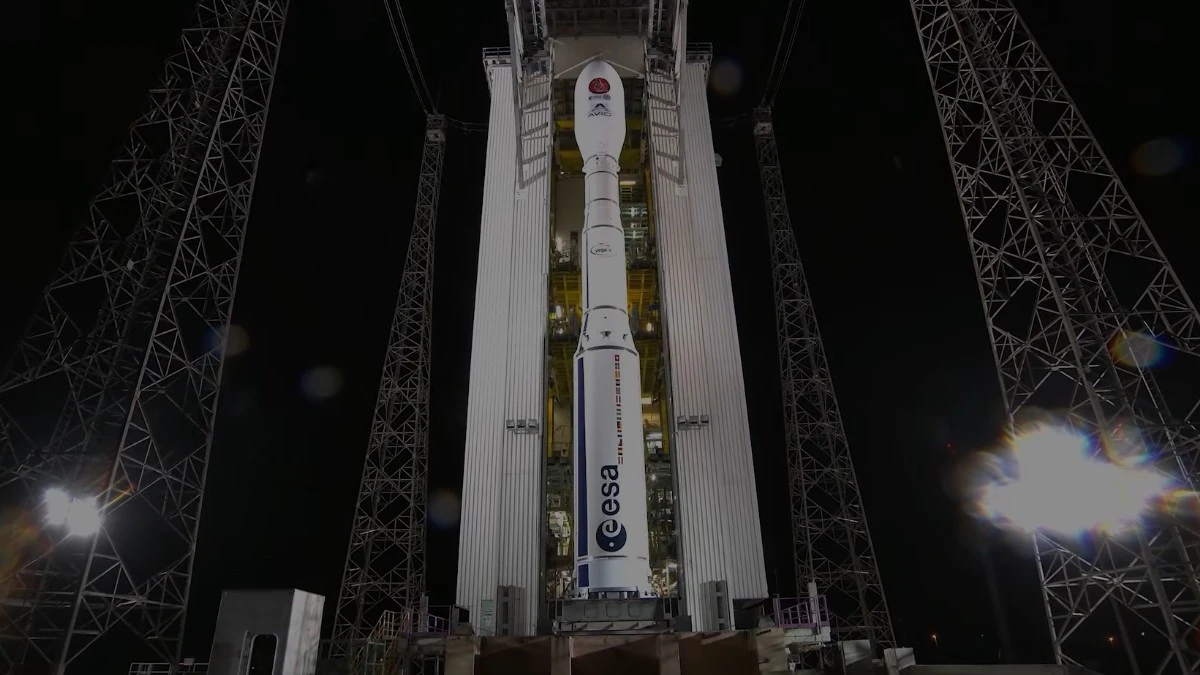
Image credit: ESA
ESA and the Chinese Academy of Sciences (CAS) launched Smile – the Solar wind Magnetosphere Ionosphere Link Explorer – at 03:52 UTC on May 19, 2026, beginning a mission intended to provide the first global X-ray views of Earth’s magnetic environment.
ESA confirmed first signal acquisition at 04:48 UTC and solar array deployment one minute later, marking the successful start of the spacecraft’s three-year mission.
Smile is designed to investigate how the solar wind interacts with Earth’s magnetic shield — a crucial process for the formation of geomagnetic storms and other space weather phenomena.
While scientists have measured local plasma and magnetic field conditions in near-Earth space for decades, those point measurements have not provided a system-wide view of how Earth’s magnetosphere responds to changing solar wind conditions.
The mission is built around four instruments intended to observe the Sun-Earth system simultaneously. Smile’s soft X-ray imager will attempt the first continuous imaging of Earth’s magnetosphere by detecting emissions generated through solar wind charge exchange, a process in which highly charged particles from the solar wind interact with neutral particles in Earth’s geocorona.
Scientists expect the observations to reveal how the magnetopause, the outer boundary of Earth’s magnetic field, shifts as solar wind pressure and magnetic-field orientation change.
The spacecraft will combine those observations with ultraviolet imaging of the northern lights and in situ measurements of ion populations and magnetic fields across the solar wind, magnetosheath, and magnetosphere.
ESA states Smile will be capable of monitoring auroral activity continuously for up to 45 hours at a time, allowing researchers to compare large-scale magnetospheric behavior with local measurements collected inside the system.
According to Wang et al. (2025), the mission is intended to improve understanding of how energy enters and propagates through Earth’s magnetic environment, particularly around the magnetopause and polar cusps where solar wind first interacts with the planet’s magnetic field. The mission overview describes this combination of global imaging and local measurements as a way to examine reconnection processes and magnetospheric dynamics on minute time scales.
For space weather science, Smile’s near-term value is observational rather than operational forecasting. ESA describes the mission as an effort to improve scientific understanding of processes that affect satellites, astronauts, and technological systems operating in near-Earth space, including the connection between solar wind forcing, auroral response, and geomagnetic storm development.
Smile is the first mission jointly selected, designed, implemented, launched, and operated by ESA and the Chinese Academy of Sciences. ESA is responsible for the payload module, launch vehicle, one instrument, and part of science operations, while CAS is responsible for three instruments, the spacecraft platform, and mission operations.
References:
1 Smile lifts off on quest to reveal Earth’s invisible shield against the solar wind – ESA – May 19, 2026

I'm a dedicated researcher, journalist, and editor at The Watchers. With over 20 years of experience in the media industry, I specialize in hard science news, focusing on extreme weather, seismic and volcanic activity, space weather, and astronomy, including near-Earth objects and planetary defense strategies. You can reach me at teo /at/ watchers.news.

Commenting rules and guidelines
We value the thoughts and opinions of our readers and welcome healthy discussions on our website. In order to maintain a respectful and positive community, we ask that all commenters follow these rules.