
Scientists develop new framework to track polar vortex splits and displacement
Researchers have developed a new framework that tracks how the Northern Hemisphere stratospheric polar vortex splits, shifts and evolves through winter. The framework uses persistent homology and ERA5 reanalysis data to assign daily split and displacement scores, providing a continuous view of vortex geometry before, during and after sudden stratospheric warming events.
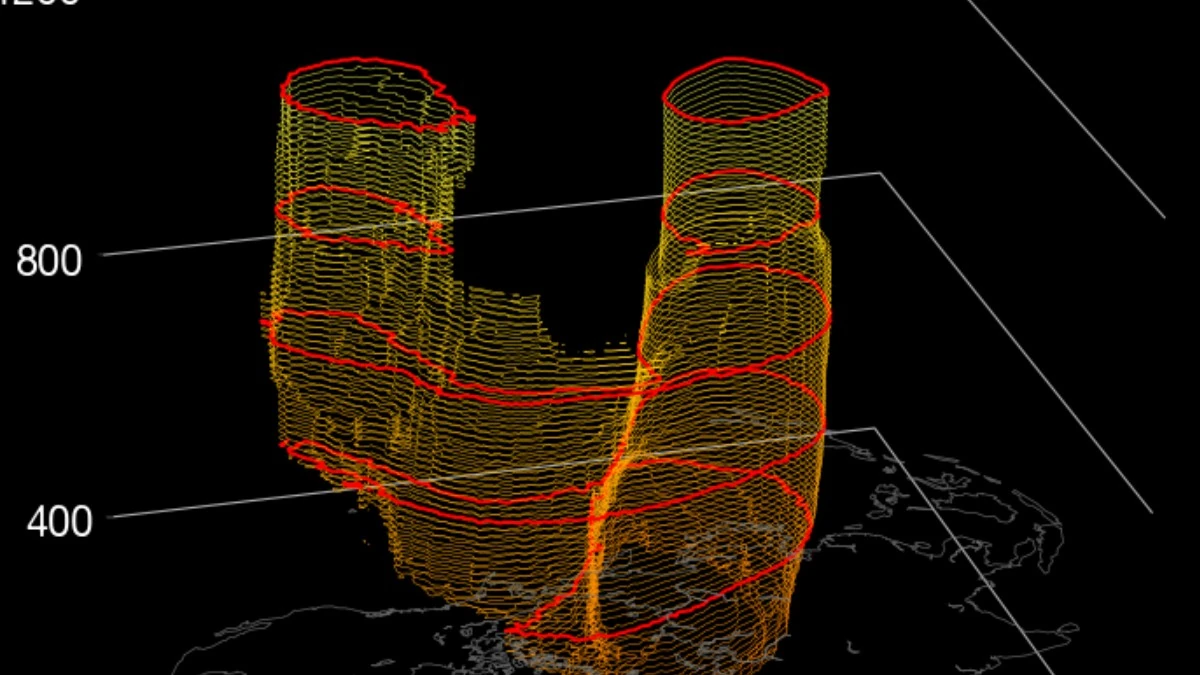
GFS Stratospheric Polar Vortex Structure valid 0000 UTC February 15, 2026. Credit: Stratobserve
Jake Cordes, Barbara Giunti, and Zheng Wu of the University at Albany describe SuPerPoV — short for SUperlevel PERsistence of POlar Vortices — in Geophysical Research Letters, Volume 53, Issue 16, article e2026GL121910. Cordes et al. (2026) developed the framework to quantify changes in the geometry of the Northern Hemisphere winter stratospheric polar vortex.
The stratospheric polar vortex forms during the cold season as a broad circulation of strong westerly winds around the Arctic stratosphere. Sudden stratospheric warmings, or SSWs, can rapidly disturb that circulation, producing major changes in vortex strength and geometry, including displaced and split configurations.
Definitions used to identify major SSWs have developed over more than six decades. A widely used criterion identifies a major warming when the climatological westerly zonal-mean wind at 60°N and 10 hPa reverses direction. Other definitions apply different variables, thresholds, persistence requirements, and minimum intervals between events, which can produce different event catalogs. Butler et al. (2015) documented those classification differences.

SuPerPoV derives its split and displacement scores without applying an empirical event threshold during the calculation. Researchers can later select score levels for a particular classification task, including thresholds for weak or major disturbances, while the underlying sequence retains the day-to-day values describing vortex geometry.
The analysis uses daily geopotential-height fields from the European Centre for Medium-Range Weather Forecasts (ECMWF) ERA5 reanalysis for Northern Hemisphere extended winters from November through April between 1959 and 2021. Geopotential height describes the altitude of a given atmospheric pressure surface; changes in the shape of that surface provide information about the structure of the stratospheric circulation. The main SuPerPoV analysis uses 10 hPa, while the authors also calculate scores at 2, 5, 50 and 100 hPa to examine vortex structure at different levels of the stratosphere.
Persistent homology is applied by scanning the geopotential-height field through successive height thresholds and recording loop-shaped H1 structures as they appear and disappear. The range of geopotential-height values across which a structure persists — its lifespan in the filtration — provides a measure of its geometric prominence.
The split score is calculated from the ratio between the second-longest and longest persistent H1 lifespans in the field. Two similarly persistent structures produce a larger split score, corresponding to a more strongly divided vortex configuration.
The displacement score uses the longest persistent H1 lifespan calculated from the field in geographic-grid coordinates and the longest lifespan calculated after the same field is represented in polar cylindrical coordinates. The ratio between those values gives a dimensionless measure of the degree of displacement within the SuPerPoV framework. Larger scores correspond to more strongly displaced vortex states.
For comparison with earlier major-SSW classifications, Cordes et al. examined the event intervals associated with those definitions and extracted the maximum SuPerPoV split and displacement values occurring within each interval. Across the compared events, the mean maximum displacement score was 0.92, while the mean maximum split score was 0.28. The January 7, 1986 event was the only case in the comparison with a displacement score below 0.4 under one of the earlier definitions examined in the paper.
Daily calculations show how the numerical state develops around individual events. In an example centered on December 5, 1987, the displacement score rose from about 0.4 to almost 1 as the vortex entered a strongly displaced configuration. The split score remained below 0.3 during the displayed interval but increased toward December 12, indicating an increasingly split configuration.
A whole-winter calculation for 2018–2019 shows repeated changes in split and displacement scores across several months. The authors identify displacement around December 16 and another displacement phase extending from late December through late January. A major split developed around December 31, weakened around January 12, and gradually disappeared by the end of January. Unlike event definitions that separate qualifying SSWs using intervals such as 20, 30 or 60 days, the daily SuPerPoV series retains the intervening evolution of vortex geometry.
Late-season values require seasonal context. Cordes et al. note that increased activity during late March and April can occur as the polar vortex undergoes its seasonal weakening and transition toward the end of the Northern Hemisphere cold season.
The same calculations can be performed at different pressure levels. In the published study, Cordes et al. compare split and displacement scores at 2, 5, 10, 50 and 100 hPa for the period from four days before to ten days after February 11, 2018. Comparing scores across these levels allows researchers to examine how changes in vortex structure vary with altitude and provides a framework for investigating vertical coupling within the stratosphere.
Stratospheric vortex disturbances can affect circulation below the stratosphere. Butler et al. (2015) describe how circulation anomalies associated with SSWs can descend into the troposphere and produce surface-weather impacts, including wintertime extreme cold-air outbreaks. The SuPerPoV authors identify vortex-state prediction, precursor patterns, vertical coupling, and relationships with surface weather among areas for further research using the framework.
SuPerPoV is available as open-source software, while the geopotential-height data prepared for the study have been released through Zenodo. The software can calculate scores for a single date, a selected sequence surrounding an event, or a complete winter.
References:
1 SuPerPoV: Score and evolution of the stratospheric polar vortex via persistent homology – Jake Cordes, Barbara Giunti, and Zheng Wu – Geophysical Research Letters – August 18, 2026 – DOI: https://doi.org/10.1029/2026GL121910
2 Defining sudden stratospheric warmings – Amy H. Butler, Dian J. Seidel, Steven C. Hardiman, Neal Butchart, Thomas Birner, and Aaron Match – Bulletin of the American Meteorological Society – November 2015 – DOI: https://doi.org/10.1175/BAMS-D-13-00173.1

I’m a science journalist and researcher at The Watchers, contributing to the Epicenter edition, where I cover peer-reviewed scientific research and emerging discoveries across Earth and space sciences. With a background in astronomy and a passion for environmental science, I’ve worked in shark and coral conservation in Fiji, conducting reef and shark-behavior research, contributing to mangrove restoration, and earning PADI Open Water and Coral Reef Certifications. I bring a blend of scientific rigor and storytelling to illuminate the discoveries shaping our planet and beyond.
Published in the last 24 hours
- Weather radar tracked meteorites falling into Cape Cod Bay after a 1.1-kiloton fireball over Massachusetts on 30 May 2026; researchers have now traced its orbit almost out to Jupiter. Epicenter
- 10 named storms, one hurricane for the first time since 1925: Why has the Atlantic been so quiet in 2026 Epicenter
- Amazon fire hotspots rise 82.6% in October 2026 as El Niño intensifies Epicenter
- In 2005, a driver near Russia's Chulyshman River picked up a stone to wedge under his car wheel and kept it for 20 years; the Meteoritical Bulletin has now approved it as the Altai Republic's first meteorite. Epicenter
