
Research explains link between X-rays, gamma rays, and lightning initiation
A study published in the Journal of Geophysical Research finds that strong electric fields in thunderclouds can accelerate electrons, creating runaway avalanches that emit X-rays and gamma rays, a process connected to the conditions that lead to lightning initiation.

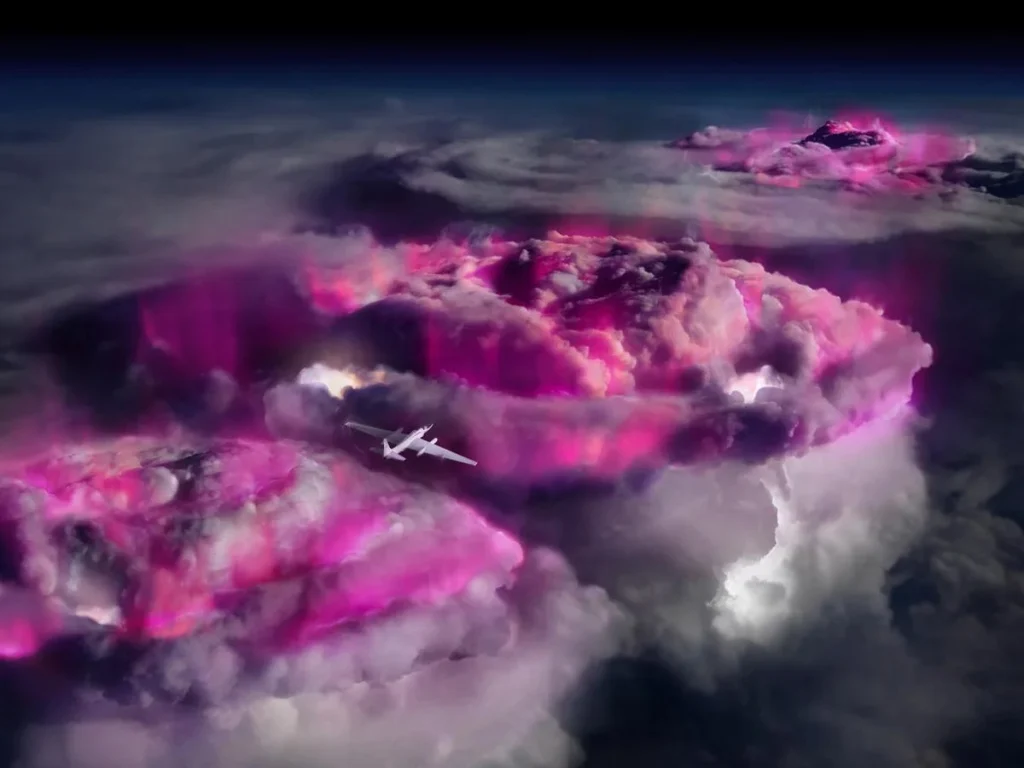
In this artist's impression, a high-altitude NASA spy plane carries instrumentation to record purple-colored terrestrial gamma-ray flashes in thunderclouds. Credit: NASA/ALOFT team
Scientists have long known that thunderstorms require strong electric fields for lightning. What remained unclear was how these fields ignite the very first conductive channel through the air.
The new Penn State study, led by Victor Pasko, demonstrates how runaway electron avalanches, amplified by X-ray photoelectric feedback, grow until they form a bolt. It provides the first quantitative explanation connecting terrestrial gamma ray flashes, radio pulses, and thundercloud electrification into a single mechanism.
To probe these hidden sparks, scientists have relied on a network of instruments. Ground-based sensors, satellites, and high-altitude NASA aircraft have all recorded bursts of X-rays and gamma rays in thunderclouds.
In one campaign, a NASA research plane carried instruments designed to capture purple flashes of high-energy radiation from storms. These observations provided critical field data that Pasko’s team used to test their model. By replicating the conditions measured in clouds, the simulations offered a complete explanation for the X-rays and radio emissions observed before lightning begins.
Cosmic rays from space constantly bombard Earth’s atmosphere. They produce energetic electrons that seed runaway avalanches inside thunderstorms. When these electrons meet strong cloud fields, they accelerate to near-relativistic speeds. Collisions with nitrogen and oxygen molecules release X-rays and gamma rays.
Crucially, some photons scatter back and free new electrons by the photoelectric effect. This runaway feedback loop multiplies the avalanche within microseconds, creating the conditions for lightning initiation.
Terrestrial gamma ray flashes (TGFs) last only tens of microseconds. They can release photons with tens of mega electron volts, yet many appear optically dim or completely invisible.
The model shows how avalanches in compact regions generate intense photon bursts while producing weak light and radio signatures. This explains why some gamma flashes emerge from storm regions that look dark to both the eye and radio sensors. Aircraft and ground campaigns confirm this by recording sequences of gamma pulses with little or no optical or radio emissions.
Thunderclouds often emit narrow bipolar events (NBEs), sharp radio bursts lasting just microseconds. They are the strongest natural VHF sources but frequently remain invisible.
The study links these events, along with initial breakdown pulses and energetic in-cloud pulses, to the same feedback mechanism. It also highlights compact intracloud discharges, localized sparks that may precede larger flashes.
Doctoral researcher Zaid Pervez matched the model results with field observations of these compact discharges. His comparisons showed how photoelectric avalanches account for the diversity of radio signals seen before lightning strikes.
The simulations provide strong evidence for photoelectric feedback as a lightning trigger. But the authors emphasize that broader testing across storm types and regions is still needed. They present their findings as a precise quantitative explanation, not a final proof.
Other seeding sources, such as electrons from streamers or leaders, may also play a role. Future multi-instrument campaigns combining optical, radio, gamma-ray, and in-cloud measurements will be crucial to confirm how often this pathway sparks lightning.
Lightning alters atmospheric chemistry by producing nitrogen oxides that influence ozone balance. Explaining its initiation helps refine both weather and climate models.
TGFs rival laboratory accelerators, offering a natural stage for studying relativistic particles. The team published the equations behind the Photoelectric Feedback Discharge model in full, allowing other researchers to apply them to storm simulations and laboratory tests.
References:
1 Photoelectric Effect in Air Explains Lightning Initiation and Terrestrial Gamma Ray Flashes – Victor P. Pasko et al. – JGR Atomospheres – July 28, 2025 – https://doi.org/10.1029/2025JD043897 – OPEN ACCESS

I’m a science journalist and researcher at The Watchers, contributing to the Epicenter edition, where I cover peer-reviewed scientific research and emerging discoveries across Earth and space sciences. With a background in astronomy and a passion for environmental science, I’ve worked in shark and coral conservation in Fiji, conducting reef and shark-behavior research, contributing to mangrove restoration, and earning PADI Open Water and Coral Reef Certifications. I bring a blend of scientific rigor and storytelling to illuminate the discoveries shaping our planet and beyond.

Commenting rules and guidelines
We value the thoughts and opinions of our readers and welcome healthy discussions on our website. In order to maintain a respectful and positive community, we ask that all commenters follow these rules.