
Study links plume–plate interaction to volcanism, seismicity, and geothermal potential in Britain and Ireland
Variations in lithospheric thickness controlled volcanism across the North Atlantic Igneous Province, from Scotland to Greenland, a study published in Nature Communications on August 22, 2025, shows. Using seismic tomography and a new method called seismic thermography, researchers from the University of Cambridge found that volcanic centers formed where the lithosphere was anomalously thin, allowing plume material to spread laterally over thousands of kilometers. The same structures continue to guide seismicity in Britain and Ireland and coincide with regions of elevated geothermal potential.
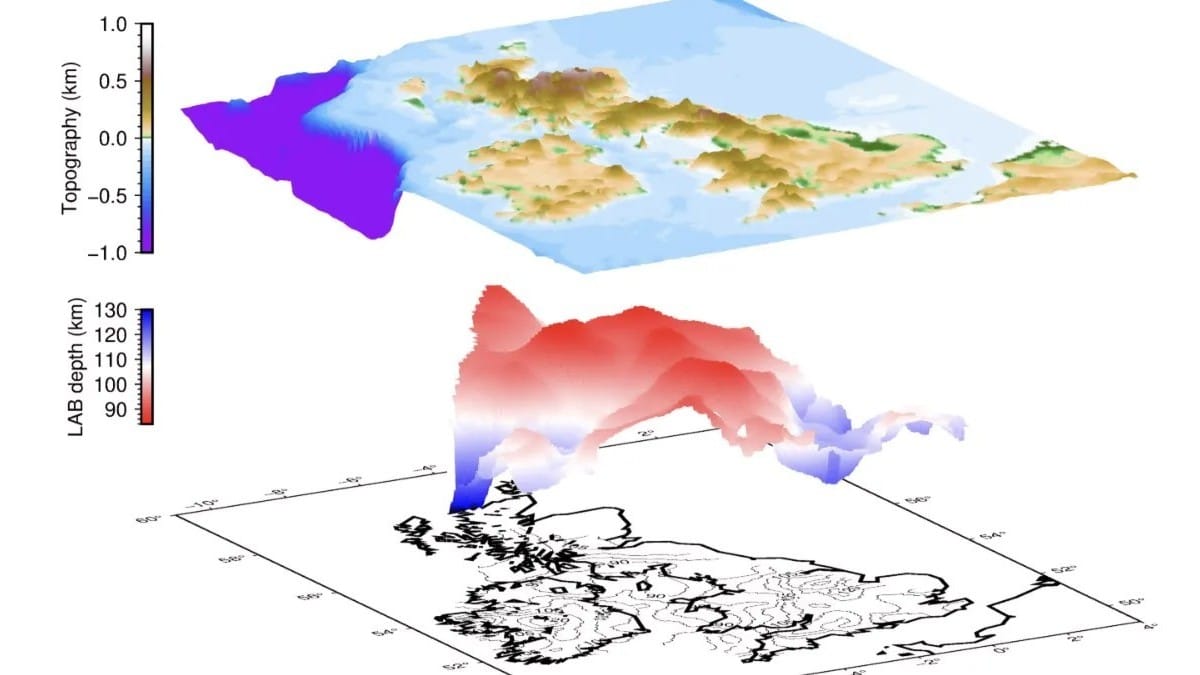
Image credit: University of Cambridge
Researchers from the University of Cambridge have provided new evidence explaining how volcanism in the North Atlantic Igneous Province (NAIP) developed. The team used seismic tomography and a newly developed method called seismic thermography to map lithospheric thickness beneath Britain and Ireland.
The results indicate that volcanic centers formed preferentially within corridors of thin lithosphere, which acted as channels for buoyant plume material.
Instead of rising vertically, hot mantle material from the Iceland plume was diverted laterally into these weak zones, enabling magma to spread across thousands of kilometers. This mechanism left a volcanic footprint stretching from Scotland to Greenland, including features such as the Giant’s Causeway in Northern Ireland.

“We see ancient volcanoes concentrated within this corridor of thin lithosphere beneath the Irish Sea and surrounding areas,” said Raffaele Bonadio, lead author of the study published in Nature Communications.
Bonadio explained that the plume’s hot material was diverted into weaker zones, where it accumulated and triggered surface eruptions.
The study also shows that plume activity eroded the lithosphere, leaving long-lasting mechanical weaknesses. These structures continue to influence seismicity in the region today. A previous investigation by the same team demonstrated that intraplate earthquakes in Britain and Ireland cluster within areas of thin lithosphere, showing the lasting imprint of plume–plate interaction.
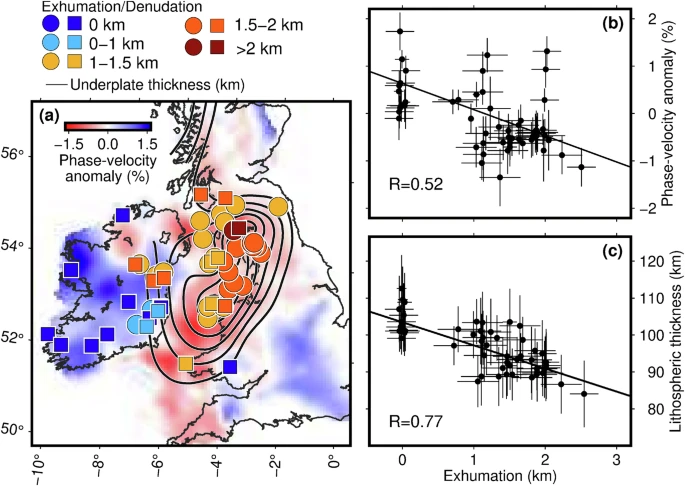

Sergei Lebedev, co-author of the study, noted that this correlation highlights how the Iceland plume shaped not only past volcanism but also present-day geodynamics. “This resulting combination of thin lithosphere, hot asthenosphere and decompression melting likely caused the uplift and volcanic activity,” he said.
Beyond volcanism and earthquakes, the research has implications for geothermal resources. Areas with thin lithosphere beneath Britain and Ireland coincide with regions of higher mantle heat flow. Bonadio and Lebedev are now applying their seismic thermography methods globally to assess geothermal energy potential.
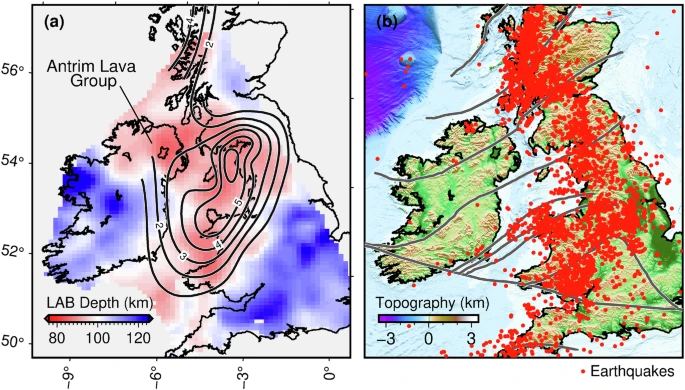
The findings demonstrate that the North Atlantic Igneous Province, one of Earth’s largest volcanic systems, was shaped not by multiple mantle plumes but by lateral diversion of plume material into lithospheric weaknesses. This mechanism may also explain the scattered volcanic centers of other Large Igneous Provinces worldwide.
References:
1 Volcanism and long-term seismicity controlled by plume-induced plate thinning – Raffaele Bonadio, Sergei Lebedev, David Chew, Yihe Xu, Javier Fullea & Thomas Meier – Nature Communications – August 22, 2025 – https://doi.org/10.1038/s41467-025-62967-5 – OPEN ACCESS

I’m a science journalist and researcher at The Watchers, contributing to the Epicenter edition, where I cover peer-reviewed scientific research and emerging discoveries across Earth and space sciences. With a background in astronomy and a passion for environmental science, I’ve worked in shark and coral conservation in Fiji, conducting reef and shark-behavior research, contributing to mangrove restoration, and earning PADI Open Water and Coral Reef Certifications. I bring a blend of scientific rigor and storytelling to illuminate the discoveries shaping our planet and beyond.

Commenting rules and guidelines
We value the thoughts and opinions of our readers and welcome healthy discussions on our website. In order to maintain a respectful and positive community, we ask that all commenters follow these rules.