
Newly discovered planet-forming disk challenges planet formation models
Astronomers using JWST found a planet-forming disk unusually rich in carbon dioxide but poor in water, challenging models of how planetary systems develop.

Astronomers find carbon dioxide rich planet-forming disk in massive NGC 6357 region. Credit: Stockholm University (SU) and María Claudia Ramírez-Tannus, Max Planck Institute for Astronomy (MPIA)
A study led by Stockholm University detected a planet-forming disk with an unusual chemical composition around the young star XUE 10 in NGC 6357, about 1.7 kiloparsecs (53 quadrillion km / 33 quadrillion miles) away.
JWST’s Mid-Infrared Instrument (MIRI) revealed four distinct forms of carbon dioxide (CO2) in the disk. At the same time, water vapor was nearly absent, which is a stark contrast to most nearby disks, where water typically dominates the inner regions. The results were published in Astronomy & Astrophysics.
“Unlike most nearby planet-forming disks, where water vapor dominates the inner regions, this disk is surprisingly rich in carbon dioxide,” said Jenny Frediani, Department of Astronomy, Stockholm University. “In fact, water is so scarce in this system that it’s barely detectable, which is a dramatic contrast to what we typically observe.”
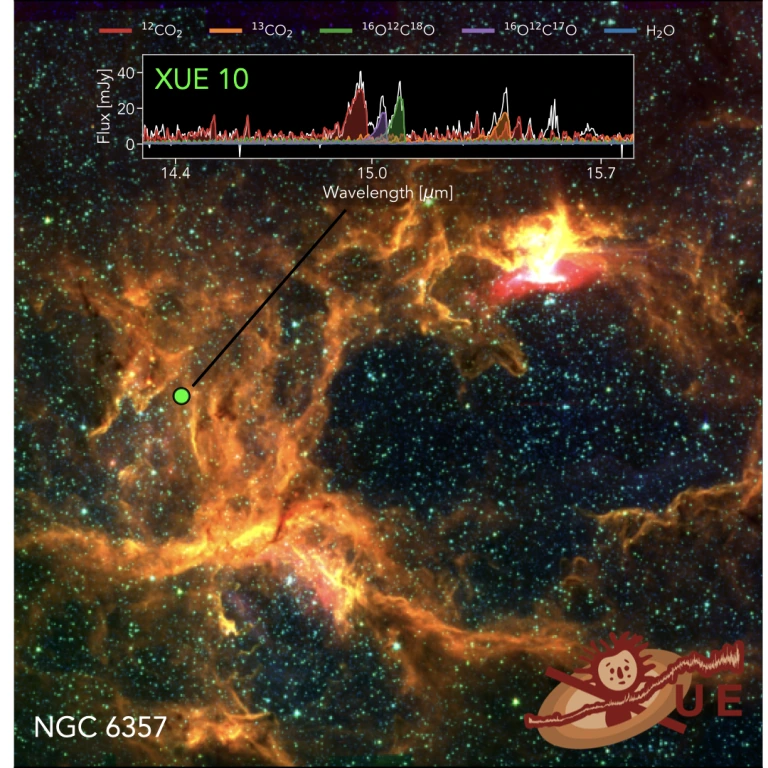
In conventional models, icy pebbles drift from the outer to the inner disk, sublimating into water vapor as temperatures rise. The strong CO2 signal observed here challenges that framework.
“Such a high abundance of carbon dioxide in the planet-forming zone is unexpected,” said Arjan Bik, also at Stockholm University. “It points to the possibility that intense ultraviolet radiation, either from the host star or neighbouring massive stars, is reshaping the chemistry of the disk.”
The researchers also identified isotopologues of CO2 enriched in carbon-13 and oxygen isotopes ¹⁷O and ¹⁸O. These isotopic fingerprints may help explain long-standing anomalies in meteorites and comets from the early Solar System.
Maria-Claudia Ramirez-Tannus of the Max Planck Institute for Astronomy, who leads the eXtreme Ultraviolet Environments (XUE) collaboration, said: “It reveals how extreme radiation environments — common in massive star-forming regions can alter the building blocks of planets. Since most stars and likely most planets form in such regions, understanding these effects is essential for grasping the diversity of planetary atmospheres and their habitability potential.”
The discovery was made possible by JWST’s MIRI instrument, developed with contributions from Stockholm University and Chalmers. MIRI operates at infrared wavelengths between 5 µm and 28 µm and includes coronagraphs designed for exoplanet observations, allowing astronomers to probe dust-rich, distant regions of planet formation with unprecedented precision.
References:
1 Unusual carbon dioxide-rich disk detected around young star challenges planet formation models – Stockholm University – August 29, 2025

I’m a science journalist and researcher at The Watchers, contributing to the Epicenter edition, where I cover peer-reviewed scientific research and emerging discoveries across Earth and space sciences. With a background in astronomy and a passion for environmental science, I’ve worked in shark and coral conservation in Fiji, conducting reef and shark-behavior research, contributing to mangrove restoration, and earning PADI Open Water and Coral Reef Certifications. I bring a blend of scientific rigor and storytelling to illuminate the discoveries shaping our planet and beyond.

Commenting rules and guidelines
We value the thoughts and opinions of our readers and welcome healthy discussions on our website. In order to maintain a respectful and positive community, we ask that all commenters follow these rules.