
New lunar mineral identified in first lunar meteorite found in China
China Geological Survey (CGS) reported that Chinese scientists identified a new lunar mineral, Magnesiochangesite-(Ce), in Pakepake 005, the first lunar meteorite found in China, and formally approved through meteorite nomenclature. The rare-earth-bearing phosphate was approved by the International Mineralogical Association’s Commission on New Minerals, Nomenclature and Classification. It represents the 11th lunar mineral discovered worldwide.

Image credit: CGS
The mineral was discovered by a team led by Hou Zengqian at the State Key Laboratory of Deep Earth and Mineral Exploration under the Chinese Academy of Geological Sciences. CGS described it as a trigonal rare-earth-bearing phosphate and a new member of the cerite supergroup and merrillite-group mineral family.
Magnesiochangesite-(Ce) is colorless and transparent, with glasslike luster, brittle behavior, conchoidal fractures, and fluorescence, according to CGS. The mineral occurs mainly as subhedral granular or euhedral columnar grains along the margins of anorthite, forsterite, and fluorapatite, with grains measuring about 3–25 μm and generally less than 10 μm.
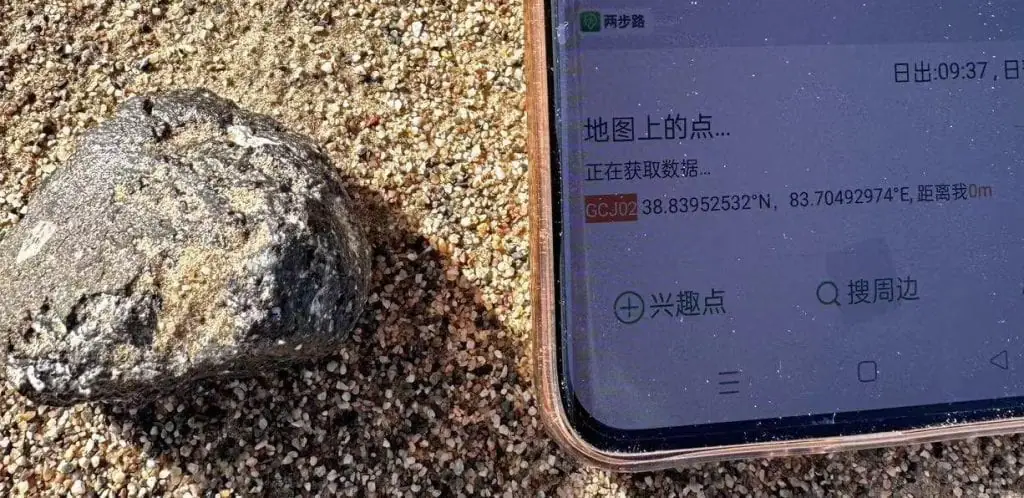
Pakepake 005 was found in the Taklamakan Desert, Xinjiang, on January 22, 2024. The single spherical stone weighs 44 g (1.6 oz), has a dark fusion crust, and contains visible white anorthitic clasts and dark clasts.
The Meteoritical Bulletin lists Pakepake 005 as an official meteorite name, with China as the country, 2024 as the year found, a mass of 44 g (1.6 oz), and a recommended classification of lunar fragmental breccia.
The stone was discovered by a meteorite hunter from Korla in the Taklamakan Desert on January 22, 2024. It was purchased from the anonymous finder and was subsequently acquired by Ziyao Wang on January 27, 2024.
The research team identified the mineral through physical-property measurements, spectroscopic vibration studies, chemical-composition analysis, and crystal-structure refinement.
Wang Yanjuan, a doctoral graduate at the Chinese Academy of Geological Sciences and the first identifier of the mineral, said the discovery provides mineralogical evidence for studying the Moon’s origin and evolution, linking the mineral’s crystal structure and chemical composition to lunar volcanic activity and rare-earth element separation during planetary formation.
Che Xiaochao, an associate researcher at the Planetary Science Research Center of the Institute of Geology under CAGS, told China Daily that the meteorite analysis used a domestically developed high-resolution secondary ion mass spectrometer. The instrument uses a focused ion beam to analyze microscopic surface composition without dissolving or destroying the sample.
CGS said the mineral was formally approved on April 3, 2026, and described it as the third lunar mineral found in a lunar meteorite, after discoveries by U.S. and German research teams. According to CGS, China has now identified four lunar minerals, tying the United States for the highest national total.
The meteorite records evidence from a major lunar impact associated with the Imbrium basin formation period about 3.92 billion years ago and later lunar volcanic activity about 3.49 billion years ago.
References:
1 央视新闻:第十一种月球新矿物 我国发现并申报的铈镁嫦娥石正式获批 – CGS – April 22, 2026
2 Pakepake 005 – LPI/MBD – Accessed May 19, 2026

I'm a dedicated researcher, journalist, and editor at The Watchers. With over 20 years of experience in the media industry, I specialize in hard science news, focusing on extreme weather, seismic and volcanic activity, space weather, and astronomy, including near-Earth objects and planetary defense strategies. You can reach me at teo /at/ watchers.news.

Commenting rules and guidelines
We value the thoughts and opinions of our readers and welcome healthy discussions on our website. In order to maintain a respectful and positive community, we ask that all commenters follow these rules.