
Moonquakes, not meteor strikes, caused landslides at Apollo 17 site
Repeated moonquakes along the Lee-Lincoln fault, not meteor impacts, caused boulder falls and landslides in the Taurus-Littrow valley, the Apollo 17 landing site, a study published recently in Science Advances has found. The findings raise concerns for the safety of future long-term lunar outposts.
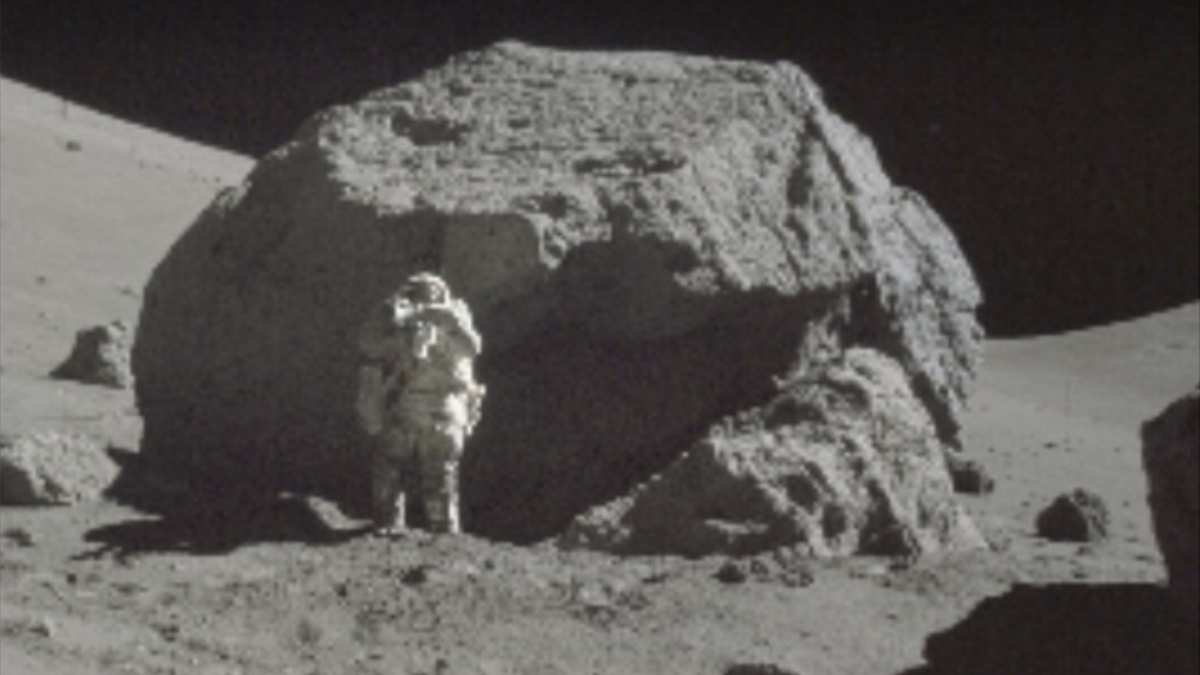
Astronaut with a lunar boulder. Credit: Thomas R. Watters, Nicholas C. Schmerr
A study co-authored by Thomas R. Watters, Smithsonian Senior Scientist Emeritus, and Nicholas C. Schmerr, geophysicist at the University of Maryland, shows that shallow moonquakes repeatedly reshaped the surface of the Apollo 17 landing site over the past 90 million years.
The analysis used geological features left by seismic shaking, including landslides and boulder falls, to reconstruct the magnitude and frequency of past events.
The research focused on the Lee-Lincoln thrust fault, a young fault scarp crossing the Taurus-Littrow valley. Samples and observations from Apollo 17 astronauts Eugene Cernan and Harrison Schmitt allowed exposure ages of four boulders, two at Station 2, one at Station 6, and one at Station 7, and one large landslide deposit to be determined using cosmic ray dating. These ages constrain the timing of past moonquakes.

One of the most prominent features, the “light mantle” deposit extending from South Massif across the valley floor, was also attributed to seismic-triggered landslides rather than Tycho ejecta. The Station 6 boulder, measuring approximately 15 m × 8 m (49 x 26 feet), left a visible track on the slopes of North Massif.
Trails of other boulders in the valley similarly showed no connection to fresh impact craters, ruling out impact ejecta and supporting seismic shaking as the trigger.
The team estimated ground motions equivalent to earthquakes of Mw ~2.9–3.3. While such magnitudes are considered minor on Earth, their effects on the Moon, where attenuation is weaker, would be significant near active faults.

Watters said the global distribution of young thrust faults and their potential to remain active must be considered when planning lunar infrastructure. “The global distribution of young thrust faults like the Lee-Lincoln fault, their potential to be still active, and the potential to form new thrust faults from ongoing contraction should be considered when planning the location and assessing stability of permanent outposts on the Moon,” he said.
The study calculated a one-in-20-million daily chance of a damaging moonquake occurring near an active fault. Over a single decade-long mission, this probability accumulates to about 1 in 5 500. Schmerr emphasized the growing hazard with longer stays: “If astronauts are there for a day, they’d just have very bad luck if there was a damaging event.
But if you have a habitat or crewed mission up on the Moon for a whole decade, that’s 3 650 days times 1 in 20 million, or the risk of a hazardous moonquake becomes about 1 in 5 500. It’s similar to going from the extremely low odds of winning a lottery to much higher odds of being dealt a four of a kind poker hand.”

Schmerr also noted the limitation of Apollo-era seismic instruments. “We don’t have the sort of strong motion instruments that can measure seismic activity on the Moon like we do on Earth, so we had to look for other ways to evaluate how much ground motion there may have been, like boulder falls and landslides that get mobilized by these seismic events,” he said.
The implications extend to future Artemis missions, especially for tall, slender landers such as SpaceX’s Starship, which may be more vulnerable to shaking.
Schmerr cautioned against building directly on or near active scarps: “We want to make sure that our exploration of the Moon is done safely and that investments are made in a way that’s carefully thought out. The conclusion we came to is: don’t build right on top of a scarp, or recently active fault.”
Future Artemis missions are expected to deploy modern seismic instruments far more sensitive than those of Apollo, providing refined hazard maps and a better understanding of the distribution of active faults. These data will support site selection for long-term lunar habitats and infrastructure.
References:
1 Thomas R. Watters, Nicholas C. Schmerr – Paleoseismic activity in the moon’s Taurus-Littrow valley inferred from boulder falls and landslides – July 30, 2025 – DOI: 10.1126/sciadv.adu3201

I’m a science journalist and researcher at The Watchers, contributing to the Epicenter edition, where I cover peer-reviewed scientific research and emerging discoveries across Earth and space sciences. With a background in astronomy and a passion for environmental science, I’ve worked in shark and coral conservation in Fiji, conducting reef and shark-behavior research, contributing to mangrove restoration, and earning PADI Open Water and Coral Reef Certifications. I bring a blend of scientific rigor and storytelling to illuminate the discoveries shaping our planet and beyond.

Commenting rules and guidelines
We value the thoughts and opinions of our readers and welcome healthy discussions on our website. In order to maintain a respectful and positive community, we ask that all commenters follow these rules.