
James Webb reveals massive stellar nursery Pismis 24
The James Webb Space Telescope released a new image of the young star cluster Pismis 24 in the Lobster Nebula (NGC 6357), located about 5 500 light-years away in the constellation Scorpius, on September 4. The near-infrared image reveals thousands of stars, including Pismis 24-1, a system of at least two massive stars with 74 and 66 solar masses, embedded in towering spires of dust and gas.

NASA’s James Webb Space Telescope captures the dazzling star birth in Pismis 24, a vibrant young star cluster in the Lobster Nebula, 5,500 light-years away in Scorpius. Credit: NASA, ESA, CSA, STScI; Image Processing: A. Pagan (STScI)
The Near-Infrared Camera (NIRCam) on JWST revealed thousands of stars in Pismis 24, ranging in mass, brightness, and color. The cluster lies within the Lobster Nebula, one of the closest massive star-forming regions to Earth.
At the center of the cluster is Pismis 24-1, once thought to be the most massive star known. Observations later determined it is a binary system consisting of two stars with estimated masses of 74 and 66 solar masses. These stars emit intense ultraviolet radiation and stellar winds, which are actively reshaping the surrounding gas and dust.
The image shows spire-like structures of dense gas and dust extending up to 5.4 light-years in height. The tallest spire’s tip spans approximately 0.14 light-years wide enough to contain over 200 solar systems the size of Neptune’s orbit.
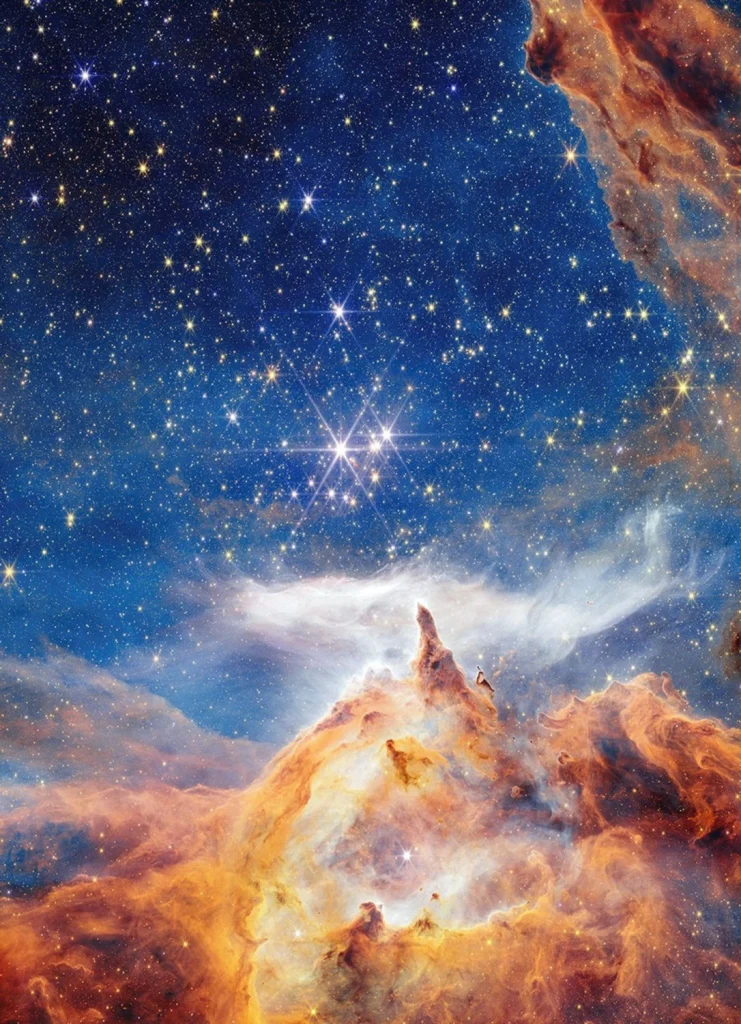
Color-coded NIRCam imaging highlights the nebula’s components: cyan marks hot, ionized hydrogen gas, orange traces dust molecules, red shows cooler molecular hydrogen, and black indicates dense gas with no light emission. White wisps represent dust scattering starlight.
The radiation and stellar winds from massive stars in Pismis 24 are compressing the surrounding gas, creating conditions for new star formation. This feedback mechanism both disperses nebular material and triggers secondary stellar birth.
The proximity of Pismis 24 makes it an important laboratory for studying massive star formation. These stars, although rare, play a key role in galactic evolution through radiation, winds, and eventual supernova explosions.
The new JWST observations provide astronomers with a more complete picture of the chemical composition of the star-forming environment, the structure of the nebula, and the interaction between young stars and interstellar material.
References:
1 James Webb Space Telescope Unveils Star Birth in Pismis 24 – James Webb Discovery – September 4, 2025

I’m a science journalist and researcher at The Watchers, contributing to the Epicenter edition, where I cover peer-reviewed scientific research and emerging discoveries across Earth and space sciences. With a background in astronomy and a passion for environmental science, I’ve worked in shark and coral conservation in Fiji, conducting reef and shark-behavior research, contributing to mangrove restoration, and earning PADI Open Water and Coral Reef Certifications. I bring a blend of scientific rigor and storytelling to illuminate the discoveries shaping our planet and beyond.

Commenting rules and guidelines
We value the thoughts and opinions of our readers and welcome healthy discussions on our website. In order to maintain a respectful and positive community, we ask that all commenters follow these rules.