
Inside Earth’s fastest quake that shattered speed limits in Myanmar
An M7.7 earthquake struck Myanmar on March 28, 2025, rupturing between 475–530 km (295–329 miles) of the Sagaing Fault, where a UCLA-led team found that the southern branch reached sustained supershear speeds approaching 5 km/s (3.1 mps).

A temple destroyed by the M7.7 earthquake in Myanmar on March 28, 2025. Image credit: amithype
At 06:20:52 UTC on March 28, a massive earthquake struck near Mandalay, Myanmar, along the Sagaing Fault. The event measured M7.7 on the Richter Scale and generated one of the fastest continental ruptures ever recorded on Earth.
Satellite radar and seismic data show that the rupture raced for more than 500 km (310 miles), with a 450 km (279 miles) southern segment moving faster than seismic shear waves travel through rock. These speeds reached up to 5 km/s (3.1 mps), surpassing the crust’s natural limits.
Such motion created a rare phenomenon known as a supershear rupture, where the fault front overtakes the waves that normally carry its energy. The result is a Mach front, similar to a sonic boom, that doubles the shaking intensity and extends destruction far beyond the epicenter.
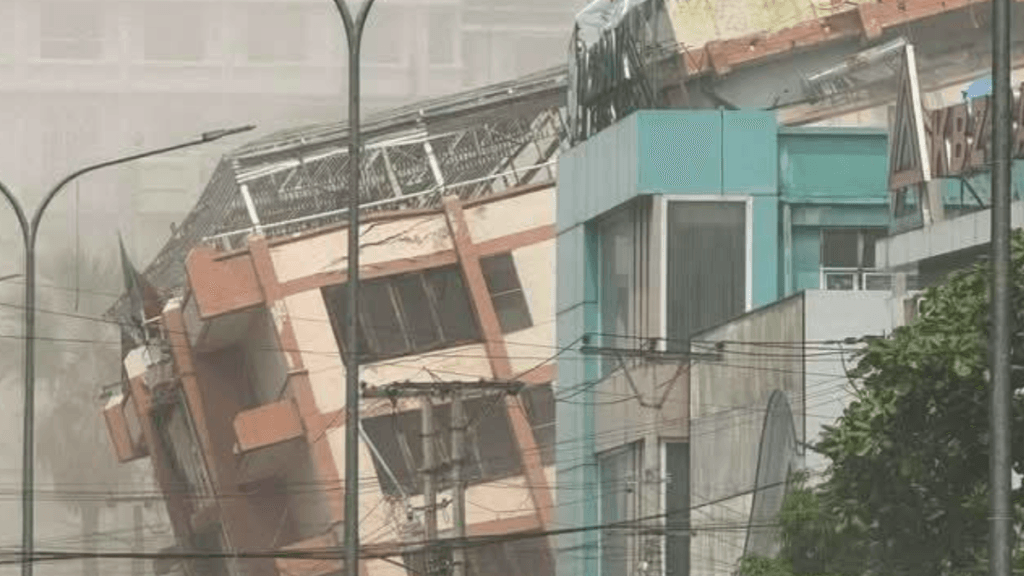
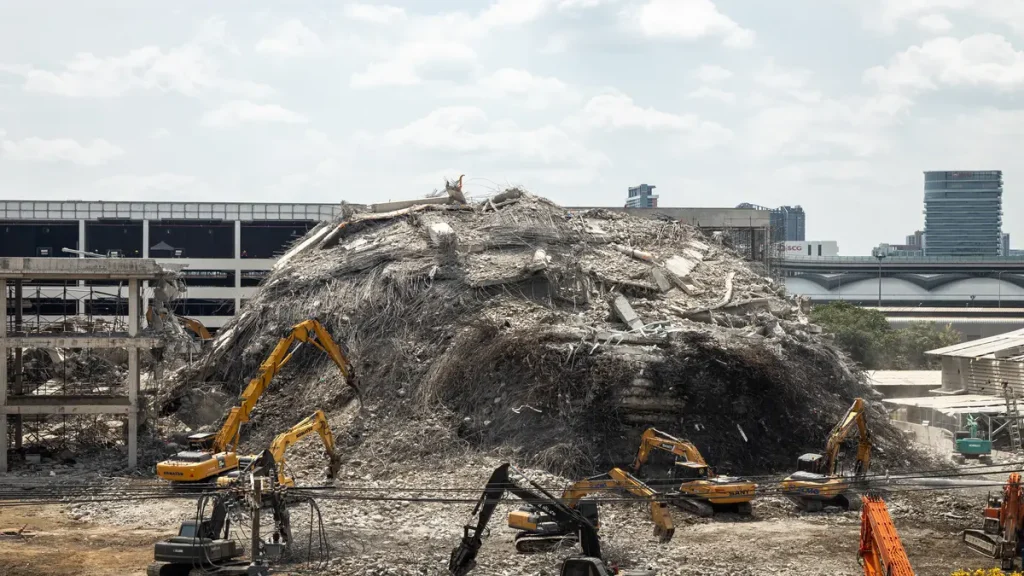
Witnesses described a long, violent shaking sequence that struck in waves. Urban centers hundreds of kilometers away reported structural collapses, and satellite images later revealed surface cracking and widespread ground deformation across central Myanmar.
The physics behind the speed
Supershear earthquakes occur when the rupture velocity exceeds the shear-wave velocity in rock, a threshold of about 3.5 km/s (2.2 mps) in continental crust. Once this barrier is crossed, seismic energy becomes focused ahead of the fault tip, intensifying the motion that follows.
Researchers from UCLA reconstructed the Myanmar event using global seismic records, radar interferometry, and optical satellite imagery. Their analysis showed that the southern branch of the Sagaing Fault transitioned to supershear soon after initiation and maintained that velocity for nearly 450 km (279 miles).
Unlike most ruptures, which slow down when they encounter bends or heterogeneities, this one stayed stable. The southern fault trace is unusually linear, with few geometrical obstacles to halt acceleration. It acted almost like a runway carved through the crust.
The study’s authors compared this to breaking the sound barrier in rock. Once the rupture reached critical speed, it released compressed stress as concentrated shock waves, causing near-field shaking strong enough to liquefy ground layers in the central plains.
The trio of super factors
Scientists identified three key geological conditions that made this acceleration possible. The first was geometry. The Sagaing Fault’s southern segment runs in a straight, smooth line for hundreds of kilometers, reducing energy loss and keeping motion focused.
The second factor was time. This part of the fault had been quiet since 1839, when the last major rupture, the Ava earthquake, struck central Myanmar. For more than 180 years, tectonic stress accumulated as the Indian and Sunda plates continued to grind past each other.
The third factor was contrast. Rocks on either side of the fault have different stiffness and density, a condition known as the bimaterial effect. When one side is stronger and the other weaker, stress builds unevenly and releases asymmetrically, allowing one side to pull the rupture faster.
Together, these three influences created what the researchers called a favorable energy ratio, a perfect balance between stored stress and fracture energy. Once the rupture began, that energy ratio enabled it to sustain supershear speeds across an extraordinary distance.
Destruction mapped from orbit
Because Myanmar was in the midst of ongoing conflict, scientists could not conduct extensive fieldwork. Instead, they turned to satellites to map the damage remotely, using radar coherence and optical change detection techniques.
These satellite maps revealed widespread building collapse across cities in central Myanmar, especially in areas built on soft sediments. Liquefaction zones appeared as mottled patches near rivers, where wet ground lost strength and temporarily flowed like liquid.
Interferometric radar (InSAR) showed ground offsets of several meters along the fault trace. Combined with optical imagery, these data provided a high-resolution view of crustal deformation that would normally require weeks of fieldwork to collect.
This approach marked one of the most complete remote analyses of a continental supershear rupture to date. It also demonstrated how modern space-based tools can provide life-saving insights when ground access is impossible.
What this means for the world’s faults
The Mandalay earthquake challenges long-held assumptions about how continental faults behave. For decades, scientists believed that supershear ruptures could not persist over long distances because rough fault geometry would disrupt the motion.
The 2025 event proved that under the right structural and material conditions, a continental fault can maintain supershear velocity over hundreds of kilometers. This realization reshapes how scientists model the risk of extreme ground motion in populated regions.
Faults with similar geometry and composition exist elsewhere. Long, straight strike-slip faults in California, Turkey, Iran, and western China all share characteristics that could allow similar behavior under sufficient stress.
Understanding these dynamics is crucial for hazard modeling. Supershear ruptures radiate energy more efficiently than typical earthquakes, producing stronger shaking farther from the source. Cities located tens or even hundreds of kilometers from such faults could experience unexpectedly intense motion.
Preparing for the unthinkable
The Myanmar earthquake is now one of the clearest case studies of sustained supershear motion on land. Its physics provide new parameters for future seismic hazard forecasts.
In regions like the San Andreas Fault in California, the North Anatolian Fault in Turkey, or the Kunlun Fault in China, researchers are reassessing whether long, linear segments could reach similar speeds under high stress. Some experimental models already suggest it is possible.
Urban planning agencies can use this knowledge to refine risk assessments, particularly for structures sensitive to long-duration ground motion. Building codes, early-warning systems, and disaster plans must now consider the potential of supershear dynamics.
As lead author Lingsen Meng put it, “Even well-studied continental faults can behave in unexpected and dangerous ways. Knowing what allows a rupture to go supershear helps us prepare for the unthinkable.”
References:
1 Researchers discover the trio of super factors that combined to cause Myanmar’s deadly 2025 earthquake – UCLA Newsroom – October 30, 2025
2 Bimaterial effect and favorable energy ratio enabled supershear rupture in the 2025 Mandalay earthquake – Liuwei Xu, Lingsen Meng et al. – Science – October 30, 2025 – DOI: 10.1126/science.ady6100

I’m a science journalist and researcher at The Watchers, contributing to the Epicenter edition, where I cover peer-reviewed scientific research and emerging discoveries across Earth and space sciences. With a background in astronomy and a passion for environmental science, I’ve worked in shark and coral conservation in Fiji, conducting reef and shark-behavior research, contributing to mangrove restoration, and earning PADI Open Water and Coral Reef Certifications. I bring a blend of scientific rigor and storytelling to illuminate the discoveries shaping our planet and beyond.

Commenting rules and guidelines
We value the thoughts and opinions of our readers and welcome healthy discussions on our website. In order to maintain a respectful and positive community, we ask that all commenters follow these rules.