
Earth’s axis wobble recorded with unmatched precision
Researchers at the Technical University of Munich measured Earth’s axis precession and nutation at the Geodetic Observatory Wettzell, Bavaria, over 250 days, achieving 100 times higher precision than previous methods. The ring laser experiment provided sub-hour resolution and immediate results, marking a major advance over the global VLBI network.
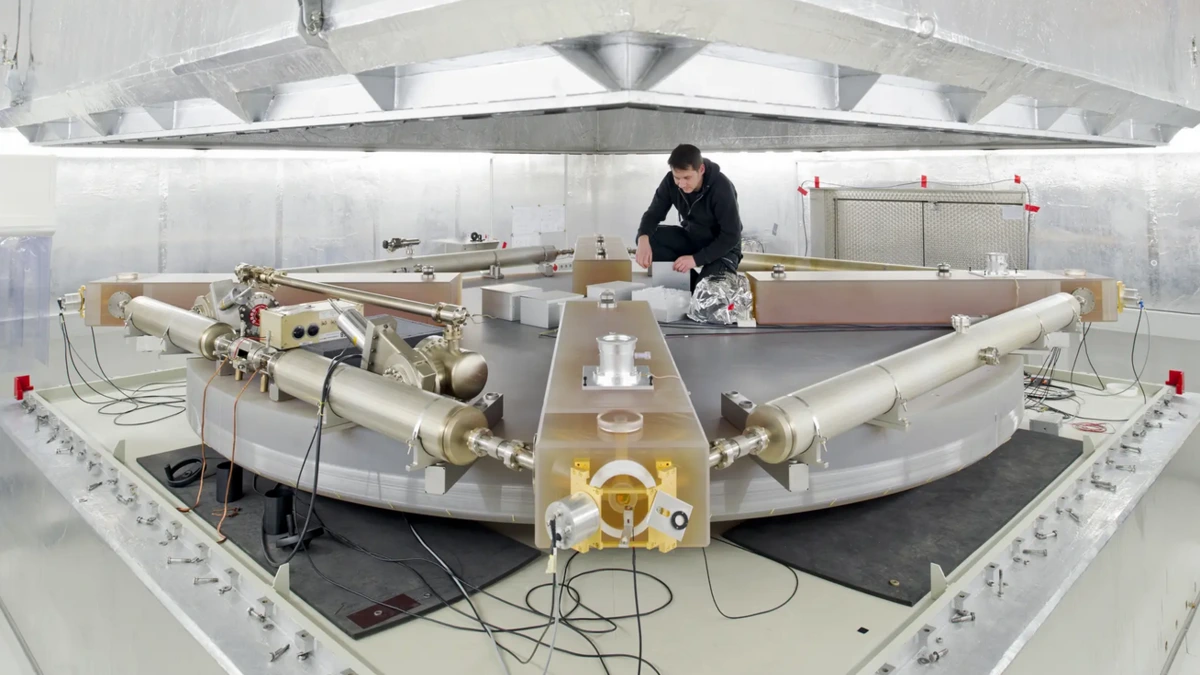
The underground ring laser at the Geodetic Observatory of TUM in Wettzell. Credit: Astrid Eckert/TUM
A team led by K. Ulrich Schreiber operated the G ring laser at the Geodetic Observatory Wettzell (Technical University of Munich) and recorded the instantaneous rotation signal of the laboratory relative to inertial space over a continuous 250-day interval.
Because the device is an optical Sagnac interferometer in which two counterpropagating laser modes produce a beat frequency proportional to the local rotation rate, the instrument senses motions of Earth’s rotation axis (precession and nutation) intrinsically and without reference to external sources.
This inertial measurement, therefore, complements the standard, geometrical Earth-orientation techniques (very-long-baseline interferometry, GNSS, satellite laser ranging, DORIS) used to maintain the international terrestrial reference frame (ITRF) and GNSS timing and positioning products.
How the ring laser works
A ring laser gyroscope encloses an optical path in a closed cavity. Two narrow-linewidth laser modes circulate in opposite directions; rotation of the cavity causes a difference in optical frequency (the Sagnac effect) that is measured as a beat note.
For the Wettzell G instrument, the cavity is a square with 4 m sides, monolithically mounted on a massive monument and built from low-expansion Zerodur to maximize mechanical stability. The recorded beat frequency is proportional to the area and orientation of the cavity and to the instantaneous rotation vector of the Earth relative to the instrument.
Because the sensor is rigidly attached to bedrock, the slow motion of the rotation axis in space (precession and nutation) produces a measurable in-phase diurnal signal on the instrument.

250 days of wobble data
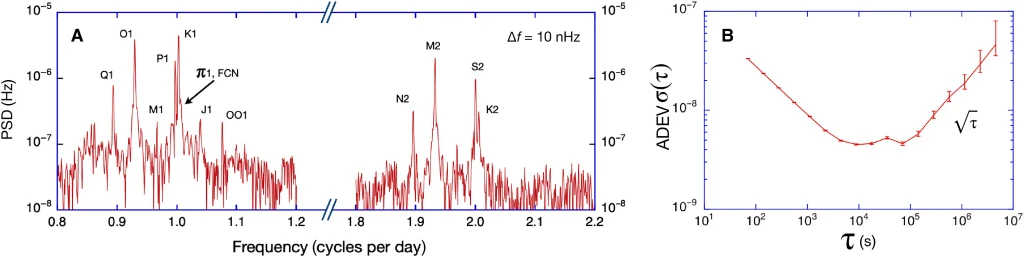
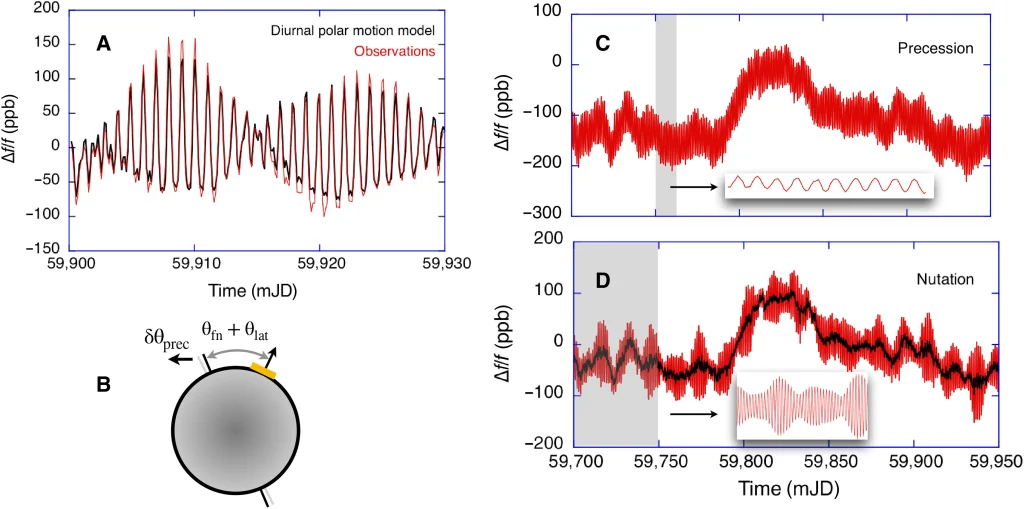
Over the 250-day campaign, the ring laser produced continuous records that contain the expected precession and nutation signatures, including the large 18.6-year lunar nutation component expressed as short-period variations in the diurnal band, and many smaller periodicities down to weekly and daily timescales.
The instrument reached an accuracy limit for rotation sensing of 48 ppb (picoradians per second scale sensitivity), and the residual spectrum shows only a few small components at the level of a few ppb in the diurnal and semidiurnal bands.
These metrics place the Wettzell G ring laser substantially ahead of prior inertial sensors and within less than an order of magnitude of the sensitivity needed to detect certain relativistic precessions.
Limits to precision
Two principal error classes constrain high-precision rotation sensing: (i) scale-factor stability (related to the optical cavity, wavelength stability, and mirror losses) and (ii) orientation stability of the instrument plane (colatitude and tilt).
Long-term changes in scale factor or slow variations in the instrument’s effective colatitude produced by solid Earth tides, diurnal polar motion, the Chandler wobble, tectonic displacements, seismic events, and microseismic noise appear in the rotation record and must be modeled or measured independently to isolate the celestial precession/nutation signal.
The Wettzell installation mitigates many of these errors by using an underground, ambient-pressure-stabilized vessel and a monolithic Zerodur mount, but residual contributions remain in the ppb regime and define the path for further improvements.
Toward relativity tests
The authors quantify that an additional factor-of-10 improvement in measurement accuracy and long-term stability would bring the instrument into a regime where de Sitter (geodetic) precession and the Lense-Thirring frame-dragging term could be directly probed from a ground-based gyroscope.
Achieving that advance will require further suppression of scale-factor drift, enhanced environmental isolation, and perhaps coordinated multi-instrument deployments to separate local tilts from global inertial signals.
If realized, a surface detection of frame dragging would provide an independent and complementary test of general relativity to satellite missions. It would open a new experimental window in fundamental physics using optical interferometry techniques.
Why wobble matters
Continuous, inertial rotation sensing at Wettzell demonstrates a viable alternative and supplement to the global geometric observing networks used to maintain Earth-orientation parameters. Faster availability of high-precision rotation data (hourly rather than daily or weekly) could improve operational products that rely on rapid Earth-orientation updates, such as high-precision GNSS positioning for geodesy and real-time applications.
Furthermore, because fluctuations in rotation reflect mass transfers between the solid Earth, cryosphere, atmosphere, and oceans, continuous ring laser records can become a unique tracer for detecting and attributing such transports on sub-seasonal timescales.
References:
1 Wobbling precisely through space – TUM – September 4, 2025
2 Gyroscope measurements of the precession and nutation of Earth’s axis – K. Ulrich Schreiber, Urs Hugentobler – Science Advances – September 3, 2025 – DOI: 10.1126/sciadv.adx6634 – OPEN ACCESS

I’m a science journalist and researcher at The Watchers, contributing to the Epicenter edition, where I cover peer-reviewed scientific research and emerging discoveries across Earth and space sciences. With a background in astronomy and a passion for environmental science, I’ve worked in shark and coral conservation in Fiji, conducting reef and shark-behavior research, contributing to mangrove restoration, and earning PADI Open Water and Coral Reef Certifications. I bring a blend of scientific rigor and storytelling to illuminate the discoveries shaping our planet and beyond.

Commenting rules and guidelines
We value the thoughts and opinions of our readers and welcome healthy discussions on our website. In order to maintain a respectful and positive community, we ask that all commenters follow these rules.