
Cooling episode 7 200 years ago linked to 500-year hiatus in early Chinese culture
A 7 200-year-old cold event, recorded on the Chinese Loess Plateau, triggered a 500-year hiatus in the Dadiwan Culture, according to a study published in Catena on September 19, 2025. Researchers link the event to reduced solar activity, disruptions in the Atlantic Meridional Overturning Circulation (AMOC), and weakened monsoons. While the strongest signal for the cooling episode is seen across the Northern Hemisphere, global drivers such as reduced solar irradiance suggest the Southern Hemisphere was likely affected as well, though evidence there is less clear.
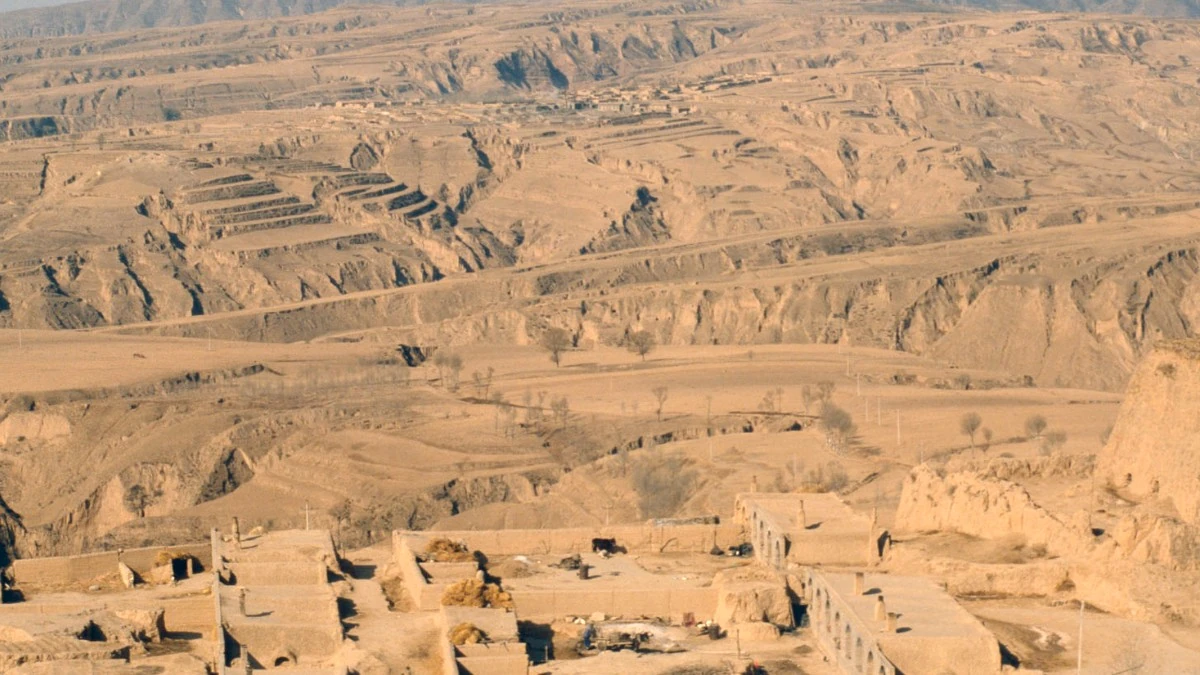
Loess landscape in China. Credit: Till Niermann
The Dadiwan Culture is a key representative of China’s Neolithic period. Centered in the western Chinese Loess Plateau, within the Yellow River Basin, it is considered one of the origins of the later Yangshao Culture.
Radiocarbon dating places the Dadiwan Culture’s occupation between roughly 7 800 and 4 800 calibrated years before present (about 5 850–2 850 BCE). Yet archaeologists long noted a puzzling gap in this sequence. Between Phase I (7 800–7 300 cal yr BP, or ~5 850–5 350 BCE) and Phase II (6 500–6 000 cal yr BP, or ~4 550–4 050 BCE), evidence of human activity almost disappears.
For decades, researchers debated whether the interruption was due to local social changes, incomplete excavation records, or climate stress. The cause remained unresolved until now.
Soil chemistry reveals signs of climate stress
A team led by Prof. Sun Youbin and Associate Prof. Liu Xingxing from the Institute of Earth Environment of the Chinese Academy of Sciences (IEECAS), together with collaborators from the Northwest Institute of Eco-Environment and Resources, Lanzhou University, and Northwest University, turned to high-resolution climate archives.
They analyzed sediment from the high-deposition Dadiwan section, just 2 km (1.2 miles) from the archaeological site. By measuring organic carbon (OC400) and total nitrogen (TN) content, they reconstructed vegetation productivity and soil fertility spanning the past 14 000 years.
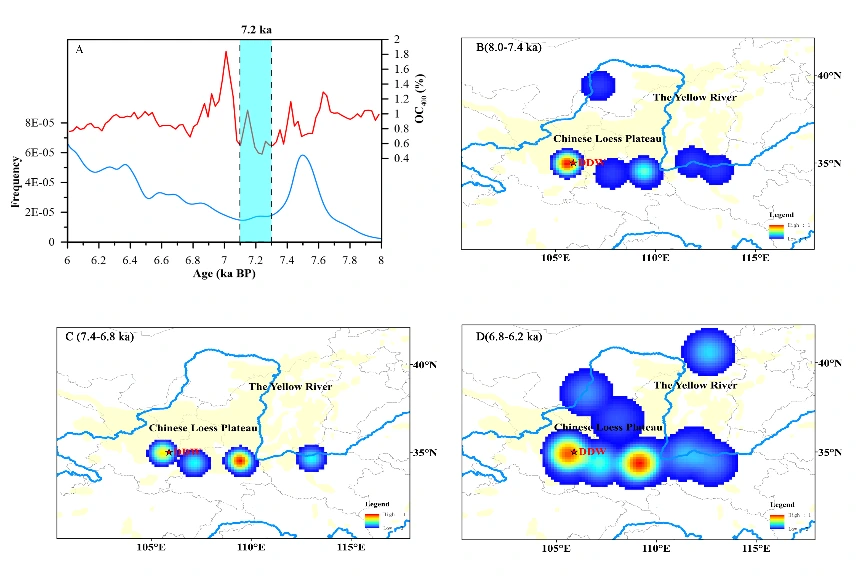
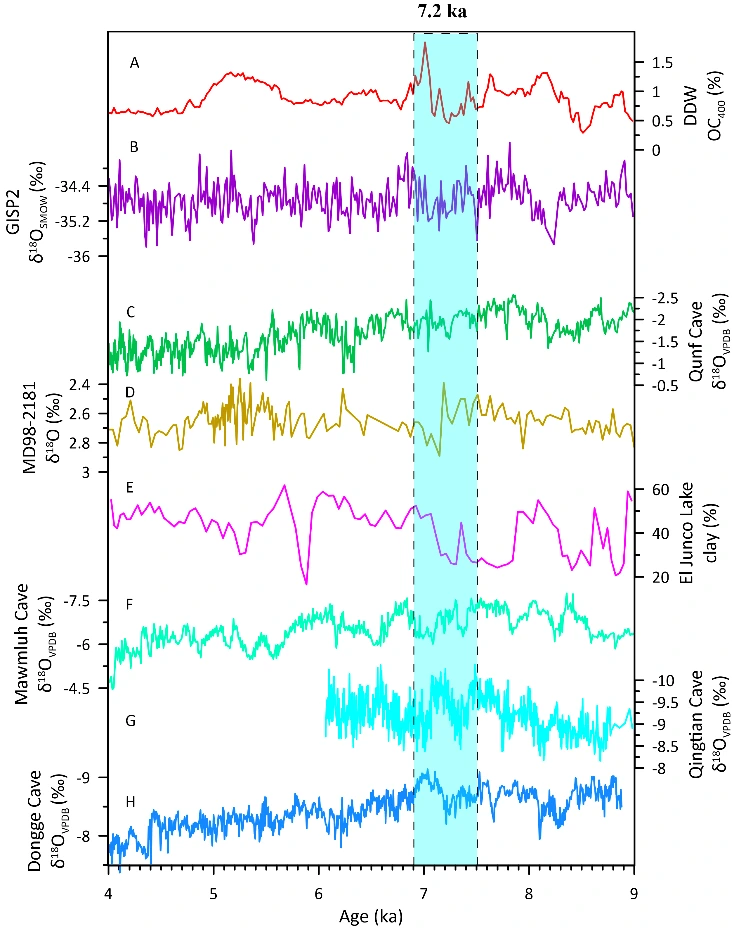
The data reveal a sharp drop in OC400 and TN around 7 200 years ago, signaling weakened vegetation growth and reduced agricultural capacity. The findings align with isotope and sediment records showing a simultaneous weakening of the East Asian summer monsoon.
The climate downturn coincides exactly with the cultural hiatus, providing the strongest evidence yet that environmental stress disrupted human settlement.
Ocean and solar changes behind the cold event
After identifying weakened summer monsoons as a local factor, the researchers looked for wider causes of the anomaly. Their analysis of multiple climate records points to two overlapping drivers.
One driver was a reduction in solar irradiance, which lowered the amount of energy reaching Earth during the mid-Holocene. The other was an influx of freshwater into the North Atlantic, which disrupted the Atlantic Meridional Overturning Circulation (AMOC), a large-scale system of ocean currents that carries heat northward and helps stabilize climate.
Together, these factors produced a cooling episode most clearly felt across the Northern Hemisphere. Comparison with records such as Greenland ice cores, Mediterranean sediments, cave deposits that preserve oxygen isotope signals (δ¹⁸O), and lake sediments confirms the event 7 200 years ago was a hemispheric-scale disruption. Global drivers such as reduced solar irradiance suggest the Southern Hemisphere may also have been affected, but fewer studies cover this interval there and the evidence remains uncertain.
Unlike the more widely known 8 200-year and 4 200-year events, the cold event 7 200 years ago occurred during the Holocene Climate Optimum, when conditions were otherwise relatively stable and favorable. Its timing makes it an especially instructive analogue for modern warming scenarios, where stable baselines may still mask abrupt regional anomalies.
Archaeological records match the climate downturn
To test whether the climate event matched settlement patterns, the team compiled radiocarbon (^14C) dates from Dadiwan and other archaeological sites across the Loess Plateau. Radiocarbon dating uses the decay of carbon-14 in organic material to estimate the age of human activity.
Using probability density and kernel density estimates, they showed a marked drop in human settlements at around 7 200 years ago. The decline is synchronous with the climate proxies, strengthening the case for causation.
The cultural sequence shows a clear structure:
- Phase I (7 800–7 300 cal yr BP, or ~5 850–5 350 BCE): Active settlement, millet farming, and pottery.
- Hiatus (~500 years): No evidence of sites or settlement.
- Phase II (6 500–6 000 cal yr BP, or ~4 550–4 050 BCE): Renewed occupation and farming.
When humans returned, they brought adaptations. The later Yangshao Culture built on Dadiwan’s foundations but developed new strategies in farming and community organization, suggesting lessons were learned from earlier vulnerability.
How the event 7 200 years ago compares to other Holocene crises
The cooling episode 7 200 years ago (about 5 250 BCE) now joins the 8 200-year event (about 6 250 BCE) in the North Atlantic and the 4 200-year megadrought (about 2 250 BCE) as part of the catalog of Holocene climate disruptions with societal impacts.
The event 8 200 years ago, triggered by glacial meltwater outflow, reshaped early farming in Europe and the Middle East. The 4 200-year event has been linked to crises in Egypt, Mesopotamia, and the Indus Valley, as well as to the decline of late Neolithic cultures in China. The disruption 7 200 years ago provides a crucial bridge between these events, showing that even during a climatic optimum, localized shocks could halt early civilizations.
Together, the episodes show that Neolithic societies were resilient but not invulnerable. Their dependence on rainfall-driven farming meant that even modest reductions in precipitation could trigger migration or cultural reorganization.
References:
1 Scientists Discover 7,200-Year-Old Climate Shift Coincides with Dadiwan Culture Disappearance – Chinese Academy of Sciences – September 18, 2025
2 The 7.2 ka cold event and its societal impact: climate-induced hiatus in the Dadiwan Culture of the Chinese Loess Plateau – Yuqing Yang et al. – Science Direct- September 15, 2025 – https://doi.org/10.1016/j.catena.2025.109448

I’m a science journalist and researcher at The Watchers, contributing to the Epicenter edition, where I cover peer-reviewed scientific research and emerging discoveries across Earth and space sciences. With a background in astronomy and a passion for environmental science, I’ve worked in shark and coral conservation in Fiji, conducting reef and shark-behavior research, contributing to mangrove restoration, and earning PADI Open Water and Coral Reef Certifications. I bring a blend of scientific rigor and storytelling to illuminate the discoveries shaping our planet and beyond.

Commenting rules and guidelines
We value the thoughts and opinions of our readers and welcome healthy discussions on our website. In order to maintain a respectful and positive community, we ask that all commenters follow these rules.