
Collapse of Panama’s seasonal upwelling cycle signals pattern disruption
The collapse of Panama’s seasonal wind-driven upwelling cycle between January and April 2025 marked the first observed disruption in over four decades of records, breaking a long-standing physical pattern that supports marine productivity and buffers coastal ecosystems from thermal stress. Patterns like these are tracked because their consistency signals system stability and their collapse may indicate underlying shifts in climate dynamics.

Chlorophyll a (l2) concentrations in Gulf of Panama on February 10, 2025. Credit: NASA, PACE/OCI, The Watchers
- The 2025 collapse of Panama’s seasonal upwelling marks the first recorded disruption of a stable physical cycle in over 40 years of satellite and in situ observations.
- This event signals a possible shift in the behavior of wind-driven tropical ocean systems, occurring despite only weak La Niña conditions and without a clear singular cause.
- The collapse disrupted nutrient supply, weakened marine productivity, and removed a natural thermal buffer for coral reefs.
For at least 40 years, the Pacific waters of the Gulf of Panama have experienced a predictable seasonal cycle. Each year between January and April, northerly trade winds drove surface waters away from the coast, allowing colder, nutrient-rich waters to rise from the deep. This upwelling fueled plankton blooms, sustained highly productive fisheries, and provided cooling that shielded coral reefs from thermal stress.
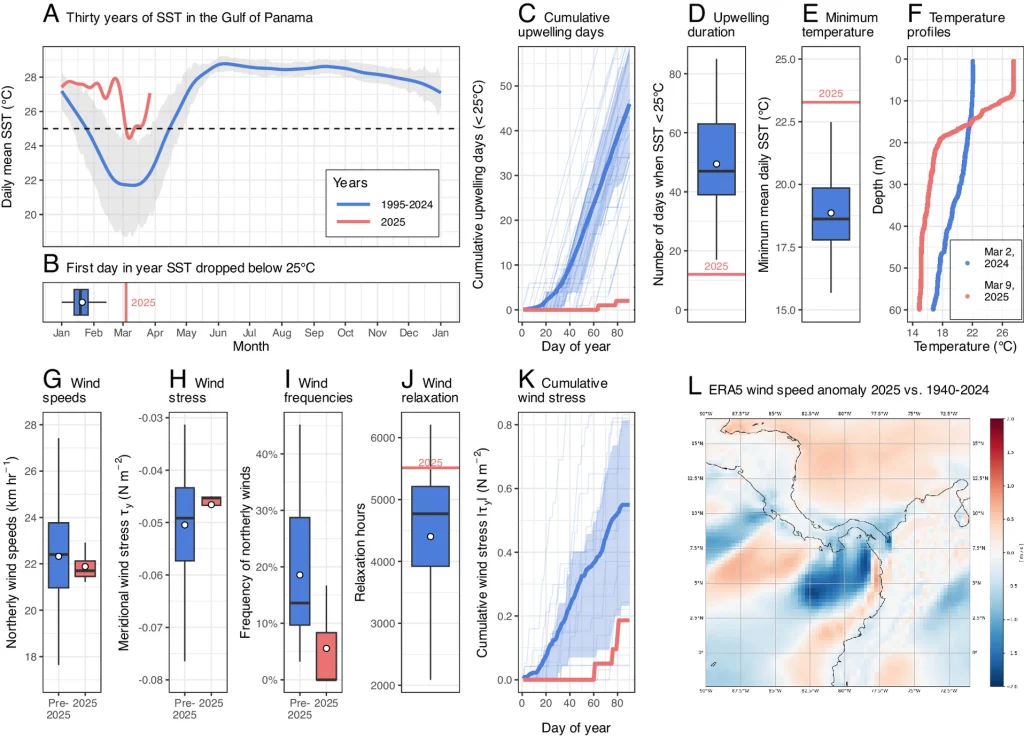
But in 2025, that rhythm was broken. Scientists from the Smithsonian Tropical Research Institute (STRI) documented that the expected drop in sea surface temperatures never occurred. Instead, chlorophyll concentrations — a proxy for phytoplankton productivity — remained low, and the normal seasonal spike in marine life failed to materialize.
The study, published in the Proceedings of the National Academy of Sciences (PNAS), marks the first recorded collapse of Panama’s upwelling system since modern monitoring began.

The missing winds
At the heart of the anomaly lies the Panama wind jet, a channel of northerly winds that funnels through the Isthmus of Panama and drives the mixing of the ocean surface.
Analysis of 40 years of satellite records and 30 years of in situ measurements revealed stark differences in 2025. On average, upwelling began by January 20, lasted 66 days, and cooled waters to around 19°C (66.2°F), with historical extremes as low as 14.9°C (58.8°F). In 2025, however, the onset was delayed until March 4 — 42 days later than usual — and lasted only 12 days. The minimum temperature recorded was 23.3°C (73.9°F), the warmest in the entire record.
When northerly winds did occur in 2025, their speed and strength were comparable to historical values. But they occurred far less often — a 74% reduction in frequency — and relaxation periods were longer, weakening cumulative wind stress across the gulf.
Researchers suggest the anomaly may be linked to the position of the Intertropical Convergence Zone (ITCZ) during the weak 2024–2025 La Niña. Yet, this explanation is incomplete.
The Gulf has experienced much stronger ENSO cycles in the past without any upwelling failure, showing that local and regional dynamics likely play a more complex role than ENSO conditions alone.
Ecological and economic consequences
The collapse of upwelling is more than a missing seasonal event — it disrupts a system that coastal communities have depended on for millennia.
Without the nutrient injection from deeper waters, phytoplankton productivity plummeted. This loss at the base of the food web cascades upward, reducing fish biomass and threatening both artisanal and commercial fisheries in the region.
Coral reefs, which typically gain temporary relief from warm-season stress thanks to upwelling’s cooler waters, faced prolonged thermal exposure. Such conditions increase the likelihood of bleaching, a process that weakens or kills reef-building corals and undermines the ecosystems they support.
The broader implication is that ecosystems and economies finely tuned to a reliable seasonal cycle are vulnerable when that cycle fails.
A poorly monitored system
Despite their importance, tropical upwelling systems remain less studied than their temperate counterparts, such as those off California or Peru. Panama’s event highlights a gap in ocean observation: while temperate systems are relatively well-monitored, tropical regions often lack the data density needed to anticipate or fully explain anomalies.
The study authors urge strengthening of climate-ocean monitoring networks in the tropics. Without continuous observation and predictive capacity, similar disruptions could strike without warning, leaving fisheries and reef ecosystems unprepared.
Why it matters
Seasonal upwelling in the Gulf of Panama is not just an ecological event, it is a recurring physical pattern, observed, measured, and relied upon across centuries.
For thousands of years, this wind-driven process has surfaced cool, nutrient-rich waters each boreal winter, shaping marine ecosystems, pre-Columbian subsistence systems, and modern fisheries alike. It has been one of the most stable seasonal events in the eastern tropical Pacific.
The collapse of this pattern in 2025 represents more than a fisheries concern, it is a disruption of a long-standing oceanographic rhythm. Scientists track patterns to understand system behavior and stability and when a pattern fails without a clear cause, it signals a potential threshold has been crossed.
Despite occurring during only a weak La Niña, the 2025 collapse defied expectations, suggesting that small regional-scale shifts — such as in wind-jet frequency or ITCZ placement — can now interrupt systems once thought resilient.
Whether this event is a single outlier or the first signal of destabilization in tropical upwelling systems remains an open question.
While the 2025 upwelling failure is unprecedented within the available observational record, it is important to note that this conclusion is limited to the period for which high-resolution ocean temperature data exist.
The study analyzed 40 years of satellite-derived sea surface temperatures (1985–2025) and 30 years of in situ measurements (1995–2025). It remains unknown whether similar collapses occurred before the satellite era, as no equivalent long-term physical records exist for the region’s ocean–atmosphere interactions.
References:
1 Unprecedented suppression of Panama’s Pacific upwelling in 2025 – Aaron O’Dea, Andrew J. Sellers – PNAS – – September 2, 2025 – https://doi.org/10.1073/pnas.2512056122 – OPEN ACCESS
2 Upwelling Failure – STRI – September 1, 2025

I’m a science journalist and researcher at The Watchers, contributing to the Epicenter edition, where I cover peer-reviewed scientific research and emerging discoveries across Earth and space sciences. With a background in astronomy and a passion for environmental science, I’ve worked in shark and coral conservation in Fiji, conducting reef and shark-behavior research, contributing to mangrove restoration, and earning PADI Open Water and Coral Reef Certifications. I bring a blend of scientific rigor and storytelling to illuminate the discoveries shaping our planet and beyond.

Commenting rules and guidelines
We value the thoughts and opinions of our readers and welcome healthy discussions on our website. In order to maintain a respectful and positive community, we ask that all commenters follow these rules.