
Butterfly Nebula observations uncover clues to Earth’s creation
A study published in the Monthly Notices of the Royal Astronomical Society on August 27, 2025, revealed crystalline silicates and polycyclic aromatic hydrocarbons in the Butterfly Nebula (NGC 6302), located 3 400 light-years (1 040 parsecs) away in Scorpius, providing new insights into the formation of rocky planets like Earth.
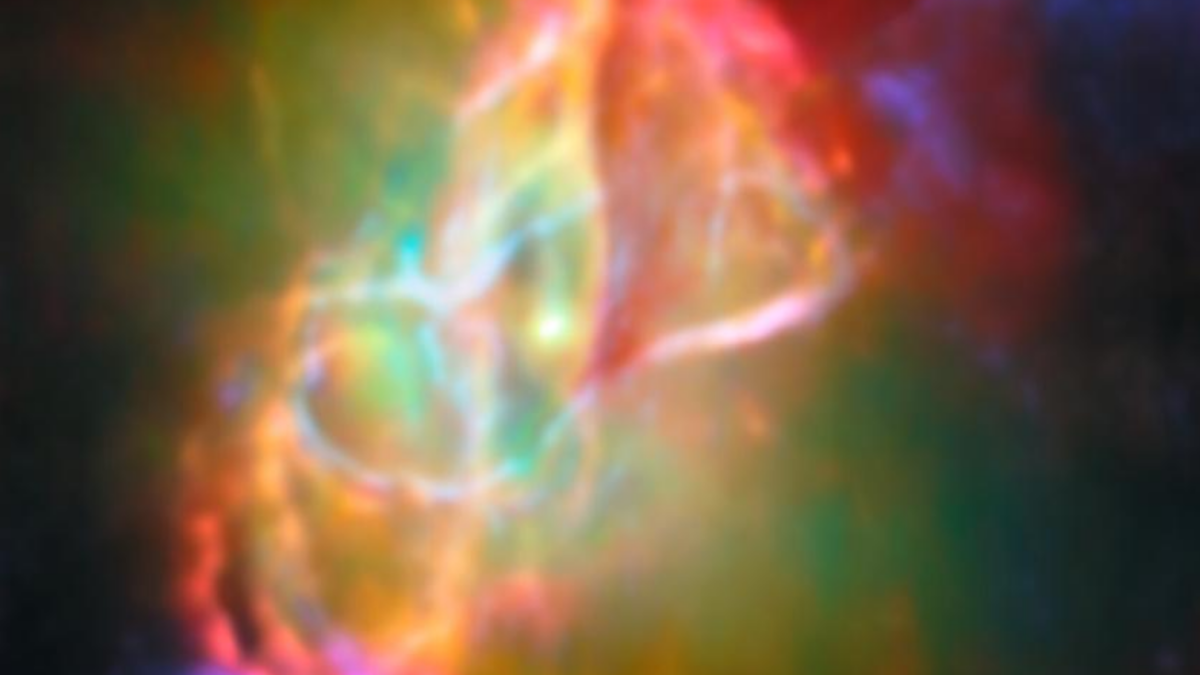
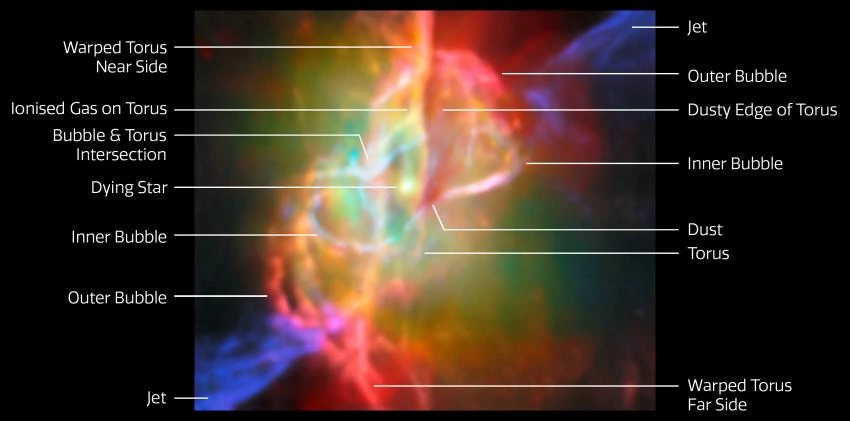
This image, combining James Webb Space Telescope infrared data with ALMA submillimeter observations, shows the Butterfly Nebula’s central star surrounded by a vertical doughnut-shaped torus, bright red helium and neon gas bubbles, and opposing jets of ionised iron. Credit: ESA/Webb, NASA & CSA, M. Matsuura, ALMA (ESO/NAOJ/NRAO), N. Hirano, M. Zamani (ESA/Webb)
Researchers published the most detailed infrared and submillimter view to date of the planetary nebula NGC 6302, also known as the Butterfly Nebula, using the James Webb Space Telescope (JWST) and the Atacama Large Millimeter/submillimeter Array (ALMA) on August 27. The study revealed crystalline silicate dust grains, polycyclic aromatic hydrocarbons (PAHs), and nested ionized structures around the nebula’s central star.
The nebula’s central star has an estimated surface temperature of 220 000 K, making it one of the hottest planetary nebula nuclei in the Milky Way. The JWST Mid-Infrared Instrument (MIRI) spectroscopic data resolved nearly 200 atomic and molecular emission lines, mapping ionization structures and dust chemistry within the inner regions of the nebula.
At the center, a dense torus of gas and dust surrounds the obscured star. Webb data confirm that the torus contains crystalline silicates such as quartz as well as irregularly shaped dust grains. Grain sizes, on the order of 1 µm (0.00004 inches), suggest that the material has been processed over long timescales.
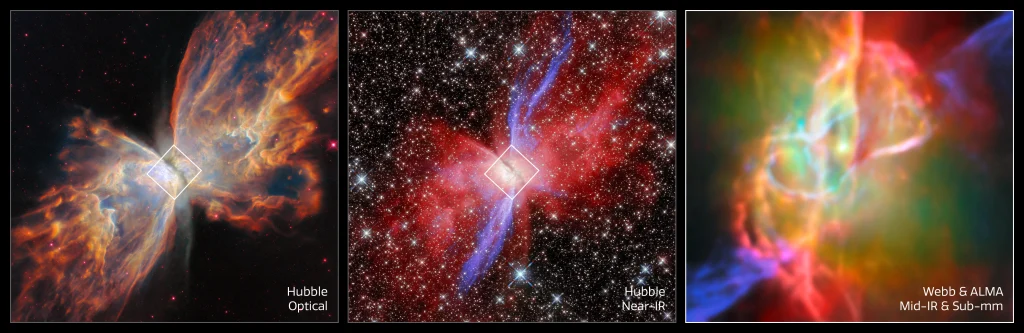
Jets traced by iron and nickel ions extend outward from the torus in opposite directions. Emission lines reveal stratification, with highly ionized species such as magnesium and silicon confined close to the central star, while lower-energy ions such as hydrogen dominate at larger distances.
The detection of PAHs in this environment is particularly notable. PAHs typically form in carbon-rich regions, while NGC 6302 shows an oxygen-rich chemistry. Their presence suggests that they formed when stellar winds created shocks in the surrounding gas. This may represent the first evidence of PAH formation in an oxygen-rich planetary nebula.
Planetary nebulae form when stars between 0.8 and 8 solar masses shed their outer layers during the late asymptotic giant branch (AGB) phase. The ejected gas and dust, irradiated by the hot remnant core, produce the visible nebula. NGC 6302 is a bipolar planetary nebula, with two lobes extending in opposite directions and a dusty equatorial torus forming the “body” of the butterfly.
The nebula’s wings span over 2.1 parsecs (6.8 light-years), with expansion dating the bipolar outflows to about 2 250 years ago, following the earlier ejection of the torus. Multiple later mass ejections suggest a dynamic, possibly binary-driven history.
The JWST and ALMA observations provide the first spatially resolved map of PAH and crystalline silicate distribution in NGC 6302. Researchers argue that the results represent a major step forward in understanding the origin of cosmic dust material that ultimately contributes to the formation of rocky planets such as Earth.
References:
1 The JWST/MIRI view of the planetary nebula NGC 6302 – I. A UV-irradiated torus and a hot bubble triggering PAH formation – Matsuura, M. et al. -Monthly Notices of the Royal Astronomical Society – August 27, 2025 – https://doi.org/10.1093/mnras/staf1194
2 Cosmic butterfly reveals clues to Earth’s creation – RAS – August 27, 2025

I’m a science journalist and researcher at The Watchers, contributing to the Epicenter edition, where I cover peer-reviewed scientific research and emerging discoveries across Earth and space sciences. With a background in astronomy and a passion for environmental science, I’ve worked in shark and coral conservation in Fiji, conducting reef and shark-behavior research, contributing to mangrove restoration, and earning PADI Open Water and Coral Reef Certifications. I bring a blend of scientific rigor and storytelling to illuminate the discoveries shaping our planet and beyond.

Commenting rules and guidelines
We value the thoughts and opinions of our readers and welcome healthy discussions on our website. In order to maintain a respectful and positive community, we ask that all commenters follow these rules.