
Aseismic slip and seismic swarms preceding Taiwan’s 2024 M7.3 Hualien earthquake
Years before the ground shook across eastern Taiwan, the faults beneath Hualien were already in motion. A new study in Nature Communications shows that deep aseismic slip and migrating fluids quietly increased stress by about 30 kilopascals before the April 3, 2024 M7.3 Hualien earthquake, revealing how silent deformation can set the stage for disaster.

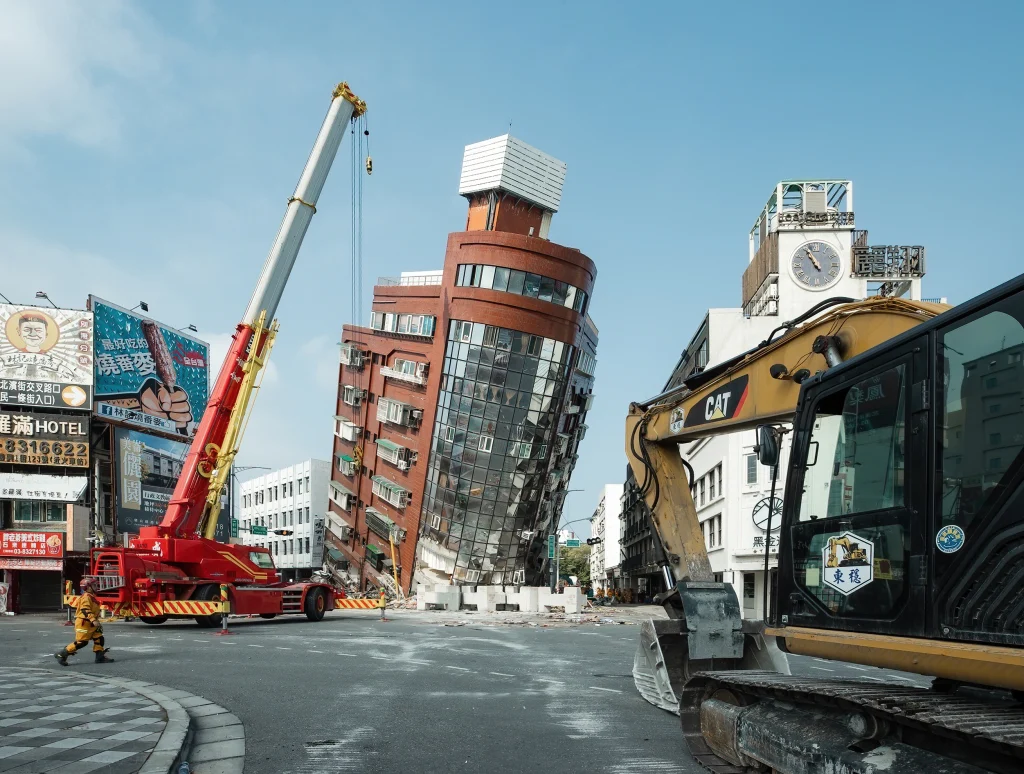
Rescuers at the Uranus Building in Hualien City. Credit: Military News Agency
Eastern Taiwan lies where the Eurasian and Philippine Sea plates collide, compressing the crust at roughly 70 mm (2.8 inches) per year. The Longitudinal Valley marks this collision, containing two opposing faults: the east-dipping Longitudinal Valley Fault (LVF) and the west-dipping Central Range Fault (CRF). Since 2000, more than a dozen earthquakes above magnitude 6 have ruptured along this zone.
For decades, repeating micro-earthquakes have shown that parts of the faults slip steadily even when the ground above appears still. These events, nearly identical in waveform and location, reveal patches that creep quietly between larger quakes. Between 2000 and 2024, scientists recorded 1 499 such events in 148 clusters, indicating that the CRF in northern Taiwan moves continuously at depths of 10–25 km (6–15 miles).
By 2019, the rate of these repeating events began to accelerate. GNSS instruments recorded subtle ground shifts, implying that stress was building more quickly. In 2021, seismic swarms erupted along the CRF, marking the first clear sign that deeper slip was influencing the brittle crust.
Taken together, the data pointed to a years-long loading process. The April 2024 mainshock was not a sudden event but the result of long-term, nearly invisible motion deep within the fault system.
Fluids on the move and rocks starting to slide
In 2021, the crust beneath Hualien entered an extraordinary phase. Over four months, nearly 800 small earthquakes occurred at depths between 5–22 km (3–14 miles), migrating upward and downward in a pattern typical of fluid movement through fractured rock.
Analysis of the swarm’s spread indicated a hydraulic diffusivity near 5.4 m²/s, one of the fastest rates measured in any tectonic setting. Such rapid migration implies that fluids were flowing through open fractures, possibly driven by slow slip on nearby fault patches.
At the same time, clusters of repeating earthquakes at 15–25 km (9–16 miles) depth accelerated. GNSS stations measured eastward displacements up to 20 mm (0.8 inches), too large to be explained by the swarm’s small quakes alone. The crust was deforming aseismically while fluids advanced upward through the fault.
Rising pore pressure lowers the friction that locks faults together, allowing steady creep to spread. That slip then opens new paths for the fluids, creating a feedback loop of pressure, movement, and weakening that can persist for months or years.
The chain reaction toward a major quake
The lead-up to the 2024 Hualien event developed in four stages, each linking deep creep with bursts of seismicity.
From April to August 2021, the CRF’s deep sections accelerated their slip while the long-lasting swarm shook the mid-crust. Ground stations tracked eastward shifts of 10–20 mm (0.4–0.8 inches), confirming that multiple fault levels were moving together.
In 2022, three major earthquakes followed in sequence: M6.7 in March, M6.1 in June, and M7.0 in September. Each altered the stress field along the suture zone. While some areas relaxed, others, especially near Hualien, grew more stressed, loading the segment that would later rupture.
By late 2022, repeating earthquakes and moment release rates increased again. Shallow seismicity grew through 2023, with a greater share of small events signaling mechanical fatigue. The crust was fracturing more often but had not yet failed.
In early 2024, deep slip, shallow fracturing, and lingering high pore pressure aligned. When rupture began 21 km (13 miles) below Hualien, the accumulated stress and fluid pressure drove a powerful release along the LVF. Within weeks, a new swarm appeared, proving that the loading cycle had already resumed.
Stress stored in silence
Scientists used Coulomb stress modeling to calculate how each slow-slip episode changed the surrounding crust. When one segment of a fault moves, it redistributes stress in the surrounding area. Positive stress promotes failure, while negative stress delays it.
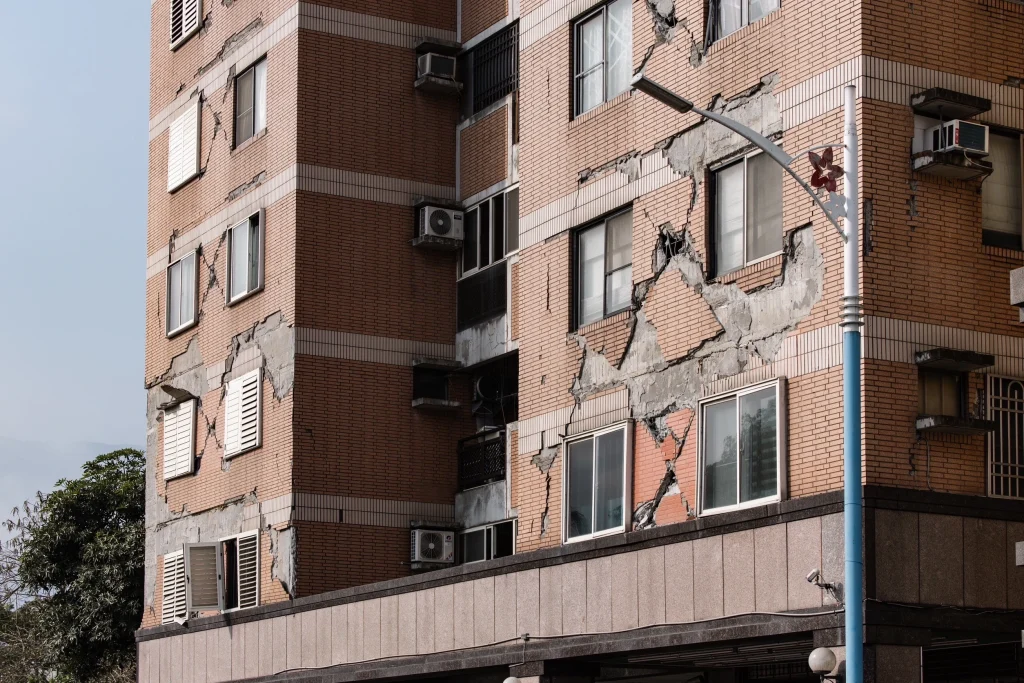
The 2021 swarm and its associated slow slip increased stress by about 10 kPa on the fault patch, which later produced the 2022 M6.1 quake. Successive events added further increments. By early 2024, cumulative aseismic and seismic activity had increased stress on the Hualien rupture plane by roughly 30 kPa.
A change of this size is significant. Laboratory studies show that an additional 10 kPa can advance a large earthquake’s timing by years. In Hualien, creeping motion and fluid migration appear to have pushed the locked segment closer to failure far sooner than tectonic loading alone would have done.
The highest stress accumulated where the creeping CRF meets the locked LVF a mechanical transition that finally gave way in April 2024. The quake’s true origin lay in that slow and silent transfer of stress through the crust.
Fluids shaping fault behavior
The fluids that helped weaken the fault likely originated deep within the Philippine Sea Plate as it slid beneath Taiwan. At depths of 15–25 km (9–16 miles), metamorphic dehydration releases water that rises through fractures, carrying heat and minerals.
Seismic imaging shows high Vp/Vs ratios and low resistivity in the region, signatures of fluid-filled rock. Low-frequency earthquakes detected during the 2021 swarm confirm that fluid flow was active at depth. Such tremor-like signals usually mark the boundary between creeping and brittle fault zones.
Fluids alter stress distribution and encourage both swarms and aseismic slip. In Hualien, they linked deep and shallow fault segments into one continuous system, erasing the line between locked and creeping regions. The measured diffusivity suggests a highly permeable fault acting like a conduit between deep metamorphic sources and the brittle upper crust.
Over time, that flow weakened the rock column and primed the upper fault for rupture, showing how water movement can transform a stable boundary into a seismically active one.
Global lessons from Taiwan’s slow countdown
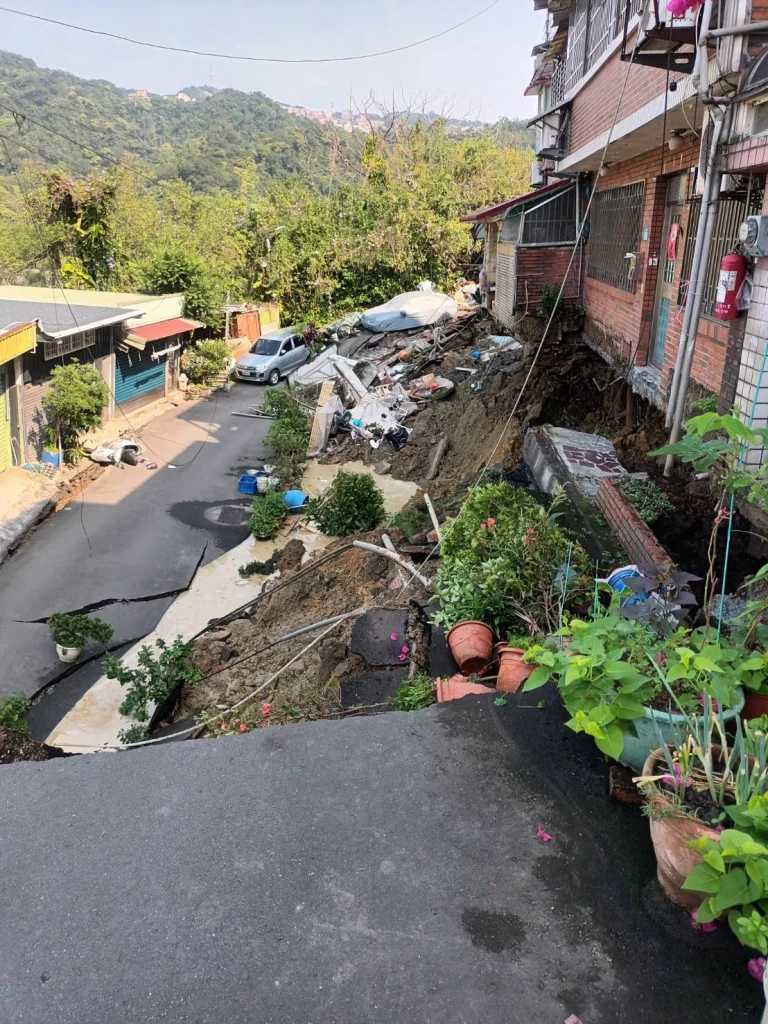
The Hualien sequence now ranks among the clearest examples of an aseismic prelude to a major continental quake. Comparable behavior has been documented before the 2023 M7.7 Noto Peninsula earthquake in Japan, in northern Chile’s subduction zones, and along New Zealand’s Hikurangi margin. The coupling of slow slip, fluid migration, and swarms is emerging as a universal feature of active plate boundaries.
Taiwan’s case is unique because it occurs in a collisional setting rather than a pure subduction trench. The opposing dips of the LVF and CRF create a complex stress environment where a small change in load can trigger wide-scale adjustment. This geometry amplifies the influence of creeping motion and fluid pressure.
For hazard assessment, the study shows that changes in repeating earthquake frequency, swarm activity, and GNSS motion can serve as early indicators of evolving stress. When multiple signals rise together, accelerating slip rates, transient surface deformation, and shallow seismic clustering, they point to a fault approaching a critical state.
While precise prediction remains out of reach, monitoring such trends can define periods of elevated hazard and guide emergency readiness. The 2024 Hualien event shows that large earthquakes are rarely sudden; they grow slowly in the dark, driven by processes that instruments are only beginning to see.
References:
1 Aseismic slip and seismic swarms leading up to the 2024 M7.3 Hualien earthquake – Wei Peng et al. – Nature Communications – October 13, 2025 – https://doi.org/10.1038/s41467-025-64117-3 – OPEN ACCESS

I’m a science journalist and researcher at The Watchers, contributing to the Epicenter edition, where I cover peer-reviewed scientific research and emerging discoveries across Earth and space sciences. With a background in astronomy and a passion for environmental science, I’ve worked in shark and coral conservation in Fiji, conducting reef and shark-behavior research, contributing to mangrove restoration, and earning PADI Open Water and Coral Reef Certifications. I bring a blend of scientific rigor and storytelling to illuminate the discoveries shaping our planet and beyond.

Myanmar vs Taiwan, Taiwan atleast gathers such data, though may not be transparent to layperson, citizen science in Taiwan is likely very underdeveloped, i.e. no public facing framework or web interface. BUT Myanmar, I don’t think they even bother to collect such technical data.
All very technical, eye opening, but I’m not qualified to judge how this level of detail on this topic. However, transparency beats “stay silent, don’t scare the sheep”, even if it is high technical information that could have garbage data issues. At minimum, maybe someone can eyeball it. I’d imagine volcanoes such as Kilauea also have parallel concepts in water dynamics contributing to pressure, and I would not be surprised if water itself is instrumental in supervolcano development. In case of landslide in Taiwan this month, it was a known hazard weeks before deadly event occurred, but again, nobody spoke up.