
Ancient magma chamber fueled Japan’s 2024 Noto earthquake
A solidified magma body formed about 15 million years ago beneath Japan’s Noto Peninsula may have intensified the M7.6 earthquake that struck the region at 16:10 JST (07:10 UTC) on January 1, 2024, according to a Science Advances study by Tohoku University. The ancient magma appears to have trapped stress below the crust until its failure triggered one of Japan’s strongest inland quakes in decades.
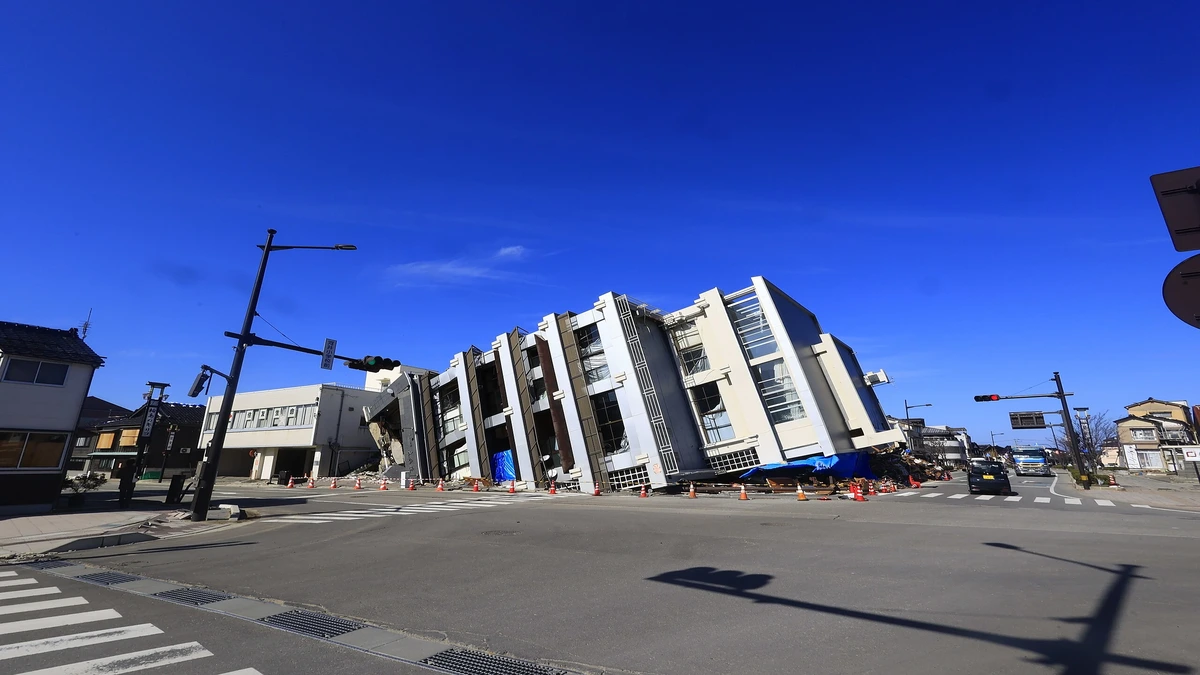
Collapsed building in Wajima City. Credit: Araisyohei
A buried relic of fire shaped Japan’s strongest inland quake in decades
A dense block of ancient magma, frozen beneath Japan’s Noto Peninsula, may have played a crucial role in amplifying the M7.6 earthquake that struck on January 1, 2024. Researchers from Tohoku University report that the hard, 15-million-year-old rock acted as both a stress trap and a rupture barrier, focusing energy into brittle crust above it.
The earthquake occurred at 16:10 Japan Standard Time (07:10 UTC) and reached the Japan Meteorological Agency’s maximum intensity level of Shindo 7. The JMA measured a local magnitude (Mj) of 7.6 and a depth of 16 km (10 miles), while moment-magnitude estimates place it near Mw 7.5.
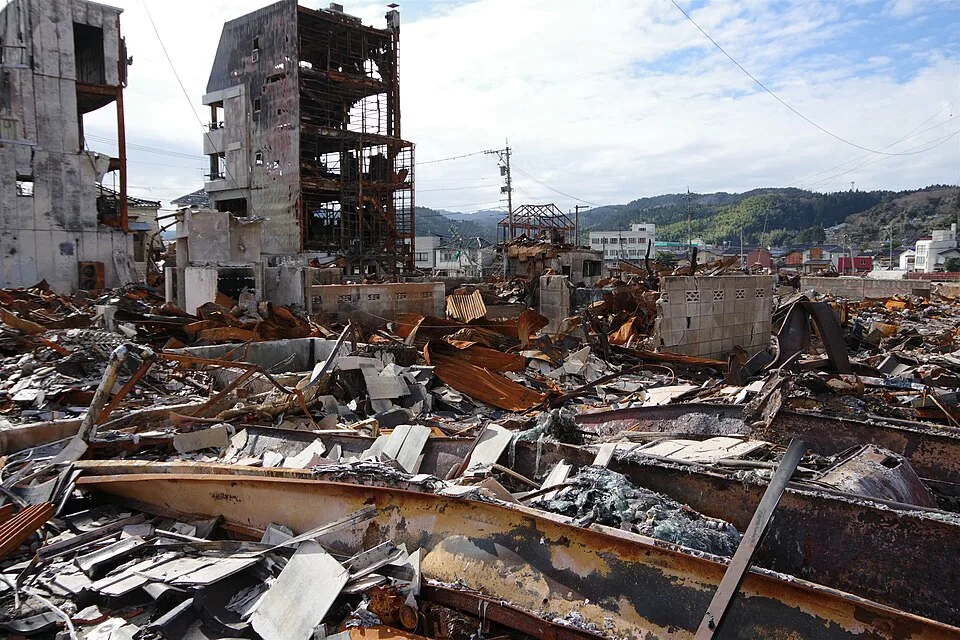
More than 1 200 buildings were damaged and parts of the coast rose by about 1 m (3.3 feet), making it one of Japan’s most destructive inland quakes in recent memory. Yet the region, known for quiet hills and hot springs, is far from any active volcano or major plate boundary, leaving scientists searching for a deeper cause.
The new study, published in Science Advances in October 2025, proposes that the hidden magma body—once molten and now a block of dense crystalline rock—was the missing piece. According to seismic imaging, it lies directly beneath the fault system that ruptured, extending roughly 10–15 km (6–9 miles) wide and down to about 15 km (9 miles) below ground.
Imaging the invisible: how scientists found the buried magma
To investigate the quake’s origins, the team used advanced 3-D seismic tomography combined with Japan’s dense earthquake monitoring network. The data revealed an unusually high-velocity zone beneath the rupture area, where seismic waves travel significantly faster than in the surrounding crust.
Such high velocities typically indicate compact, igneous material rather than loose sediments. The researchers concluded that this structure represents a Miocene-age magma intrusion that cooled and hardened during a period of intense volcanic activity around 15 million years ago, when the Sea of Japan was opening.
The tomography images show that this ancient magma body has remained intact and extremely rigid. Unlike the fractured rocks surrounding it, the body resists deformation and fluid movement. That rigidity allows it to store stress for long periods, creating the perfect conditions for sudden release once its edges fail.
Aftershock maps confirm this relationship. Clusters of smaller quakes outline the margins of the high-velocity zone, suggesting that the mainshock ruptured along its boundary and then propagated outward into weaker crust. The geometry matches both the rupture plane of the main event and the later aftershock distribution determined by Japan’s national seismic network.
The three-year swarm that foreshadowed disaster
Before the 2024 mainshock, the region had been restless for years. Starting in late 2019, the northeastern Noto Peninsula experienced an earthquake swarm that produced more than 10 000 small tremors. The activity gradually migrated upward from about 15 km (9 miles) to 5 km (3 miles) depth.
Geophysicists had suspected the swarm was driven by deep crustal fluids rising from the lower crust or mantle. Each minor quake was a small adjustment as these fluids tried to escape through fractures. But the swarm repeatedly stalled at one particular depth—the same depth where the hardened magma body sits.
The new analysis connects these dots. The magma body appears to have acted as a hydraulic and mechanical barrier, blocking the fluid pathway. Pressure built up below it, much like water pressing against a dam. Over three years, stress accumulated around the barrier’s edges until it could no longer contain the forces.
When the edge of the magma body finally ruptured on January 1 2024, it released the stored stress in a single violent burst. The failure triggered cascading fault slips that propagated through brittle crust, producing the large-magnitude quake observed at the surface.
Ancient magma and modern stress: how geology remembers
The Noto Peninsula today shows no active volcanism, but geological records reveal that the region was once a magmatic corridor. Around 15 million years ago, the back-arc extension of the Sea of Japan produced widespread volcanic and plutonic activity across northern Honshu.
When that volcanic system cooled, it left behind bodies of dense igneous rock encased in sedimentary crust. Over geological time, tectonic compression replaced extension, turning these once-melted zones into stiff inclusions that deform differently from their surroundings.
These contrasts can trap stress and modify fault behavior. In the Noto case, the presence of a strong, impermeable magma block altered how fluids and strain accumulated, delaying rupture but intensifying its eventual release. The researchers note that such fossil magma bodies are not rare, yet their seismic role is often overlooked.
Understanding this long-term memory of the crust can reshape how scientists assess earthquake hazards. Even in areas far from active volcanoes, remnants of ancient magmatism may still influence when and how major quakes occur.
Why this discovery matters for hazard science
Recognizing the role of hardened magma bodies could transform seismic risk analysis in Japan and other intraplate regions. Traditional models focus on fault geometry and regional stress, but rarely include variations in crustal composition.
If old magma intrusions can act as stress traps, their identification becomes vital. High-velocity anomalies, detected through seismic or magnetotelluric surveys, could mark hidden zones where large earthquakes are more likely. Integrating such data into hazard maps would allow engineers and planners to refine building codes and land-use guidelines.
The three-year swarm that preceded the Noto event also offers a practical lesson. Persistent seismic swarms that repeatedly stall at fixed depths might indicate blocked fluid pathways, serving as early-warning signals for future mainshocks. Improved swarm monitoring, paired with subsurface imaging, could one day provide more reliable forecasts.
Globally, the same principle may apply in Italy, Iceland, or East Africa, where extinct volcanic systems underlie active fault zones. By linking geological history with modern geophysics, scientists can better predict where the Earth’s deep memory might next resurface.
Unanswered questions and next steps
While the evidence for a high-velocity magma body beneath Noto is strong, several uncertainties remain. The structure’s exact shape and composition are inferred from seismic data, not confirmed by drilling. Future borehole sampling or magnetotelluric imaging could refine its geometry and physical properties.
The role of fluids also remains partly speculative. Though swarm migration and ground uplift suggest fluid movement, direct geochemical sampling is still lacking. Determining the fluid sources and pressures would help clarify how they interact with rigid magma bodies.
Another question concerns causation. The study proposes that rupture of the magma body contributed to the mainshock, but regional tectonic compression alone could have eventually produced a large quake. The magma body likely intensified the event rather than causing it outright.
Researchers plan to continue monitoring post-seismic deformation and gas emissions around the peninsula. Any long-term uplift or gas anomalies could provide additional evidence of fluid redistribution after the barrier’s failure.
A deeper look into Earth’s memory
The 2024 Noto Peninsula earthquake reveals how the planet’s ancient volcanic architecture still shapes modern seismic behavior. What once was molten fire beneath the Miocene crust now governs how that crust breaks.
For scientists, this discovery is a reminder that the Earth does not easily forget. Its hardened magma, cooled for millions of years, still holds the power to reshape the surface in an instant. Understanding these hidden interactions between ancient rock and present stress may be the key to forecasting future disasters more accurately.
References:
1 Rupture of solidified ancient magma that impeded preceding swarm migrations led to the 2024 Noto earthquake – Ryota Takagi et al. – Science Advances- October 15, 2025- DOI: 10.1126/sciadv.adv5938 – OPEN ACCESS

I’m a science journalist and researcher at The Watchers, contributing to the Epicenter edition, where I cover peer-reviewed scientific research and emerging discoveries across Earth and space sciences. With a background in astronomy and a passion for environmental science, I’ve worked in shark and coral conservation in Fiji, conducting reef and shark-behavior research, contributing to mangrove restoration, and earning PADI Open Water and Coral Reef Certifications. I bring a blend of scientific rigor and storytelling to illuminate the discoveries shaping our planet and beyond.

Commenting rules and guidelines
We value the thoughts and opinions of our readers and welcome healthy discussions on our website. In order to maintain a respectful and positive community, we ask that all commenters follow these rules.