
Ancient asteroid debris detected deep within Mars’ mantle
NASA’s InSight mission data revealed kilometer-scale lumps of rocky debris scattered throughout Mars’ mantle, findings published in Science on August 28, 2025 show. The fragments, likely remnants of massive asteroid impacts 4.5 billion years ago, indicate sluggish interior mixing compared to Earth.
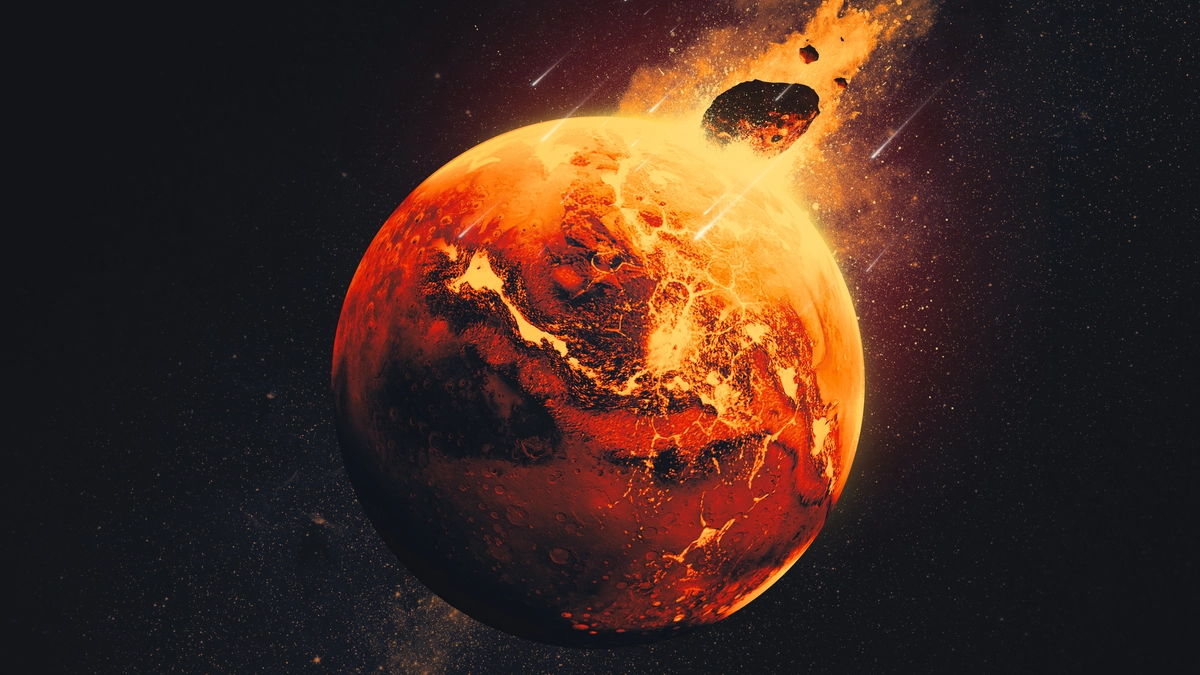
Scientists believe giant impacts — like the one depicted in this artist’s concept — occurred on Mars 4.5 billion years ago, injecting debris from the impact deep into the planet’s mantle. NASA’s InSight lander detected this debris before the mission’s end in 2022. Credit: NASA/JPL-Caltech
Seismic analysis of marsquakes recorded by NASA’s InSight lander has revealed heterogeneities throughout Mars’ mantle, according to a study published in Science on August 28, 2025. The lumps, some as large as 4 km (2.5 miles), are interpreted as remnants of early solar system impacts preserved in the interior due to the planet’s lack of plate tectonics.
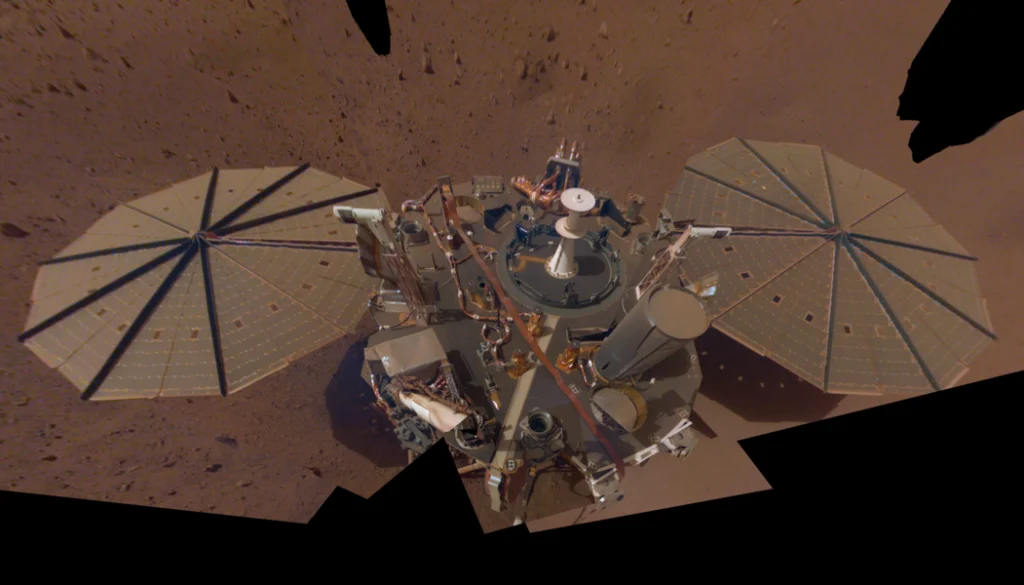
The InSight lander, which operated from 2018 until its end of mission in 2022, deployed the first seismometer on the Martian surface. Over four years, it detected 1 319 seismic events, enabling scientists to study the planet’s crust, mantle, and core.
Researchers identified eight marsquakes whose high-frequency seismic waves were significantly delayed while traveling through the mantle. Planet-scale computer simulations showed the distortions occurred only when waves passed through small, localized regions of material with a composition distinct from the surrounding mantle.
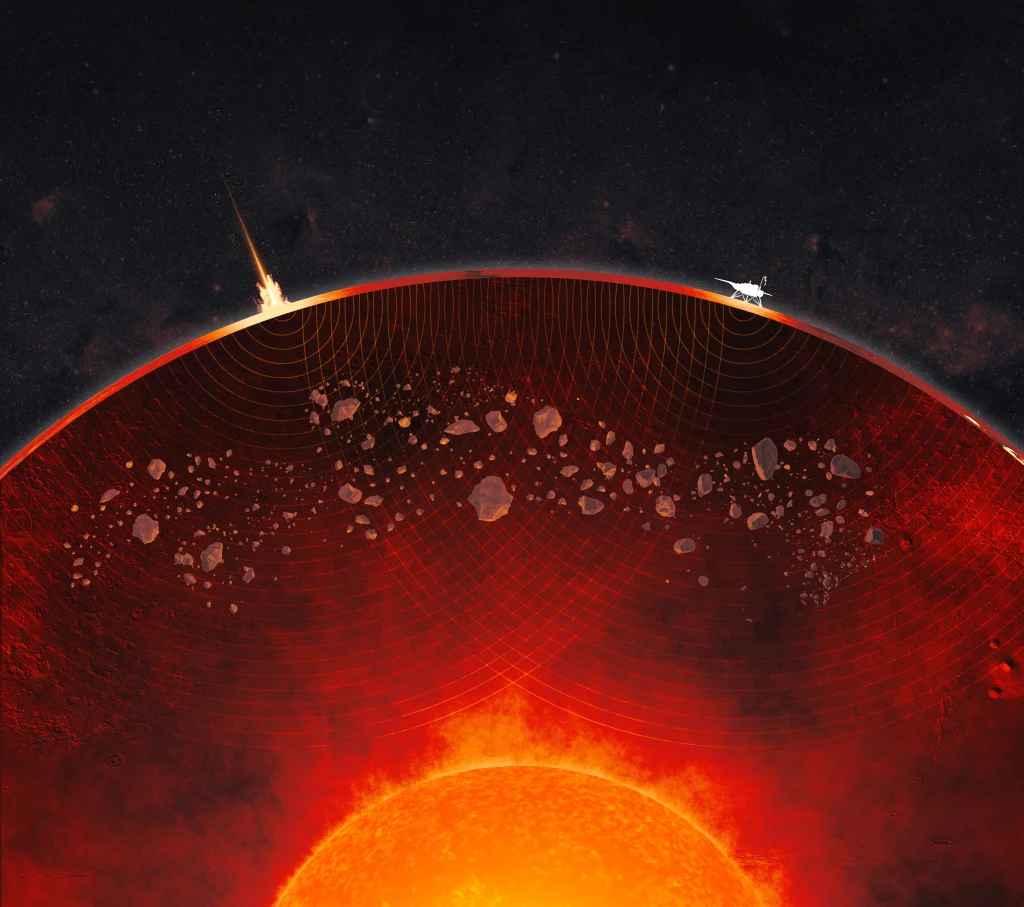
“We’ve never seen the inside of a planet in such fine detail and clarity before,” said lead author Constantinos Charalambous of Imperial College London. “What we’re seeing is a mantle studded with ancient fragments. Their survival to this day tells us Mars’ mantle has evolved sluggishly over billions of years.”
Mars’ mantle extends to a depth of up to 1 550 km (960 miles) beneath the crust and reaches temperatures of about 1 500°C (2 732°F). Unlike Earth, where plate tectonics drives vigorous convection, Mars’ single-plate structure allows for far less mixing of interior material. This has preserved kilometer-scale heterogeneities, described in the study as remnants of the planet’s violent early history.
The fragments are thought to have been emplaced during massive collisions about 4.5 billion years ago. These impacts released enough energy to melt large portions of crust and mantle into global magma oceans, simultaneously injecting asteroid material and Martian debris deep into the interior. The resulting pattern, compared by Charalambous to shattered glass, includes both large fragments and numerous smaller ones.
The study further constrains the rheology of Mars’ mantle, indicating high viscosity, pascal-seconds and low temperature dependence, with deformation occurring through dislocation creep. These values suggest limited convection and mixing since early planetary formation.
On Earth, mantle heterogeneities of this kind would have been erased by billions of years of tectonic recycling. The persistence of such features on Mars provides evidence of a primitive interior evolution, one that may be comparable to conditions on other tectonically inactive planets such as Venus and Mercury.
InSight was managed by NASA’s Jet Propulsion Laboratory for the agency’s Science Mission Directorate. The mission was part of NASA’s Discovery Program, with international contributions from France’s National Centre for Space Studies (CNES), the German Aerospace Center (DLR), the Swiss Federal Institute of Technology (ETH Zurich), the Max Planck Institute for Solar System Research, Imperial College London, Oxford University, and other partners.

References:
1 NASA Marsquake Data Reveals Lumpy Nature of Red Planet’s Interior – NASA – August 28. 2025

I’m a science journalist and researcher at The Watchers, contributing to the Epicenter edition, where I cover peer-reviewed scientific research and emerging discoveries across Earth and space sciences. With a background in astronomy and a passion for environmental science, I’ve worked in shark and coral conservation in Fiji, conducting reef and shark-behavior research, contributing to mangrove restoration, and earning PADI Open Water and Coral Reef Certifications. I bring a blend of scientific rigor and storytelling to illuminate the discoveries shaping our planet and beyond.

Commenting rules and guidelines
We value the thoughts and opinions of our readers and welcome healthy discussions on our website. In order to maintain a respectful and positive community, we ask that all commenters follow these rules.