
2024 M7.4 Chile quake reveals hidden mechanism that amplifies earthquake power
A study published recently in Nature Communications shows that the 2024 M7.4 Calama earthquake in northern Chile ruptured deeper than expected, breaking through thermal limits once thought to prevent seismic rupture and revealing a new process that can intensify deep earthquakes.
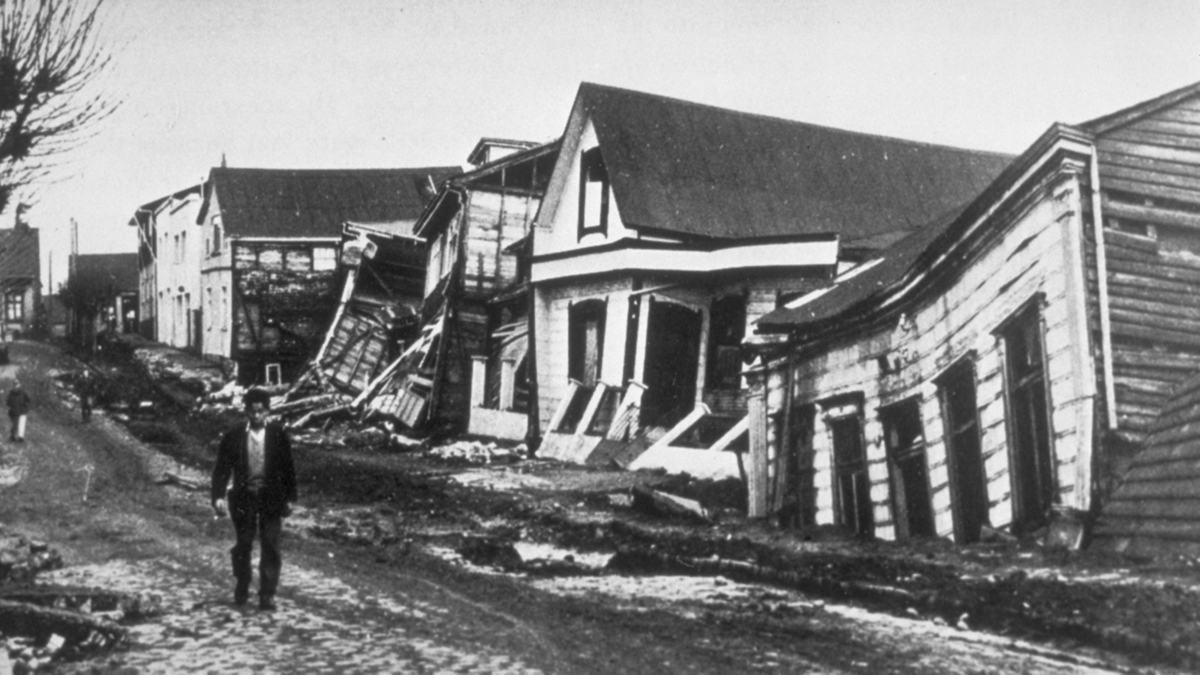
Earthquake damage to good quality, wood-frame houses in Valdivia, Chile, 1960. Credit: Pierre St. Amand - NGDC
A deep M7.4 earthquake struck near Calama in northern Chile on July 19, 2024, damaging buildings and cutting power across the Antofagasta region. Chile is no stranger to large quakes, including the record-breaking M9.5 Valdivia event in 1960, but this one stood out for a different reason.
Instead of rupturing near the plate boundary, where most destructive quakes begin, the Calama event originated deep within the subducting Nazca Plate, about 125 km (78 miles) below the surface. Earthquakes at these depths are known as intermediate-depth events and usually cause weaker shaking because their energy dissipates as it travels upward.
In Calama’s case, however, seismic waves were unusually strong for such depth. The event released energy far beyond what models predicted. Researchers began investigating why a deep intraslab quake could act like a shallower one.
Their results pointed to something unexpected: the rupture extended nearly 50 km (31 miles) deeper than the normal brittle zone, breaking into layers where temperatures exceeded 1 000°C (1 832°F). Such extreme heat should make rock behave like soft plastic, not brittle glass. Yet Calama’s rupture continued, suggesting that new physics was at work.
When heat becomes fuel for an earthquake
The classical explanation for intermediate-depth earthquakes involves dehydration embrittlement. As an oceanic plate sinks into the mantle, water stored in minerals such as serpentine is released by rising temperature and pressure. The freed fluid weakens the surrounding rock, allowing it to crack. But this process typically stops around 650°C (1 200°F).
The Calama study revealed that something else took over once that threshold was crossed. The rupture started through dehydration embrittlement in the colder, wetter part of the slab, then transitioned into another process known as thermal runaway. This occurs when friction from sliding generates heat faster than it can escape, softening the fault and speeding up the rupture in a feedback loop.
The team found that as the rupture descended, it crossed the boundary and moved into hotter zones reaching 900–1 000°C (1 652–1 832°F). Despite the intense temperature, the rupture accelerated downward at about 4.2 km/s (2.6 mi/s), roughly 93% of the local shear-wave velocity.
That speed is near the limit of stability, where ruptures can become unstable or “supershear.” Yet the Calama event remained coherent, a sign that thermal and compositional contrasts in the slab may have helped sustain the runaway slip.
Mapping the rupture deep inside the Earth
To understand how such a deep rupture evolved, researchers analyzed data from 47 Chilean seismic stations and 54 global stations. They detected five subevents that together unfolded over roughly 20 seconds. The first subevent, equivalent to M6.6, began at about 125 km (78 miles). The rupture then cascaded through four deeper stages, reaching nearly 175 km (109 miles).
This vertical sequence extended over 50 km (31 miles), while the horizontal spread remained only about 25 km (16 miles). The rupture moved steeply eastward along a fault plane dipping 71°, cutting through the descending slab like a vertical scar.
Global Navigation Satellite System (GNSS) data recorded horizontal displacements of about 1 cm (0.4 inch) and vertical movements up to 20 cm (8 inches) over distances greater than 250 km (155 miles). These ground deformations confirmed that the fault slipped efficiently and deeply.
Most of the earthquake’s energy came from the later, deeper subevents, which together accounted for nearly 80 percent of the total seismic moment. In contrast, the earlier and shallower phases produced more aftershocks, suggesting that the deeper stages released stress more completely through the runaway heating process.
Two mechanisms in one event
Calama marks the first documented case where an intermediate-depth earthquake clearly transitioned between two mechanisms. It began with dehydration embrittlement, which provided the initial weakening, and then switched to shear thermal runaway, which sustained rapid slip through hotter, ductile rock.
This combination helps explain why the rupture extended so deep. It also connects intermediate-depth earthquakes to even deeper ones that occur at 300–700 km (186–435 miles), where runaway heating from mineral transformations drives failure. Calama shows that a similar process can occur at shallower depths without the need for phase changes, provided the stress and heat buildup are sufficient.
By linking brittle and thermal faulting regimes, the event expands the known limits of how and where earthquakes can happen inside Earth’s slabs. It challenges the assumption that high-temperature zones are aseismic and shows that once slip begins, heat itself can become the driving energy source.
This insight will likely change how scientists calculate the potential size and depth of future intraslab events, especially in tectonic regions with similar conditions to Chile.
Reassessing seismic hazard in subduction zones
Intermediate-depth earthquakes have often been viewed as less destructive than shallow megathrust events, but history proves otherwise. The 1939 Chillán earthquake, which struck at a similar depth, caused thousands of deaths and widespread destruction. Calama reinforces that deep quakes can still deliver strong shaking.
If thermal runaway can extend ruptures by tens of kilometers, then the potential magnitude of intermediate-depth events may be underestimated in current hazard models. This has implications for many subduction zones worldwide, including those beneath Japan, Mexico, and Indonesia, where the thermal structure of the subducting plate is similar to Chile’s.
Understanding this mechanism could lead to better risk assessments and improved early warning systems. The University of Texas and Chilean teams have already begun deploying more broadband seismometers and GNSS instruments in northern Chile to monitor crustal movement and detect future deep events with greater precision.
These efforts aim to test whether the Calama mechanism is unique or part of a broader pattern that might influence how strong future earthquakes could become in similar settings.
Stress, structure, and the anatomy of the Nazca slab
The Nazca Plate moves beneath South America at about 7 cm (2.8 inches) per year. Within it, scientists have identified two seismic layers known as the double seismic zone. The Calama rupture occurred in the lower of these zones, where compression dominates due to slab bending and internal heating.
Waveform analysis revealed that the fault contained several small high-stress patches known as asperities. These asperities ruptured in sequence, each triggering the next and releasing pulses of seismic energy. The cascading pattern produced bursts of motion similar to what happens in supershear ruptures observed in shallower faults.
This pulsed behavior may explain why the rupture remained energetic over such a large depth range. Rather than sliding steadily, the fault slipped in stages, each one feeding the next. Such dynamic interactions between asperities had rarely been observed in deep earthquakes before Calama.
The findings also show how differences in mineral composition and hydration affect seismic behavior. Variations in grain size and water content may determine whether a patch of rock resists rupture or becomes a trigger for runaway slip. Future studies aim to map these variations more precisely to understand how stress builds and releases inside subducting slabs.
A new limit for Earth’s internal physics
The 2024 Calama earthquake has redefined the physical boundaries of earthquake generation. It demonstrated that under the right mix of stress, heat, and mineral structure, even regions once believed too warm to fracture can produce powerful ruptures.
This discovery challenges long-held assumptions about the depth limit for earthquakes and reveals that temperature alone does not control where rocks break. Instead, it is the balance between stress accumulation, fluid presence, and thermal feedback that governs when failure occurs.
By crossing from a cold, brittle zone into a hot, ductile one, Calama provided a rare natural experiment in how mechanical and thermal processes merge. It also offers new clues for understanding plate tectonics, mantle behavior, and the deep transfer of energy through Earth’s interior.
Thorsten Becker from the University of Texas said that every new event gives us a better sense of how the planet works deep down and also shows how much we still have left to figure out.
References:
1 Deep intra-slab rupture and mechanism transition of the 2024 Mw 7.4 Calama earthquake – Zhe Jia et al. – Nature Communications – August 30, 2025 – https://doi.org/10.1038/s41467-025-63480-5 – OPEN ACCESS
2 Researchers Discover Mechanism That Can Ramp Up Magnitude of Certain Earthquakes – Texas Geosciences – September 29, 2025

I’m a science journalist and researcher at The Watchers, contributing to the Epicenter edition, where I cover peer-reviewed scientific research and emerging discoveries across Earth and space sciences. With a background in astronomy and a passion for environmental science, I’ve worked in shark and coral conservation in Fiji, conducting reef and shark-behavior research, contributing to mangrove restoration, and earning PADI Open Water and Coral Reef Certifications. I bring a blend of scientific rigor and storytelling to illuminate the discoveries shaping our planet and beyond.

Commenting rules and guidelines
We value the thoughts and opinions of our readers and welcome healthy discussions on our website. In order to maintain a respectful and positive community, we ask that all commenters follow these rules.