• Galactic magnetic fields

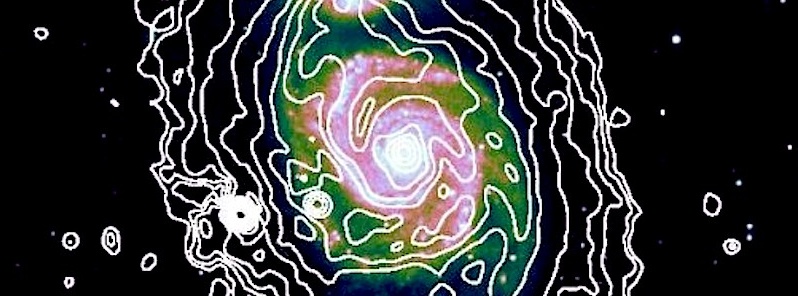
    New observation techniques increase galactic field mapping accuracy.The LOw-Frequency ARray, (LOFAR) is a radio interferometer, or radio telescope, made up of several observing stations in Europe. Signals received at the various observing stations are digitally
  • Crystal comets

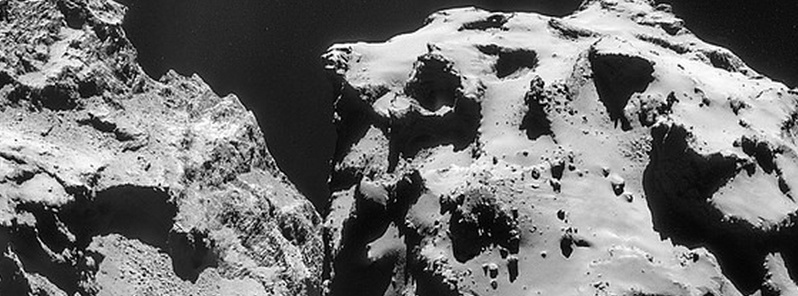
    The “dusty snowball” theory of comets needs attention, since there are crystals that need high temperatures to form in the matrix of at least two.Recently, the composition of comet 67P/Churyumov-Gerasimenko (67P/C-G) was discussed in the scientific press. It

  • Missing link in metal physics explains Earth’s magnetic field

    Earth’s magnetic field is crucial for our existence, as it shields the life on our planet’s surface from deadly cosmic rays. It is generated by turbulent motions of liquid iron in Earth’s core. Iron is a metal, which means it can easily conduct a flow

  • 2015 longer by a leap second

    At 23:59:60 UTC on June 30, 2015, a Leap Second will be added, making this day last for 86401 seconds instead of the usual 86400. This practice started in 1972 and since then a total of 25 leap seconds were added to the UTC time, last one in 2012. Correction of each UTC

  • Electrically active objects dominate the Solar System

    Small planetoids, called Near Earth Objects (NEO), are a concern for space scientists because it is thought that large rocks might strike our planet with devastating force. It is a commonly held belief that such an object caused the extinction of the dinosaurs. The

  • Still chasing the ghost of dark matter

    Scientists using the Fermi Large Area Telescope have come up empty handed in their quest to prove their theories about dark matter.Tom Wilson explores why institutional science remains determined in its pursuit to prove dark matter's existence.Video courtesy of The

  • Impossible “neutron star” shatters theory

    What is a neutron star? Astronomers tell us that these tiny yet massively dense objects form by gravitational collapse from the remnants of a massive star that has exploded. The theoretical neutron star was invented to try to explain highly intense bursts of energy from

  • Finding hints of gravitational waves in the stars

    New model describes overlooked prediction of Einstein's theory of relativity, demonstrates that stars can absorb gravitational ripples.Scientists have shown how gravitational waves – invisible ripples in the fabric of space and time that propagate through the univer