
Etna eruption intensifies, Aviation Color Code raised to Red
Strombolian activity at Mount Etna’s Voragine Crater increased rapidly during the early hours of July 30, 2026, following a sharp increase in volcanic tremor. The eruption generated an ash plume reaching 7 km (23 000 feet) above sea level, prompting Etna Observatory to raise the Aviation Color Code to Red.

Volcanic activity observed at Mount Etna on July 30, 2026. Credit: INGV Vulcani
Eruption at Mount Etna’s Voragine Crater intensified into a sustained Strombolian activity early on July 30. The Toulouse Volcanic Ash Advisory Center (VAAC) reported ash plume reached approximately 7 km (23 000 feet) above sea level. The eruption is ongoing, with volcanic ash and sulfur dioxide drifting northwest.
The Etna Observatory reported that Strombolian activity began at approximately 01:30 UTC on July 30. The activity gradually intensified over the following hours, producing a volcanic ash emission dispersing toward the northwest.
Monitoring data showed the average amplitude of volcanic tremor fluctuating widely throughout the day before undergoing a rapid increase at about 01:30 UTC, reaching high levels. Tremor sources were located beneath the Voragine and Bocca Nuova crater complex at an elevation of approximately 3 km (9 840 feet) above sea level.
The National Institute of Geophysics and Volcanology (INGV) reported that infrasonic activity remained low, with event sources concentrated beneath the Northeast Crater. A slight deformation signal was also recorded at the DRUV dilatometer station.
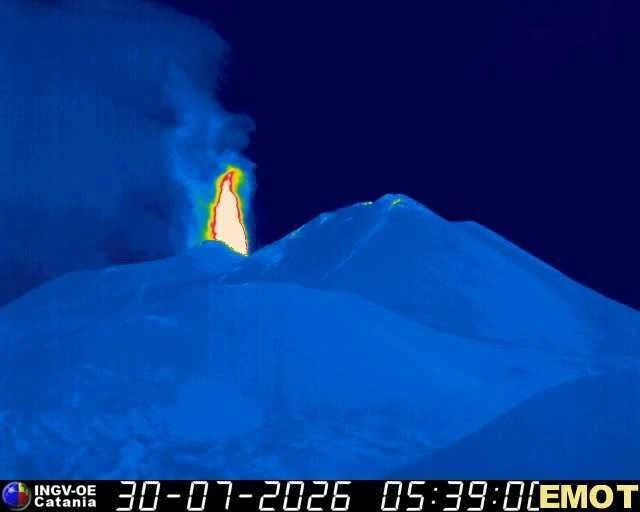
According to satellite imagery, webcams, and the Volcano Observatory Notice for Aviation (VONA), the eruption began producing an ash cloud at 03:33 UTC, which reached approximately 7 km (23 000 feet) above sea level. The Aviation Color Code was raised to Red.
A volcanic ash cloud was observed extending northwest of the volcano while moving at approximately 28 km/h (17 mph). Forecasts indicated that ash would continue drifting toward the northwest through at least 22:30 UTC on July 30.
The Toulouse VAAC reported a clearly identifiable sulfur dioxide (SO₂) plume moving ahead of the thin ash cloud. The most concentrated volcanic ash remained close to the volcano.
References:
1 Volcanic Ash Advisory – Toulouse VAAC – July 30, 2026

Rishav Kothari is Editor-in-Chief of The Watchers, where he runs the newsroom and covers earthquakes, volcanoes, severe weather and space weather.
