
Strong M6.5 earthquake hits eastern New Guinea, Papua New Guinea
A strong earthquake registered by the USGS as M6.5 hit Papua New Guinea at 10:31 UTC (21:31 local time) on December 22, 2025. The agency is reporting a depth of 110.2 km (68 miles). EMSC is reporting M6.4 at a depth of 88 km (55 miles). There is no tsunami threat from this earthquake.
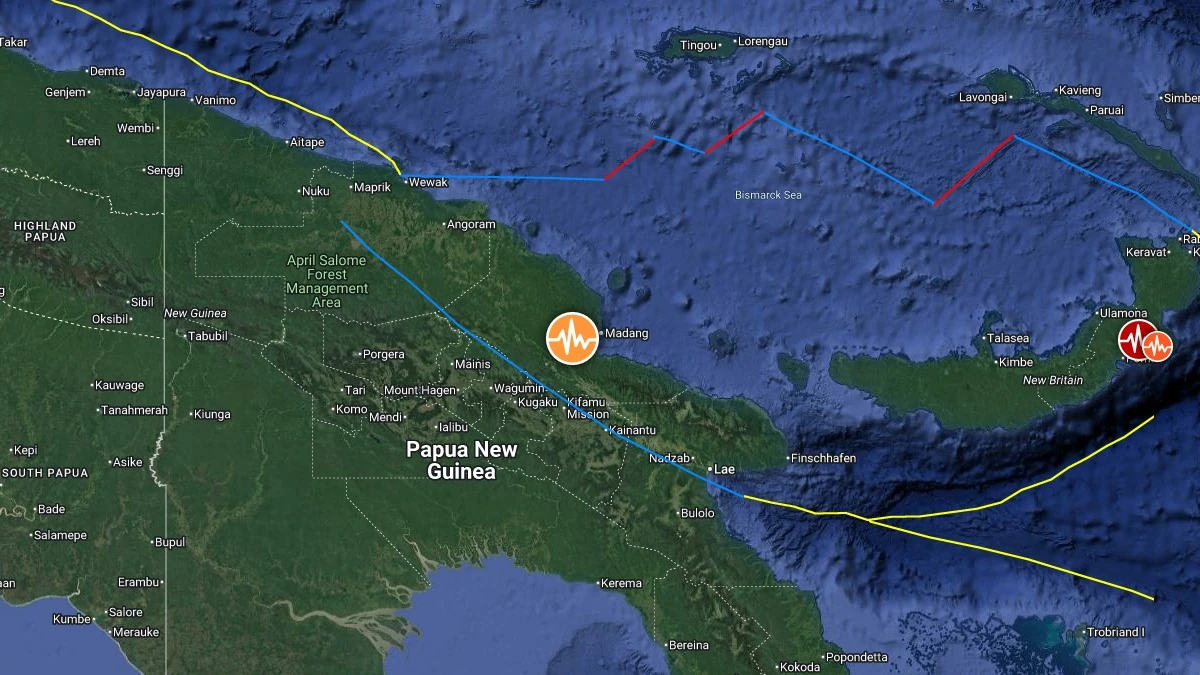
Epicenter of M6.5 earthquake in Papua New Guinea on December 22, 2025. Credit: TW/SAM, Google
The epicenter was located 42 km (26 miles) NNE of Goroka (population 18 503), 64 km (40 miles) SSW of Madang (population 27 419), 141 km (88 miles) E of Mount Hagen (population 33 623), and 200 km (124 miles) NW of Lae (population 76 255).
According to USGS estimates, 808 000 people are likely to have felt moderate shaking (MMI V), and 3 191 000 light shaking (MMI IV). Another 141 000 people experienced weak shaking.
There is no tsunami threat from this earthquake.
The USGS issued a Green alert for shaking-related fatalities and economic losses. There is a low likelihood of casualties and damage.
Overall, the population in this region resides in structures that are a mix of vulnerable and earthquake-resistant construction. The predominant vulnerable building types are informal metal, timber, and unreinforced brick masonry.
Recent earthquakes in this area have caused secondary hazards such as landslides and liquefaction that might have contributed to losses.
Liquefaction triggered by this earthquake is estimated to be significant in severity and/or spatial extent. The number of people living near areas that could have experienced liquefaction during this earthquake is large. Landslides triggered by this earthquake are expected to be few and localized.

Estimated population exposure to earthquake shaking


Selected cities exposed

Regional seismicity

References:
1 M6.5 earthquake Papua New Guinea — USGS — December 22, 2025
2 M6.4 earthquake Papua New Guinea — EMSC — December 22, 2025

Teo Blašković founded The Watchers in 2011 and edited it until 2026, covering seismic and volcanic activity, extreme weather, space weather and near-Earth objects. Articles on this page are his archive.
Published in the last 24 hours
- Weather radar tracked meteorites falling into Cape Cod Bay after a 1.1-kiloton fireball over Massachusetts on 30 May 2026; researchers have now traced its orbit almost out to Jupiter. Epicenter
- 10 named storms, one hurricane for the first time since 1925: Why has the Atlantic been so quiet in 2026 Epicenter
- Amazon fire hotspots rise 82.6% in October 2026 as El Niño intensifies Epicenter
- In 2005, a driver near Russia's Chulyshman River picked up a stone to wedge under his car wheel and kept it for 20 years; the Meteoritical Bulletin has now approved it as the Altai Republic's first meteorite. Epicenter
