
G5 – Extreme geomagnetic storm likely as another set of CMEs merges and impacts Earth on May 12

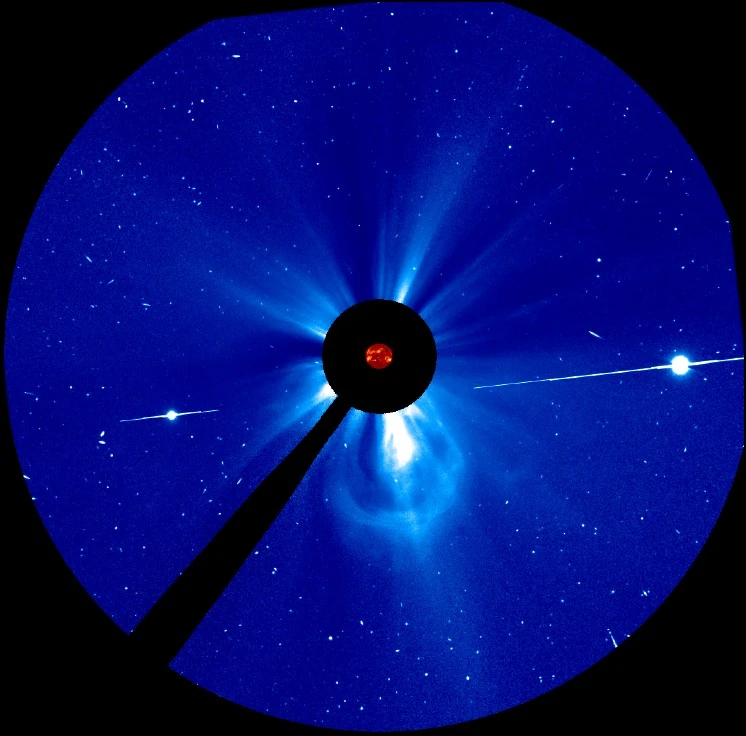
Image credit: NASA/ESA LASCO C3, Helioviewer, The Watchers. Acquired at 03:37 UTC on May 11, 2024
Coronal mass ejection (CME) produced by the X5.8 solar flare from Region 3664 at 01:23 UTC on May 11, 2024, is expected to merge with the previous in-transit CMEs and impact Earth by 12:00 UTC on May 12.
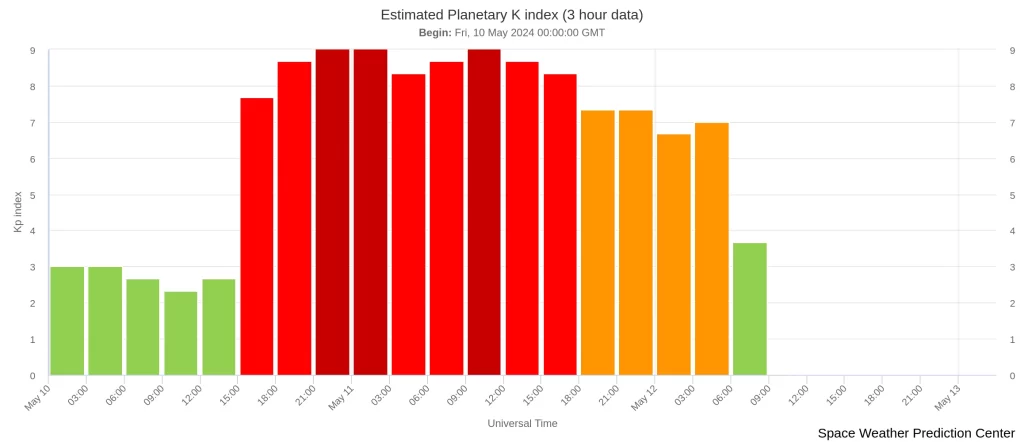
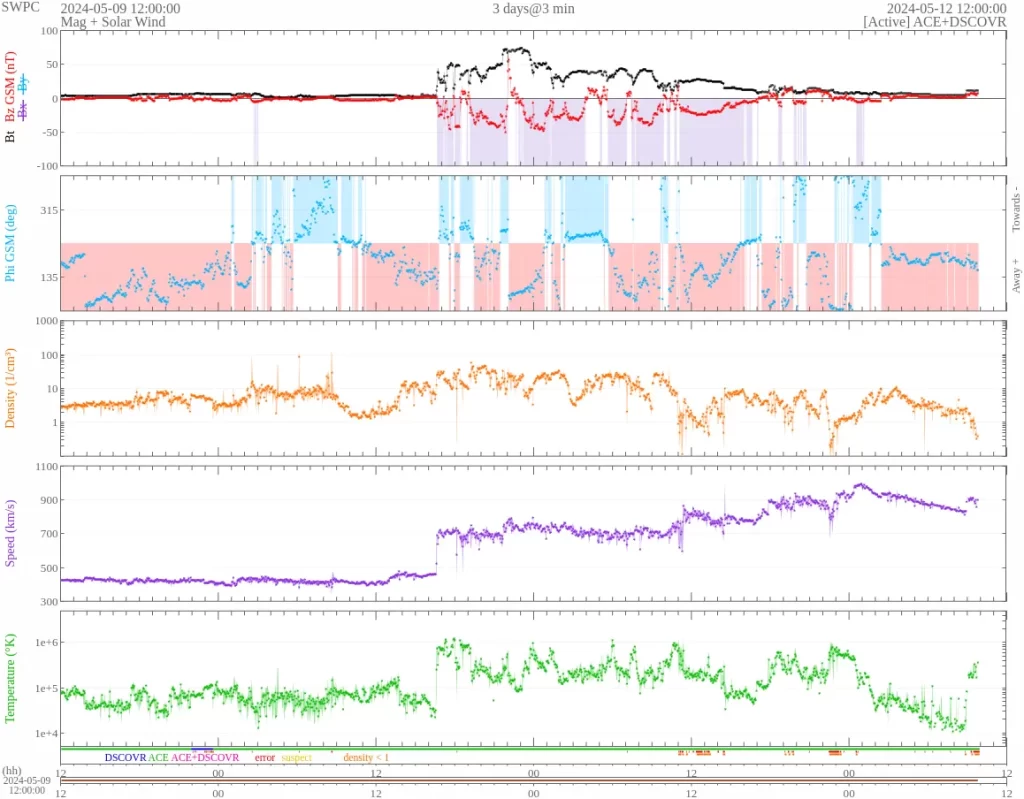
G4 – Severe to G5 – Extreme geomagnetic storms are likely on May 12 due to continued CME activity and the anticipated arrival of another series of CMEs associated with eruptive activity from Region 3664 from May 9 to 11, SWPC forecasters said at 00:30 UTC today.
This includes a fast, halo CME produced by the X5.8 flare on May 11 merging with slower-moving CMEs ahead of it and forming one strong CME (Cannibal CME).
Periods of G2 – Moderate to G3 -Strong storming are likely on May 13 due to continued CME activity and positive polarity coronal hole high speed stream (CH HSS) influences.
In addition to the X5.8 flare, Region 3664 (beta-gamma-delta) produced an X1.5 solar flare (at 11:44 UTC on May 11) and multiple M-class flares over the past 36 hours.
LASCO C3 coronagraph imagery acquired after midnight UTC on May 12 shows 2 more Earth-directed CMEs in addition to the one created by the X5.8 flare on May 11.



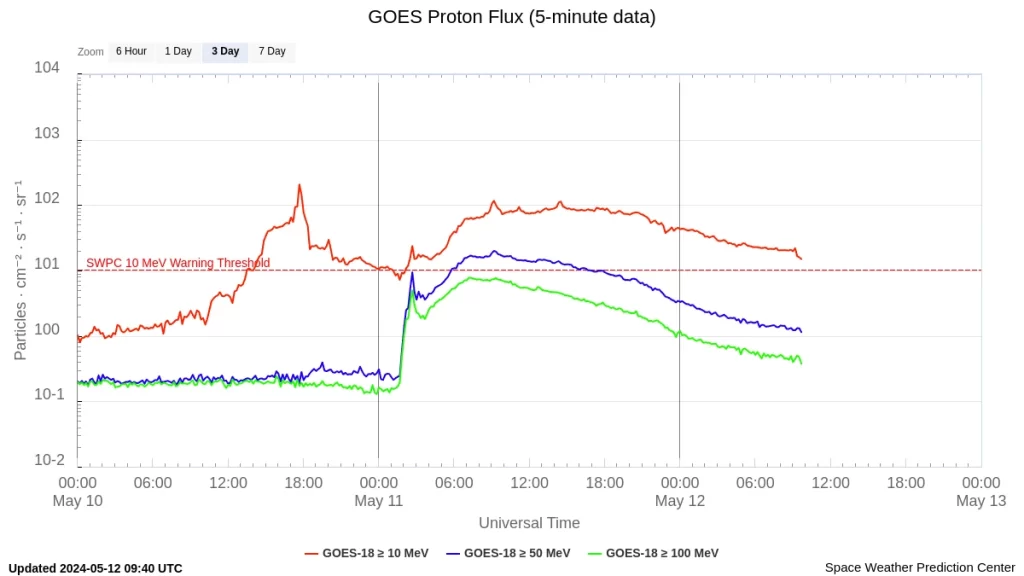
Solar radiation storm reached S2 – Moderate levels at 17:45 UTC on May 10 and is now slowly declining.
Solar activity is expected to persist at high to very high levels through May 14, with M-class (95%) and X-class flares (75%) expected, due primarily to the flare potential of Region 3664.
Yesterday’s X5.8 solar flare is the second strongest flare of the current solar cycle — Solar Cycle 25 — after X6.3 on February 22, 2024.

Teo Blašković founded The Watchers in 2011 and edited it until 2026, covering seismic and volcanic activity, extreme weather, space weather and near-Earth objects. Articles on this page are his archive.
Earlier reporting
Nothing on Watchers was published in the last 24 hours. These are older articles.
- On October 22, 2017, a single flash of lightning stretched 515 miles from eastern Texas to near Kansas City, a distance that takes eight hours to drive, and nobody realized how far it had gone until scientists went back through the satellite data years later Epicenter
- CPC posts a slight risk of heavy rain from the Gulf Coast to the Northeast urban corridor November 25-29, and a moderate risk of West Coast wind and Sierra snow on November 25
- Florida's east coast faces a moderate flash flood risk Wednesday through Friday, with 4 to 8 inches of rain forecast and the St. Johns River near Cocoa already in major flood at 17.13 feet
- Cyclone Akvan to make landfall between Nellore and Visakhapatnam around noon on November 20, IMD forecasts 120-130 km/h winds gusting to 145
