
Widespread severe thunderstorms across the Plains, U.S.
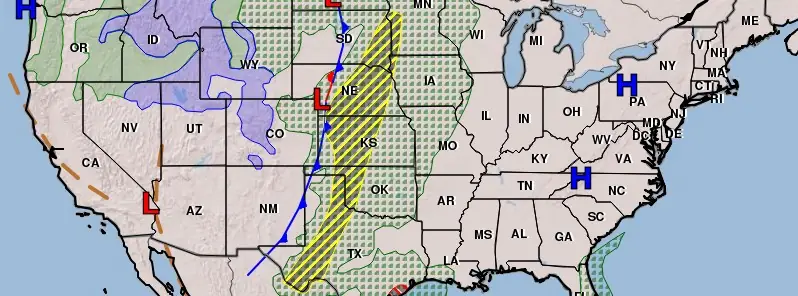
Image credit: NWS
A storm system exiting the West will trigger widespread severe thunderstorms across the Plains on Tuesday. These storms are expected to produce large hail, damaging winds, heavy rain, possible flooding, and a couple of tornadoes across the region. Ahead of this sprawling system, a number of record high temperatures are possible from the Upper Mississippi Valley and Great Lakes into the Northeast.
A front extending from the Northern Plains southward to the Southern High Plains will slowly move eastward to the Upper Great Lakes to the Southern High Plains by Thursday, October 5, 2023. Moisture will pool along the boundary, producing showers and severe thunderstorms over parts of the Plains. As a result, the NWS Storm Prediction Center has issued an Enhanced Risk of severe thunderstorms over parts of the Central/Southern Plains through Wednesday morning, October 4.
The hazards associated with these thunderstorms are frequent lightning, severe thunderstorm wind gusts, hail, and a few tornadoes. Further, there is an increased threat of hail 5 cm (2 inches) or greater over parts of the Central/Southern Plains.
Moreover, moisture streaming onshore over the Western Gulf Coast will produce showers and thunderstorms with heavy rain. Therefore, the Weather Prediction Center (WPC) has issued a Slight Risk of excessive rainfall over parts of the Western Gulf Coast through Wednesday morning.
The associated heavy rain will create mainly localized areas of flash flooding, with urban areas, roads, and small streams the most vulnerable.
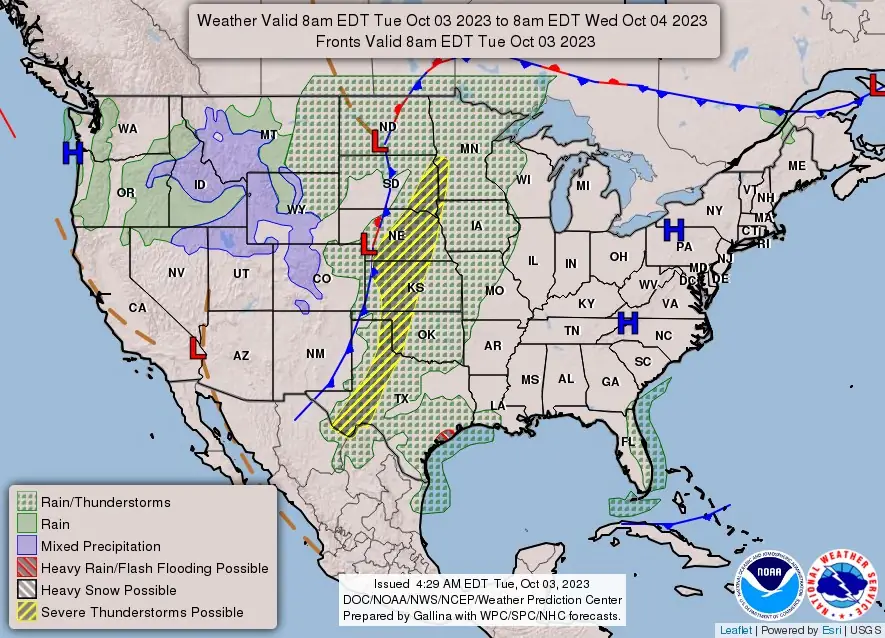
The threat of severe thunderstorms will decrease slightly on Wednesday. The front will produce showers and thunderstorms from the Upper Great Lakes southward to the Southern Plains. However, the showers and thunderstorms will become severe over parts of Northwestern Texas and southwestern Oklahoma. Therefore, the SPC has issued a Slight Risk of severe thunderstorms over parts of the Southern High Plains from Wednesday into Thursday morning. The hazards associated with these thunderstorms are frequent lightning, severe thunderstorm wind gusts, hail, and a few tornadoes.
Additionally, on Wednesday, the threat of excessive rainfall will move from the Western Gulf Coast to northeastern Texas, southeastern Oklahoma, southwestern Missouri, Western Arkansas, and extreme northwestern Louisiana. Therefore, the WPC has issued a Slight Risk of excessive rainfall over parts of the Southern Plains and Middle/Lower Mississippi Valley from Wednesday into Thursday morning. The associated heavy rain will create mainly localized areas of flash flooding, with urban areas, roads, and small streams the most vulnerable.
References:
1 Short Range Forecast Discussion – NWS Weather Prediction Center College Park MD – 343 AM EDT Tue Oct 03 2023

Teo Blašković founded The Watchers in 2011 and edited it until 2026, covering seismic and volcanic activity, extreme weather, space weather and near-Earth objects. Articles on this page are his archive.
Published in the last 24 hours
- How did one flash of lightning, lasting about seven seconds, stretch 829 km across five US states, beat the previous record by 61 km, and only be recognized as the longest ever measured nearly eight years later?
- A meteorite blew a crater beside a village near Lake Titicaca in 2007, and dozens of villagers who went to see it got headaches and nausea, though tests found nothing the rock had added to the water Epicenter
- The people who pay closest attention to the weather are the ones storms have already cost the most, a study of 946 students found, with one damaging storm making little difference to how much attention a student paid, but two or more making a clear one Epicenter
- The sea is falling in Juneau, Alaska, because land freed from melted glaciers is rising about 0.6 inches a year Epicenter
