
Bright fireball over the Atlantic Ocean

Image credit: Meteoroides
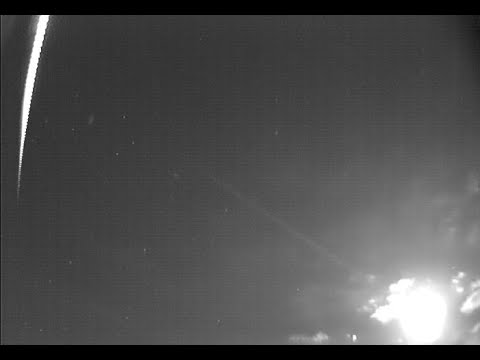
A bright fireball was spotted over the Atlantic Ocean at 21:33 UTC on September 10, 2022, by a wide number of casual eyewitnesses from Spain, who reported it on social networks.
The event was generated by a meteoroid from a comet that hit the atmosphere at about 237 000 km/h.
The fireball began at an altitude of about 143 km (88 miles) over the Cantabrian Sea, over a point located at about 115 km (71 miles) from the coast of Asturias, northern Spain.
From that location, it moved southwest, and ended at a height of around 84 km (52 miles) over the Atlantic Ocean, over a point located at about 14 km (8.7 miles) from the coast of La Coruña, Spain.
This bright meteor was recorded in the framework of the SMART project, operated by the Southwestern Europe Meteor Network (SWEMN) from the meteor-observing stations located at La Hita Observatory (Toledo), El Guijo Observatory (Madrid), and Coruña.
It was analyzed by the principal investigator of the SMART project: Dr. Jose M. Madiedo, from the Institute of Astrophysics of Andalusia (IAA-CSIC).

Teo Blašković founded The Watchers in 2011 and edited it until 2026, covering seismic and volcanic activity, extreme weather, space weather and near-Earth objects. Articles on this page are his archive.
Published in the last 24 hours
- A fireball over northern China on 6 November 2026 punched a crater into a wheat field at Beigucheng village in Hebei; the Institute of Geochemistry has now classified the fallen stones as L6 ordinary chondrites. Epicenter
- The interstellar comet 3I/ATLAS is thought to be about twice as old as Earth, and the James Webb Space Telescope has now found that its ice looks less like any comet from our own solar system than like the frozen worlds beyond Neptune, a sign it formed somewhere its star’s light could barely reach Epicenter
- Mount Everest is the highest point above sea level, but because the Earth bulges at the equator, the summit of a volcano in Ecuador sits farther from the centre of the planet, making it the closest piece of land on Earth to outer space Epicenter
- Winds high above the Arctic broke a 68-year record by collapsing in early November, and while the eastern US has already had a taste of the cold it shook loose, forecasters say a second wave could arrive around Thanksgiving weekend
