
Earthquake swarm under Ta’u volcano continues with declining frequency, American Samoa

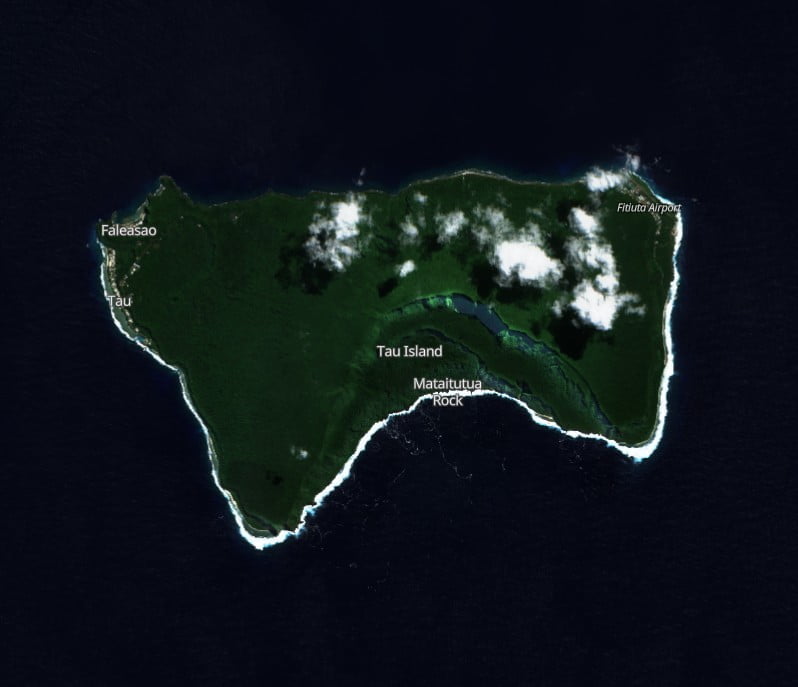
Featured image: Ta'u Island on September 3, 2022. Credit: Copernicus EU/Sentinel-2, EO Browser, The Watchers
The earthquake swarm under Ta’u Island volcano that started in July 2022 continues with declining frequency. However, the current trend of decreasing numbers of earthquakes does not mean the earthquake swarm will end.
In the past 24 hours, one felt earthquake was reported in the Manuʻa Islands, the Hawaiian Volcano Observatory (HVO) reports.1
The frequency of earthquakes in the past 24 hours remains low compared to the past week. However, the current trend of decreasing numbers of earthquakes does not mean the earthquake swarm will end, it added.
The FAGA broadband seismometer is recording events, but it is currently not transmitting data. A field team will attempt to remedy this tomorrow.
The satellite data from the previous 24 hours observed no volcanic activity.
It is unclear if this earthquake unrest will escalate to a volcanic eruption and exactly where an eruption might occur, HVO said.
An eruption could pose significant hazards to residents of American Samoa; these hazards include volcanic gases, volcanic ash, low-level localized explosions of lava, lava flows, earthquake shaking, and tsunami.
Geological summary
The 10 km (6.2 miles) wide Ta’u Island, located at the E end of the Samoan islands, is ringed by sea cliffs. It is the emergent portion of the large Lata shield volcano.
A major flank collapse event around 22 ka resulted in the steep scarps on the southern side of the island. Two smaller shields were constructed along rift zones at the NW and NE tips of the island.
The NW corner of the island has a tuff-cone complex that ejected large dunite xenoliths and coral blocks. Numerous Holocene post-caldera cones occur at the summit and on the flanks.2
References:
1 HAWAIIAN VOLCANO OBSERVATORY DAILY UPDATE – U.S. Geological Survey – Friday, September 9, 2022, 03:18 UTC
2 Ta’u Island – Geological summary – GVP

Teo Blašković founded The Watchers in 2011 and edited it until 2026, covering seismic and volcanic activity, extreme weather, space weather and near-Earth objects. Articles on this page are his archive.
Published in the last 24 hours
- High Risk of excessive rainfall covers Florida’s Space Coast as St. Johns River near Cocoa reaches 5.67 m
- Asteroid 2026 WJ to pass Earth at 1.7 lunar distances at 04:20 UTC on November 22, with 2026 WD following at 4.4 lunar distances on November 23
- Cyclone Akvan crossed the north Andhra Pradesh and south Odisha coasts close to Gopalpur on November 20 with 70-80 km/h winds gusting to 90, and has weakened into a deep depression
- A broad low over southeastern Florida and the northwestern Bahamas has a 30 percent chance of subtropical or tropical development within 48 hours and a 50 percent chance within 7 days, the National Hurricane Center says
