
Strong and shallow M6.4 earthquake hits off the coast of Luzon, Philippines

Image credit: TW
A strong earthquake registered by the USGS as M6.4 hit off the coast of Luzon, Philippines at 21:05 UTC on March 13, 2022. The agency is reporting a depth of 11 km (6.8 miles). PHIVOLCS is reporting M6.4 at a depth of 29 km (18 miles), EMSC M6.4 at a depth of 10 km (6.2 miles). Just four minutes later, at 21:09 UTC, a shallow M6.7 earthquake hit West Sumatra, Indonesia.
The epicenter was located about 67 km (42 miles) WNW of Cabra (population 3 261) and 118 km (73 miles) WSW of Mariveles (population 84 567), Philippines.
There are about 20 000 people living within 100 km (62 miles).
More than 30 million people are estimated to have felt light shaking.
Based on all available data, there is no tsunami threat from this earthquake, PTWC said.
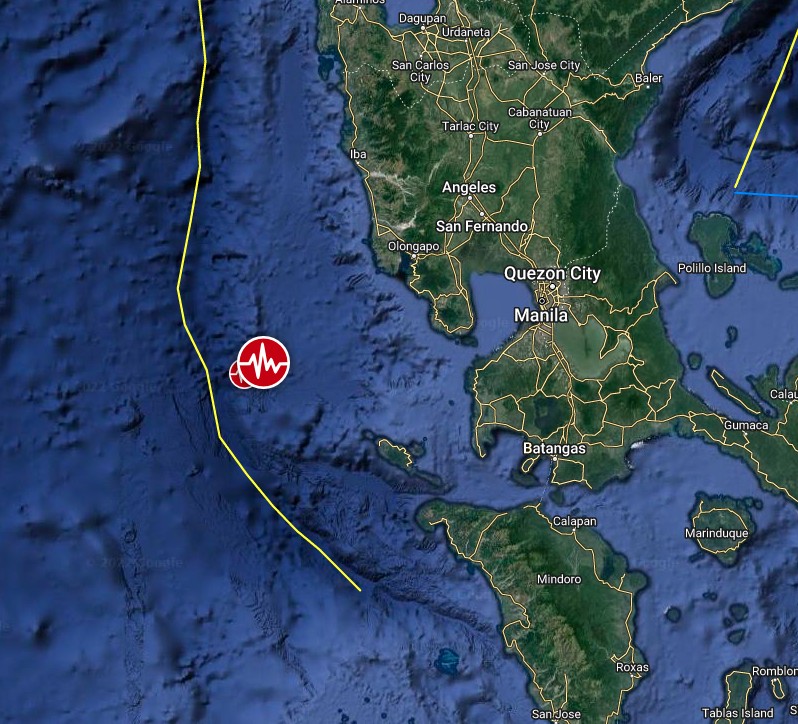
Image credit: TW/SAM, Google
The USGS issued a Green alert for shaking-related fatalities and economic losses. There is a low likelihood of casualties and damage.
Overall, the population in this region resides in structures that are a mix of vulnerable and earthquake-resistant construction. The predominant vulnerable building types are unknown/miscellaneous types and heavy wood frame construction.
Recent earthquakes in this area have caused secondary hazards such as landslides and liquefaction that might have contributed to losses.
Estimated population exposure to earthquake shaking


Selected cities exposed

Regional seismicity

Featured image credit: TW/SAM, Google

Teo Blašković founded The Watchers in 2011 and edited it until 2026, covering seismic and volcanic activity, extreme weather, space weather and near-Earth objects. Articles on this page are his archive.
Published in the last 24 hours
- A crack up to 6 m (20 ft) wide is splitting the summit of the Hochvogel in the Allgäu Alps; 12 years of measurements now put the loose block at about 400,000 cubic metres, half the peak. Epicenter
- Hayli Gubbi in Ethiopia's Afar erupted on 23 November 2025, its first historically documented eruption; a year later scientists have traced it to magma from Erta Ale that travelled more than 30 km underground. Epicenter
- Typhoon Cempaka spun up over the western North Pacific on 7 November 2026; it is now the 32nd typhoon of the year, more than any year this century, one past the 31 counted in 2013. Epicenter
- A school bus driver in Paradise, California, drove 22 children through the 2018 Camp Fire for about five hours, and when the smoke thickened, he and two teachers tore his shirt into wet strips for them to breathe through Epicenter

These earthquakes are triggered by the big crack that was opened in Earth’s magnetic field which was one of the biggest in years. Solar wind poured through the gap, adding its energy to that of a full-halo CME that headed directly to Earth. Late on March 13th, Coronagraphs onboard the Solar and Heliospheric Observatory (SOHO) recorded the storm cloud leaving the Sun