
Magmatic recharge detected beneath Laacher See volcano, Germany
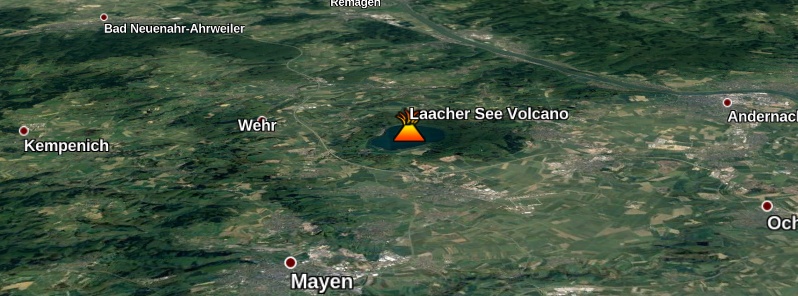
Image credit: Google, TW
For the first time since the improvement of the local seismic networks in the East Eifel region, Rhineland-Palatinate, Germany, scientists have detected and located recurrent deep low-frequency (DLF) earthquakes in the lower crust and upper mantle beneath the Laacher See Volcano (LSV), using a joint data set of permanent sensors and a temporary deployment. DLF microquakes suggest mass transport in the volcanic plumbing system and used to infer feeding channels from and into magma reservoirs.
So far, eight DLF earthquake sequences were observed in four distinct clusters at depths between 10 and 40 km (6.2 – 25 miles), scientists report in a study published recently in the Geophysical Journal International.
These clusters of weak events (ML< 2) align along an approximately 80° southeast dipping line south of the LSV. Moment tensor solutions of these events have large shear components, and the irregular dispersion and long coda of body waves indicate interaction processes between shear cracks and fluids.
"We find a rotation of P-axes orientation for shallow tectonic earthquakes compared to DLF events, indicating that the stress field in the depth interval of DLF events might favor a vertical migration of magma or magmatic fluids," authors say.
"The caldera of the LSV was formed by the last major eruption of the East Eifel Volcanic Field only 12.9 kyr ago, fed by a shallow magma chamber at 5 – 8 km (3.1 – 5 miles) depth and erupting a total magma volume of 6.7 km3 (1.6 mi3). The observed DLF earthquake activity and continuous volcanic gas emissions around the LSV indicate an active magmatic system, possibly connected with an upper mantle melt zone."
"We cannot say for sure that a large amount of magma is rising and we don't actually expect an immediate eruption very soon, or in the near future," said Dr. Torsten Dahm, Head of section 2.1: Physics of Earthquakes and Volcanoes at GFZ Potsdam and one of the authors of the new study, in an interview published in Deutsche Welle on February 6, 2019.
"It shows us that there is activity going on, and also magmatic activity. And it's the first time that we have direct evidence, meaning direct in the sense of observing seismic signals. So we know it's really occurring now," Dahm said.
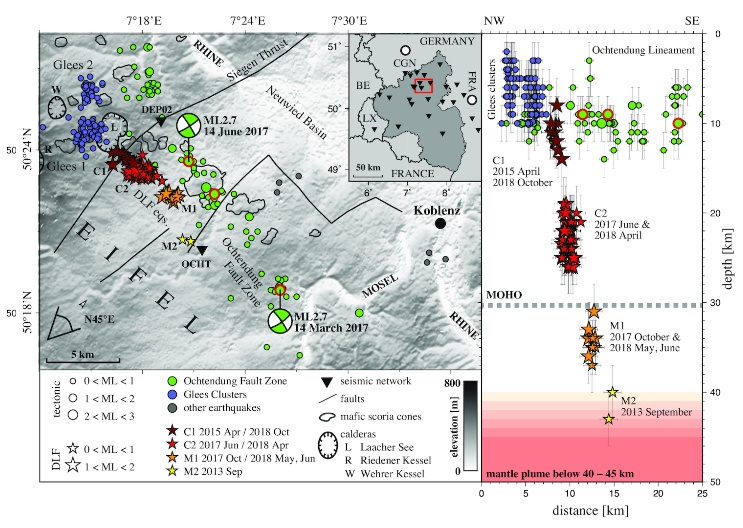
Deep low-frequency earthquakes reveal ongoing magmatic recharge beneath Laacher See Volcano (Eifel, Germany) Geophys J Int. 2019;216(3):2025-2036. doi:10.1093/gji/ggy532 Geophys J Int | © The Author(s) 2018. Published by Oxford University Press on behalf of The Royal Astronomical Society.
"This is a destructive volcano," Dahm added. "13 000 years ago it erupted with such violence that its ash stopped the Rhine River. I still can't get over that. It makes me wonder, how are we monitoring Lake Laach right now, and what should we improve?"
Asked about CO2 gasses bubbling up in parts of the lake, Dahm said that there is a danger in this region. "And everywhere where you have CO2. As you know, CO2 can be dangerous. I always thought it was forbidden to swim in some areas of Lake Laach, or at least it was not recommended to swim there."
Geological summary
Activity at the East Eifel volcanic field began about 0.65 – 0.45 million years ago with the formation of scoria cones, lava flows and tephra deposits.
The Reiden volcanic complex at the western end produced a series of scoria cones, lava flows and lava domes from 0.45 to 0.35 Ma.
Activity resumed around 0.215 Ma, continuing until 0.115 Ma, with the formation of scoria cones, maars and lava flows.
The latest eruption, at the Laacher See maar, took place about 12 900 years ago (40Argon/39Argon age) and produced about 20 km3 of tephra (Schmincke et al., 2002). (GVP)

Teo Blašković founded The Watchers in 2011 and edited it until 2026, covering seismic and volcanic activity, extreme weather, space weather and near-Earth objects. Articles on this page are his archive.
Published in the last 24 hours
- El Niño reaches 2.0°C on NOAA’s index, a tenth of a degree behind 1997–98 at the same point, as forecasters expect it to challenge the all-time record this winter
- The fastest wind gust ever measured on Earth, 253 mph, hit an oil island off Australia during Cyclone Olivia in 1996, and nobody noticed for more than a decade, until experts reading old data quietly took the record from New Hampshire's Mount Washington Epicenter
- In 1954, a grapefruit-sized meteorite crashed through a roof in Sylacauga, Alabama, and struck Ann Hodges as she napped on her couch Epicenter
- A meteorite blew a crater beside a village near Lake Titicaca in 2007, and dozens of villagers who went to see it got headaches and nausea, though tests found nothing the rock had added to the water Epicenter
