
Deadly floods hit Queensland – 277 mm of rain in 3 hours, Australia
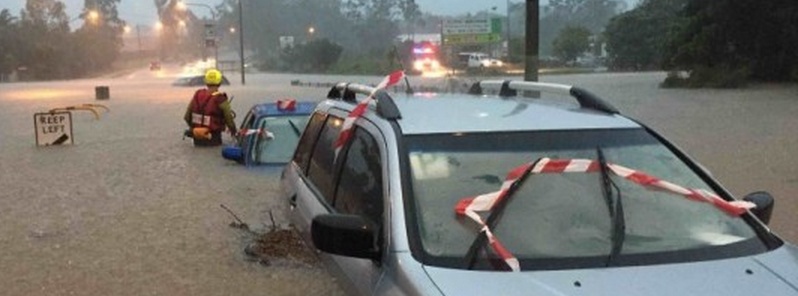
Image credit: Floods in Brisbane, May 1, 2015. Photo: Queensland Fire and Emergency Services – QFES.
Queensland felt the full force of the East Coast low on Friday afternoon (local time), May 1, 2015 as the system moved south over the NSW Northern Rivers and Mid North Coasts. Five people have died after being swept away by flood waters. All of them were in vehicles at the time.
Torrential rain, described as "off the scale" by State Premier Annastacia Palaszczuk, resulted in deadly flash floods in Australia for the second time in 2 weeks.
The hardest hit area was Caboolture, north of Brisbane, with 333 mm of rain within 24 hours, and 277 mm in just three hours.
On Saturday, May 2, the worst of the storm was over for Queensland, and the severe weather was weakening as it moved south into New South Wales, Australia's Bureau of Meteorology (BOM) said earlier today.
Some areas of New South Wales have already reported high levels of rainfall and flooding in farmland in northern areas of the state. Several flood warnings have been issued for rivers in New South Wales.
As reported by FloodList, more than 50 weather station locations in Queensland received over 200 mm of rain in 24 hours. Six locations (4 in the Caboolture area) received over 300 mm of rain during that time:
Caboolture (Bruce Hway) AL – 333 mm
Caboolture (Short St) AL – 327 mm
Caboolture (Bribie Is Rd) AL – 311 mm
Sheep Station Creek AL – 306 mm
Elimbah AL – 306 mm
Rose Creek Road AL – 303 mm

Floods in Brisbane, May 1, 2015. Photo: Queensland Fire and Emergency Services – QFES.
Before this system hit, BOM's Regional Director for Queensland, Rob Webb, said a significant and widespread rainfall in the range of 50 – 150 mm is expected and localized falls of 200 – 300 mm cannot be ruled out, particularly along the coast. He warned there is a potential for flooding and rapid rise of creeks and rivers.

A vehicle stuck in floodwater on Phillips Rd, Woombye. The occupant of this vehicle was confirmed safe. Credit: Queensland Fire and Emergency Services – QFES.
The deaths of five people, including a five-year-old boy, have served as a tragic reminder of the danger of crossing flooded roads, Sky News Australia writes.

Teo Blašković founded The Watchers in 2011 and edited it until 2026, covering seismic and volcanic activity, extreme weather, space weather and near-Earth objects. Articles on this page are his archive.
Earlier reporting
Nothing on Watchers was published in the last 24 hours. These are older articles.
- The storms drenching California this week are fed by a river in the sky, a band of water vapor that can carry up to 15 times the flow of the Mississippi River, and this winter’s near-record El Niño could keep aiming more of them at the West Coast
- 190 mm of rain and 131 km/h gusts hit New Zealand's South Island, flooding West Coast highways
- Huge waves pummel California coast during strong El Niño, flooding streets and closing piers from Pacifica to San Diego
- CPC posts a slight risk of heavy rain from the Gulf Coast to the Northeast urban corridor November 25-29, and a moderate risk of West Coast wind and Sierra snow on November 25

Has anyone investigated if this was due to HAARP? Such torrential rains have been linked to HAARP and Chemtrials in the past and HAARPs’s patents even talk about such things. It is hard to imagine that that is natural.
Scientists define climate change as being driven by increasing heat, which has been called, “warming”, resulting in extremes in rain, drought, heat and cold. When one is looking at an ongoing series of ever increasing extreme weather events right in front of their faces, most can see beyond the literal meaning of the word “warming”.
I thought rain and floods etc were going to be a thing of the past in Queensland and NSW due to global warming?
I thought it was meant to be droughts forever, and to question that forecast was to be a “skeptic” or “Denier”.