
Winter storm “Neptune” brings snow, high winds and bitter wind chill to Northeast US
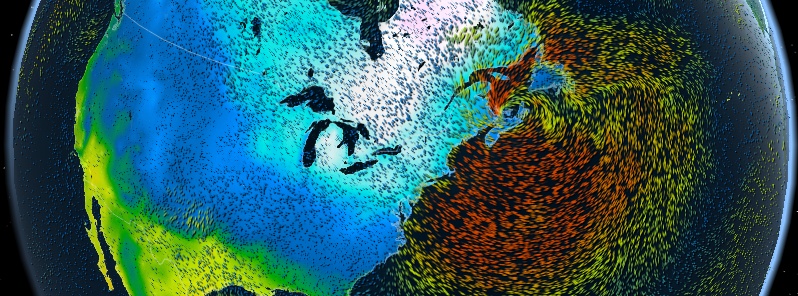
Image credit: MeteoEarth (temperature + winds) February 16, 2015.
After record breaking snow in parts of New England, another dangerous winter storm is approaching Northeast US.
Winter storm "Neptune" delivers a triple threat of snow, high winds and bitter wind chills to areas still struggling to recover from a series of major snowstorms virtually unprecedented in modern times, Weather.com warns.
This rapidly developing nor'easter is expected to produce blizzard conditions for eastern New England on Sunday and into Sunday evening, with 6 to 12 inches (15 to 30 cm) of snow expected, with locally higher amounts.
There will also be widespread windy conditions extending from there to the eastern Ohio Valley and most of the East Coast. Wind gusts could exceed 60 mph (96.5 km/h) over New England before quieter weather settles in for the beginning of the week.

This same storm is bringing in a truly arctic airmass behind it, with some of the coldest weather of the season from the Mid-Atlantic to New England on Sunday, NWS said.
High temperatures are expected to be 20 to 35 degrees below normal by February standards, with afternoon readings in the single digits and teens widespread, and 20s extending well into Virginia and North Carolina.
Strong winds will combine with these frigid temperatures to produce brutal subzero wind chills, and numerous wind chill warnings and wind chill advisories are in effect.
Sub-freezing high temperatures are also expected for Monday over these same areas.

Teo Blašković founded The Watchers in 2011 and edited it until 2026, covering seismic and volcanic activity, extreme weather, space weather and near-Earth objects. Articles on this page are his archive.
Published in the last 24 hours
- Strong El Niño reinforces above-normal winter precipitation outlook across southern and eastern U.S.
- A fog linked to about 12 000 excess deaths in London in 1952 puzzled scientists for decades, until researchers reconstructed how coal smoke formed acidic haze Epicenter
- In 2012, cameras filming a thunderstorm in western China caught ball lightning by accident, and its 1.64-second glow carried iron, silicon, and calcium from the soil it rose out of Epicenter
