
Sunspot 1996 produced M3.5 solar flare
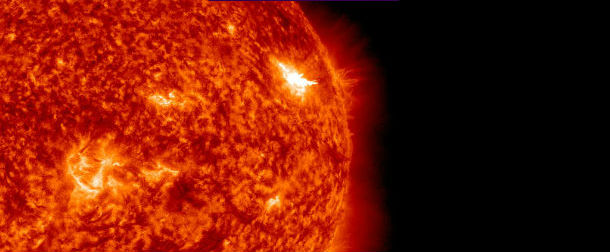
Image credit: SDO's AIA 304 image taken at 03:55 UTC on March 11, 2014. (Courtesy of NASA/SDO and the AIA, EVE, and HMI science teams)
Active Region 1996, located in the northern hemisphere, produced moderate M3.5 solar flare at 03:50 UTC on March 11, 2014. This active region continues to rotate closer towards the northwestwern limb.

SDO's AIA 304 and EVE with GOES X-ray flux plot (Credit: SDO/NOAA/SWPC)
There are currently 6 visible sunspots facing Earth. Active Region 2002 located in the southeast quadrant produced three M1 flares and few C-Class solar flares. Growing Sunspot 2002 has developed a 'beta-gamma-delta' magnetic field that harbors energy for X-class solar flares. New sunspots 2003 and 2004 were numbered overnight. All other visible regions remain stable or in a state of decay.

No Earth-directed coronal mass ejections were observed in satellite imagery. NOAA/SWPC forecasters estimate 60% chance of an M-class flares and 10% chance of X-class flares in the next 24 hours.

Published in the last 24 hours
- High Risk of excessive rainfall covers Florida’s Space Coast as St. Johns River near Cocoa reaches 5.67 m
- Four small asteroids will pass close to Earth from November 21 to 23
- Cyclone Akvan weakens after landfall near Gopalpur; more than 300 000 evacuated in Odisha, India
- A broad low over southeastern Florida and the northwestern Bahamas has a 30 percent chance of subtropical or tropical development within 48 hours and a 50 percent chance within 7 days, the National Hurricane Center says
