
Aerial view of Veniaminof shows gray-brown ash column rising from the active vent, Alaska

Image credit: Aerial view of Veniaminof volcano, Alaska, on October 7, 2013. Photograph by Joyce Alto/AVO.
Alaska Volcano Observatory (AVO) reported that eruption of Veniaminof resumed on October 6, 2013. An aerial view of the volcano today, October 7, showed a gray-brown ash column rising from the active vent. White water vapor clouds seen on the image below are indicating hot lava is interacting with snow and ice.
Yesterday, AVO increased the Aviation Color Code to Orange and the Volcano Alert Level to Watch. Seismic tremor increased, and highly elevated surface temperature were observed in satellite images. Lava effusion has likely resumed, but [yesterday] no ash emissions have been observed in satellite images. Web camera images were obscured by clouds.
This is a similar level of eruptive activity that first began in June 2013, AVO reported.
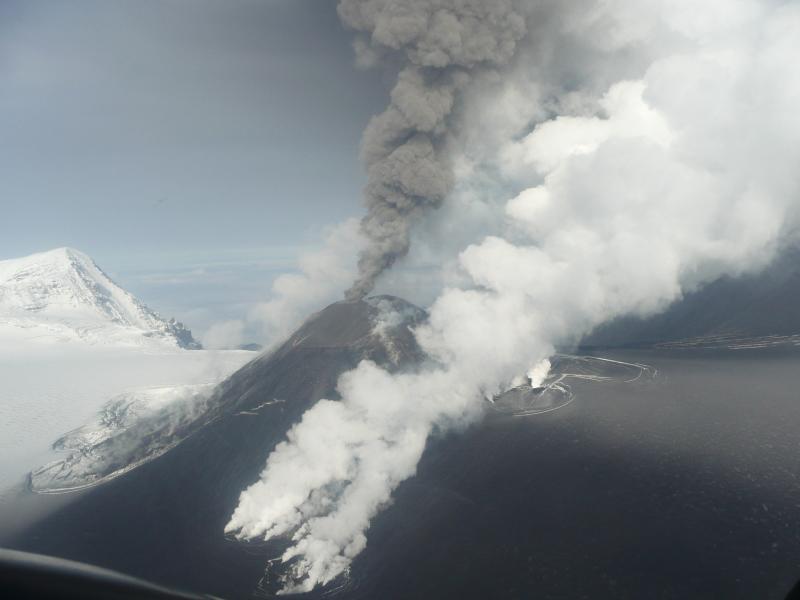
Aerial view of Veniaminof volcano erupting on September 7, 2013. Note the white water vapor clouds indicating hot lava is interacting with snow and ice. A gray-brown ash column rises from the active vent. The summit ice field is darkened with recent ashfall. Photograph by Joyce Alto/AVO.

Aerial view of Veniaminof volcano on September 7, 2013. Photograph by Joyce Alto/AVO.
Massive Veniaminof volcano, one of the highest and largest volcanoes on the Alaska Peninsula, is truncated by a steep-walled, 8 x 11 km, glacier-filled caldera that formed around 3700 years ago. The caldera rim is up to 520 m high on the north, is deeply notched on the west by Cone Glacier, and is covered by an ice sheet on the south. Post-caldera vents are located along a NW-SE zone bisecting the caldera that extends 55 km from near the Bering Sea coast, across the caldera, and down the Pacific flank.
Historical eruptions probably all originated from the westernmost and most prominent of two intra-caldera cones, which reaches an elevation of 2156 m and rises about 300 m above the surrounding icefield. The other cone is larger, and has a summit crater or caldera that may reach 2.5 km in diameter, but is more subdued and barely rises above the glacier surface (GVP).

Teo Blašković founded The Watchers in 2011 and edited it until 2026, covering seismic and volcanic activity, extreme weather, space weather and near-Earth objects. Articles on this page are his archive.
Published in the last 24 hours
- High Risk of excessive rainfall covers Florida’s Space Coast as St. Johns River near Cocoa reaches 5.67 m
- Asteroid 2026 WJ to pass Earth at 1.7 lunar distances at 04:20 UTC on November 22, with 2026 WD following at 4.4 lunar distances on November 23
- Cyclone Akvan weakens after landfall near Gopalpur; more than 300 000 evacuated in Odisha, India
- A broad low over southeastern Florida and the northwestern Bahamas has a 30 percent chance of subtropical or tropical development within 48 hours and a 50 percent chance within 7 days, the National Hurricane Center says

Commenting rules and guidelines
We value the thoughts and opinions of our readers and welcome healthy discussions on our website. In order to maintain a respectful and positive community, we ask that all commenters follow these rules.