
Polar mesospheric clouds over South Pacific Ocean
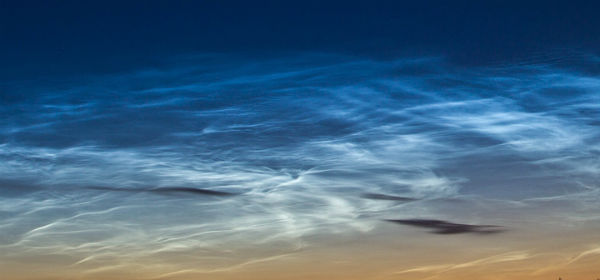
Image credit: Noctilucent clouds taken by Jan Erik Paulsen on July 15, 2010 (Photograph © 2010 Jan Erik Paulsen)
Polar mesospheric clouds—also known as noctilucent or “night shining” clouds—form between 76 to 85 kilometers (47 to 53 miles) above the Earth’s surface, near the boundary of the mesosphere and thermosphere, a region known as the mesopause. At these altitudes, water vapor can freeze into clouds of ice crystals. When the Sun is below the horizon and the ground is in darkness, these high clouds may still be illuminated, lending them their ethereal, “night shining” qualities.

Astronaut photograph ISS034-E-24622 was acquired on January 5, 2013 by ISS over the Pacific Ocean south of French Polynesia. (Credit: NASA/JSC Gateway to Astronaut Photography of Earth. Caption by William L. Stefanov, Jacobs/ESCG at NASA-JSC.)
Polar mesospheric clouds have been observed from all human vantage points in both the Northern and Southern Hemispheres—from the surface, in aircraft, and from the International Space Station (ISS) —and tend to be most visible during the late spring and early summer. Some atmospheric scientists seek to understand their mechanisms of formation, while others have identified them as potential indicators of atmospheric changes resulting from increases in greenhouse gas concentrations.

Increase of Polar Mesospheric Clouds, 1979–2010 (Credit: Robert Simmon, adapted from Latitude-dependent long-term variations in polar mesospheric clouds from SBUV version 3 PMC data. Caption by Holli Riebeek)
This astronaut photograph was taken when the ISS was over the Pacific Ocean south of French Polynesia. While most polar mesospheric cloud images are taken from the ISS with relatively short focal length lenses (to maximize the field of view), this image was taken with a long lens (400 mm) allowing for additional detail of the cloud forms. Below the brightly-lit noctilucent clouds, across the center of the image, the pale orange band is the stratosphere.
Polar Mesospheric Clouds, Northern Hemisphere
Polar Mesospheric Clouds Illuminated by Orbital Sunrise
Polar Mesospheric Clouds, Southern Hemisphere
Polar Mesospheric Clouds Over Central Asia

Noctilucent clouds are also called Polar Mesospheric Clouds, PMCs. They are 80-85 km high (50-53 mile), a few km below the mesopause, the coldest part of the atmosphere. (Credit: Atmospheric Optics)
Sources: Atmoptics, EarthObservatory

Published in the last 24 hours
- High Risk of excessive rainfall covers Florida’s Space Coast as St. Johns River near Cocoa reaches 5.67 m
- Four small asteroids will pass close to Earth from November 21 to 23
- Cyclone Akvan weakens after landfall near Gopalpur; more than 300 000 evacuated in Odisha, India
- A broad low over southeastern Florida and the northwestern Bahamas has a 30 percent chance of subtropical or tropical development within 48 hours and a 50 percent chance within 7 days, the National Hurricane Center says
