
Why are we seeing so many sungrazing comets?
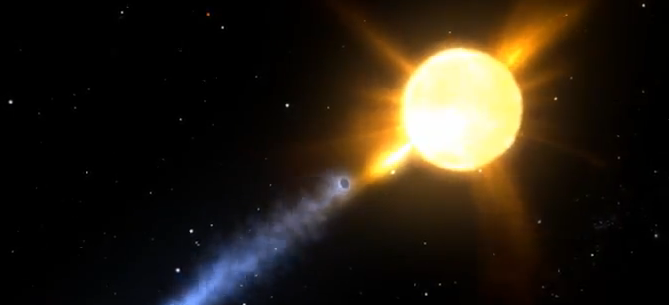
Image credit: Solar Dynamics Observatory
Before 1979, there were less than a dozen known sungrazing comets. As of December 2012, we know of 2,500. Why did this number increase? With solar observatories like SOHO, STEREO, and SDO, we have not only better means of viewing the sun, but also the comets that approach it. SOHO allows us to see smaller, fainter comets closer to the sun than we have ever been able to see before. Even though many of these comets do not survive their journey past the sun, they survive long enough to be observed, and be added to our record of sungrazing comets.

Sungrazing comets as solar probes
To observe how winds move high in Earth’s atmosphere, scientists sometimes release clouds of barium as tracers to track how the material corkscrews and sweeps around — but scientists have no similar technique to study the turbulent atmosphere of the Sun. So researchers were excited in December 2011, when Comet Lovejoy swept right through the sun’s corona with its long tail streaming behind it. NASA’s Solar Dynamics Observatory (SDO) captured images of the comet, showing how its long tail was buffeted by systems around the Sun, offering scientists a unique way of observing movement as if they’d orchestrated the experiment themselves. Since comet tails have ionized gases, they are also affected by the Sun’s magnetic field, and can act as tracers of the complex magnetic system higher up in the atmosphere. Comets can also aid in the study of coronal mass ejections and the solar wind


Teo Blašković founded The Watchers in 2011 and edited it until 2026, covering seismic and volcanic activity, extreme weather, space weather and near-Earth objects. Articles on this page are his archive.
Published in the last 24 hours
- A Virginia park ranger was struck by lightning seven times and lived, even though three of the strikes set his hair on fire Epicenter
- The hole in the ozone layer over Antarctica was about twice the size of the US this year, and scientists say it would have been bigger still if ozone-eating chemicals were at their 2000 levels Epicenter
