
International Space Station maneuvers to record the complete rotation of Sun
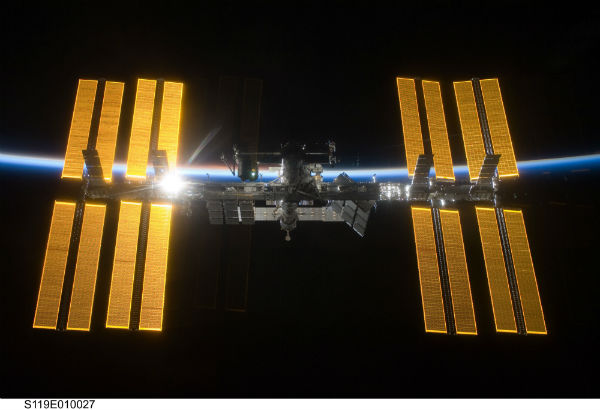
Featured image: The International Space Station taken from Space Shuttle Discovery as the Sun rises from behind Earth in March 2009. (Credits: NASA/ESA)
This weekend the International Space Station will turn itself to position ESA’s SOLAR instrument for a better view of the Sun. This would be the first time ISS has changed attitude for scientific reasons alone.
SOLAR instrument was installed on ESA’s Columbus laboratory module in February 2008, and since then it has been monitoring our Sun’s output.
 SOLAR consists of three complementary instruments: SOVIM (SOlar Variable and Irradiance Monitor) covers the near-ultraviolet, visible and thermal-infrared regions of the spectrum; SOL-ACES (SOLar Auto-Calibrating Extreme UV/UV Spectrophotometers) measures the extreme ultraviolet; and SOLSPEC (SOLar SPECtral Irradiance measurements) covers the 180–3000 nm wavelength range. (Credits: ESA)
In order to take measurements, SOLAR needs to be in direct view of the Sun. However, Space Station’s normal orbit obscures the view for two weeks every month, so only way to record a complete rotation is to rotate ISS as well. Correct orbit needs to be calculate to keep SOLAR in view of the Sun, solar panels that power the Station must remained in sunlight and communication antennas need to be reoriented to stay in contact with Earth during the procedure.
 SOLAR installed on ESA’s Columbus laboratory on the International Space Station. (Credits: ESA/NASA)
SOLAR started recording a full rotation of the Sun on 19 November. On 1 December the Station will spend two hours turning about 7º so that observations can continue. It will hold this angle for ten days before returning to its original attitude.
Source: ESA Portal

Published in the last 24 hours
- High Risk of excessive rainfall covers Florida’s Space Coast as St. Johns River near Cocoa reaches 5.67 m
- Four small asteroids will pass close to Earth from November 21 to 23
- Cyclone Akvan weakens after landfall near Gopalpur; more than 300 000 evacuated in Odisha, India
- A broad low over southeastern Florida and the northwestern Bahamas has a 30 percent chance of subtropical or tropical development within 48 hours and a 50 percent chance within 7 days, the National Hurricane Center says
