
Sunspot 1513 released M2.4 solar flare
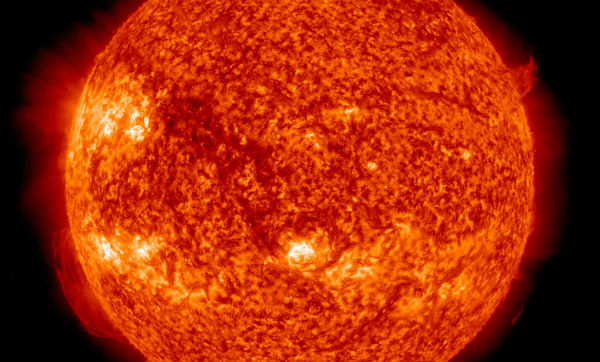
Image credit: TW
Solar activity is now at moderate levels with a short duration M2.4 Solar Flare around Sunspot 1513 located in the northeast quadrant on June 28. This region continues to show signs of growth. No Earth-directed coronal mass ejections was released. There is R1 Radio Blackout alert issued by NOAA/SWPC. Weak or minor degradation of HF radio communication on sunlit side is possible, with occasional loss of radio contact.

The visible solar disk consists of 4 numbered sunspot groups (1512, 1513, 1514 and 1515). Sunspot 1512 has a ‘beta-gamma’ magnetic field that harbors energy for M-class solar flares. According to NOAA/SWPC there is 30% chances for M-Class event.

WSA-Enlil Solar Wind Prediction
Joint USAF/NOAA Report of Solar and Geophysical Activity (2200Z on 28 Jun 2012)
Solar activity increased to moderate levels. Region 1513 (N17E45) produced an impulsive M2/1b flare at 28/1612Z along with occasional B- and C-class flares including a long-duration C2/Sf at 28/1948Z. Region 1513 showed a minor increase in spot count and an increase in magnetic complexity (beta-gamma). Region 1512 (S15W02) maintained its beta-gamma magnetic configuration, but showed little change during the period. This region produced occasional B- and C-class flares during the period. No new regions were numbered. No Earth-directed coronal mass ejections occurred during the period. Solar activity is expected to be low during the period (29 June – 01 July) with a chance for another M-class flare.
Geomagnetic field activity was at quiet to (briefly) unsettled levels. Geomagnetic field activity is expected to be at quiet to unsettled levels on day 1 (29 June) with a chance for active levels due to the arrival of a co-rotating interaction region in advance of a recurrent coronal hole high-speed stream (CH HSS). Field activity is expected to increase to unsettled to active levels during days 2 – 3 (30 June – 01 July) with a chance for minor storm levels due to CH HSS effects.

Published in the last 24 hours
- High Risk of excessive rainfall covers Florida’s Space Coast as St. Johns River near Cocoa reaches 5.67 m
- Asteroid 2026 WJ to pass Earth at 1.7 lunar distances at 04:20 UTC on November 22, with 2026 WD following at 4.4 lunar distances on November 23
- Cyclone Akvan weakens after landfall near Gopalpur; more than 300 000 evacuated in Odisha, India
- A broad low over southeastern Florida and the northwestern Bahamas has a 30 percent chance of subtropical or tropical development within 48 hours and a 50 percent chance within 7 days, the National Hurricane Center says

[…] The Watchers – Sunspot 1513 released M2.4 solar flare Solar activity is now at moderate levels with a short duration M2.4 Solar Flare around Sunspot 1513 located in the northeast quadrant on June 28. This regi.The Watchers […]
[…] The Watchers – Sunspot 1513 released M2.4 solar flare […]