
ATREX experiment – they finally did it – 5 sounding rockets successfully launched
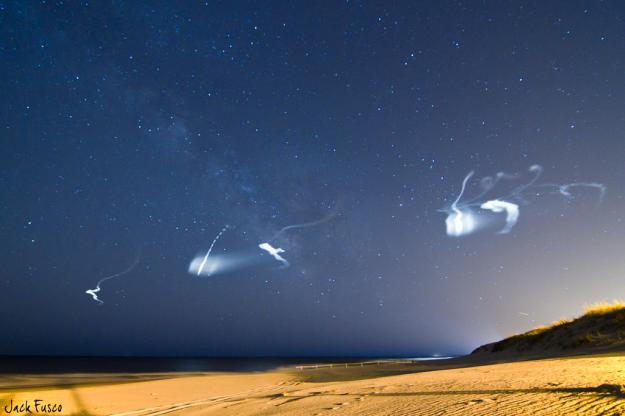
Image credit: Jack Fusco, Seaside Park, NJ.
NASA successfully launched five suborbital sounding rockets on March 27th from its Wallops Flight Facility in Virginia as part of a study of the upper level jet stream.
The first rocket was launched at 4:58 a.m. EDT and each subsequent rocket was launched 80 seconds apart.
Each of the rockets released a chemical tracer that created milky, white clouds at the edge of space. The launches and clouds were reported to be seen from as far south as Wilmington, N.C.; west to Charlestown, W. Va.; and north to Buffalo, N.Y.
The Anomalous Transport Rocket Experiment (ATREX) mission will gather information needed to better understand the process responsible for the high-altitude jet stream located 60 to 65 miles (96 – 104 km / official boundary of space) above the surface of the Earth.

At those altitudes (60 to 65 miles (96 – 104 km) winds rush through a little understood region of Earth’s atmosphere at speeds of 200 to 300 miles per hour (321 to 482 kilometres per hour). Lower than a typical satellite’s orbit, higher than where most planes fly, this upper atmosphere jet stream makes a perfect target for a particular kind of scientific experiment: the sounding rocket. Some 35 to 40 feet long (~12 m), sounding rockets shoot up into the sky for short journeys of eight to ten minutes, allowing scientists to probe difficult-to-reach layers of the atmosphere.
Inside the rockets and preparation

Launch video
Sounding rockets are usually launched one or two at a time, so launching five at once will call for specific timing and direction to gather the required data. The rockets must be launched on a clear night between March 14 and April 3. Scientists will then use special camera equipment to track the five clouds and measure how quickly they move away from each other. They can then plug this information into equations that will describe what kind of turbulence exists in the winds.

The show

Teo Blašković founded The Watchers in 2011 and edited it until 2026, covering seismic and volcanic activity, extreme weather, space weather and near-Earth objects. Articles on this page are his archive.
Published in the last 24 hours
- High Risk of excessive rainfall covers Florida’s Space Coast as St. Johns River near Cocoa reaches 5.67 m
- Asteroid 2026 WJ to pass Earth at 1.7 lunar distances at 04:20 UTC on November 22, with 2026 WD following at 4.4 lunar distances on November 23
- Cyclone Akvan crossed the north Andhra Pradesh and south Odisha coasts close to Gopalpur on November 20 with 70-80 km/h winds gusting to 90, and has weakened into a deep depression
- A broad low over southeastern Florida and the northwestern Bahamas has a 30 percent chance of subtropical or tropical development within 48 hours and a 50 percent chance within 7 days, the National Hurricane Center says
