
New sunspot regions turning earthwards

Image credit: TW
A very long in duration C6.4 event was detected around Sunspot 1402 in the northeast quadrant. A Coronal Mass Ejection (CME) was produced, but is directed to the north and east. Most of the magnetic activity in this event appears to be above the actual sunspot. Sunspot complex 1401-1402 erupted at approximately 0400 UTC. SOHO LACO C2 recorded the expanding cloud:

The CME is not heading toward Earth, at least not directly. It might deliver a glancing blow to Earth’s magnetic field on Jan. 18th. Stay tuned for further analysis of the cloud’s trajectory.

Sunspots 1401 and 1402 are both producing C-Class flares. A very long duration C6.4 solar flare was detected around Sunspot 1402 early Monday morning. This event produced a Coronal Mass Ejection (CME) off the northeast limb. This does not look to be Earth directed. Both of these sunspots will continue to rotate into a more geoeffective position, and any future eruptions may be Earth directed.

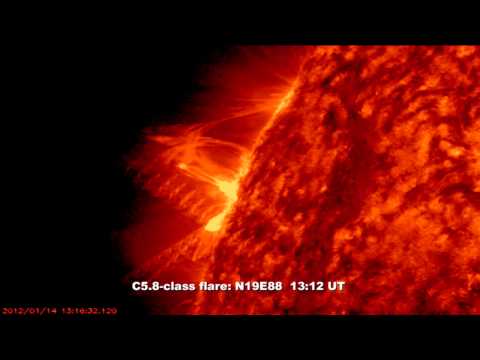
Earth-orbiting satellites detected an M1-class solar flareat 13:18 UTC yesterday (SDO movie). The source is a new sunspot emerging over the sun’s northeastern limb. Four new sunspots were numbered on Saturday – 1399, 1400, 1401 and 1402. It appears that Sunspot 1401 is the most active region on the visible solar disk. There is currently 9 numbered regions.

Solar activity suddenly increased to moderate levels over the weekend and numerous sunspot regions are now visible. The active region on the northeast limb is now rotating into view, and it did produce an M1.4 solar flare . This region was numbered 1401 on Saturday. Expect solar activity to be moderate in the next 24-48 hours.

Published in the last 24 hours
- Male toads abandoned a pond in Italy five days before a deadly 2009 earthquake, while a scientist was counting them Epicenter
- An asteroid was spotted 19 hours before it exploded over Sudan in 2008, and students picked its pieces off the desert Epicenter
- A wave up to 3 m (10 feet) high rose out of Lake Michigan on a sunny June morning in 1954 and swept fishermen off Chicago’s piers, and when a second came 10 days later, warnings had cleared the shore Epicenter
- Just 12 inches of rushing water can carry away most cars, and more than half of US flood drownings happen to people who drive into flood water Epicenter
