
Fast growing sunspot 1199
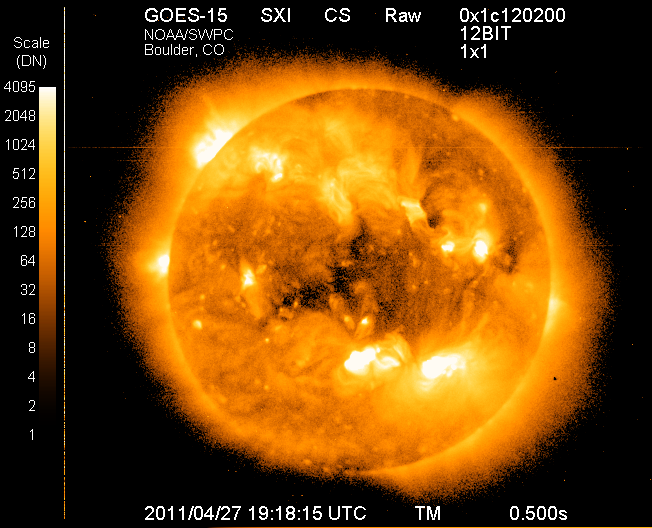
Image credit: TW
New sunspot 1199 is growing rapidly in the sun’s northern hemisphere, ballooning in area by more than a factor of five during the last 24 hours. If the expansion continues apace, this active region could soon pose a threat for flares. Stay tuned. (SpaceWeather)

New Sunspot 1199 which is located in the northern hemisphere is growing fairly quickly and may be capable of producing isolated C-Class flares. Continue to monitor this region for further development.
New sunspot 1200 and existing sunspot 1196 which are both located in the southern hemisphere are fading . Sunspot 1195 which continues to transit the southern hemisphere remains quiet. (SolarHam)

Two new regions were numbered today, Region 1199 (N21W23) and Region 1200 (S17E42). Region 1199 emerged quickly on the disk and is already classified as a C-type group. (Prepared jointly by the U.S. Dept. of Commerce, NOAA, Space Weather Prediction Center and the U.S. Air Force.)

Earlier reporting
Nothing on Watchers was published in the last 24 hours. These are older articles.
- On October 22, 2017, a single flash of lightning stretched 515 miles from eastern Texas to near Kansas City, a distance that takes eight hours to drive, and nobody realized how far it had gone until scientists went back through the satellite data years later Epicenter
- CPC posts a slight risk of heavy rain from the Gulf Coast to the Northeast urban corridor November 25-29, and a moderate risk of West Coast wind and Sierra snow on November 25
- Florida's east coast faces a moderate flash flood risk Wednesday through Friday, with 4 to 8 inches of rain forecast and the St. Johns River near Cocoa already in major flood at 17.13 feet
- Cyclone Akvan to make landfall between Nellore and Visakhapatnam around noon on November 20, IMD forecasts 120-130 km/h winds gusting to 145

According to this article this spot has grown 5 factors in 24 hours. How large is five factors?
http://www.leif.org/research/Waldmeier.pdf
http://www.aavso.org/dances-wolfs-short-history-sunspot-indices
http://www.ngdc.noaa.gov/stp/solar/ssndata.html
http://spaceweather.com/glossary/sunspotnumber.html