
Major X1.3 solar flare erupts from Region 3663
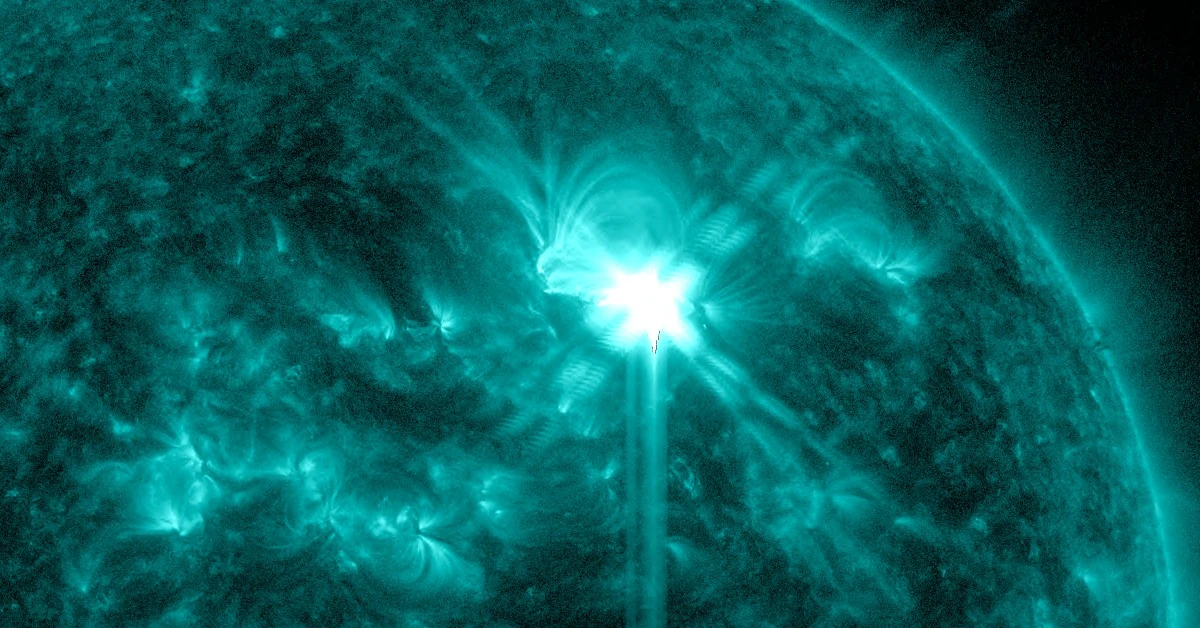
Featured image: X1.3 solar flare on May 5, 2024. Credit: NASA SDO/AIA 131, Helioviewer, The Watchers
A major solar flare measuring X1.3 erupted from Active Region 3663 at 06:01 UTC on May 5, 2024. The event started at 05:47 and ended at 06:09 UTC. This is the second X-class solar flare from this region since X1.6 at 02:22 UTC on May 3.
It doesn’t appear this flare produced a coronal mass ejection (CME). If it was, however, there is a chance we’ll see at least a part of it coming our way.
Radio frequencies were forecast to be most degraded over the Middle East, Asia, and the Indian Ocean at the time of the flare.
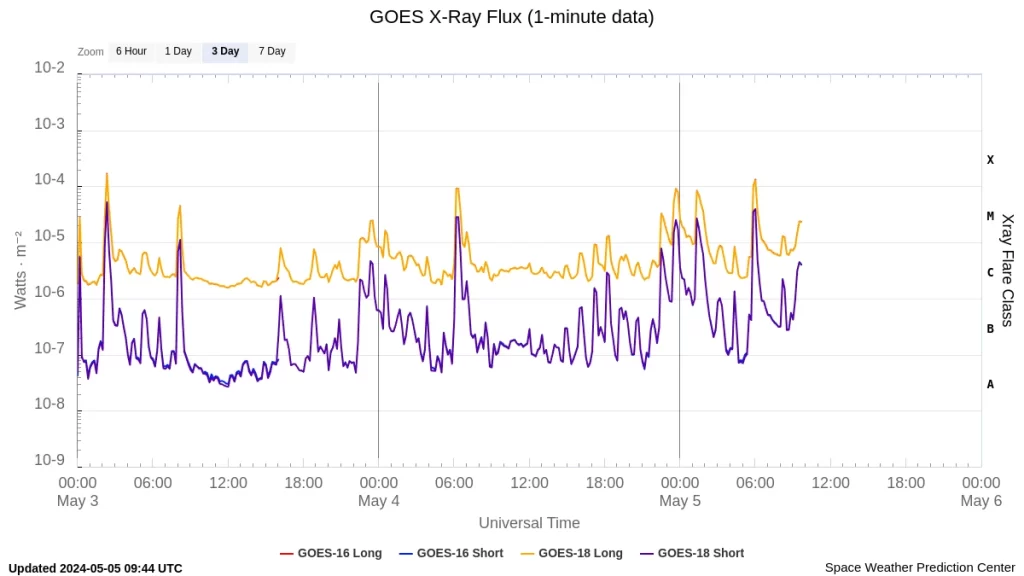
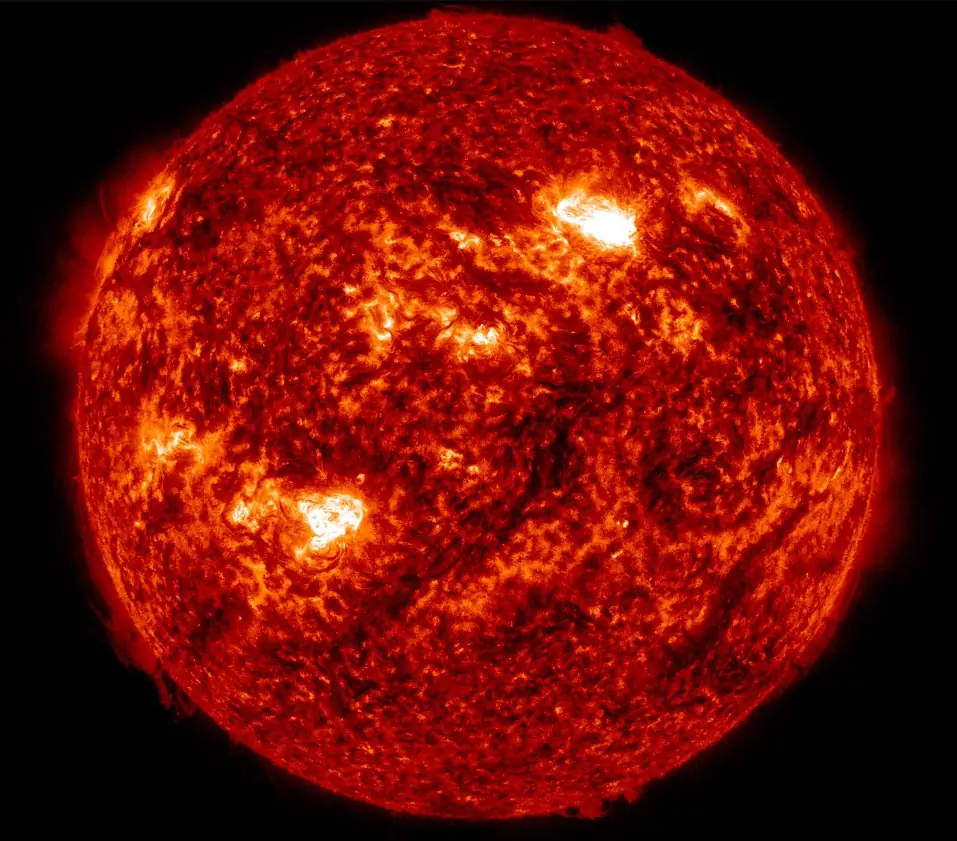
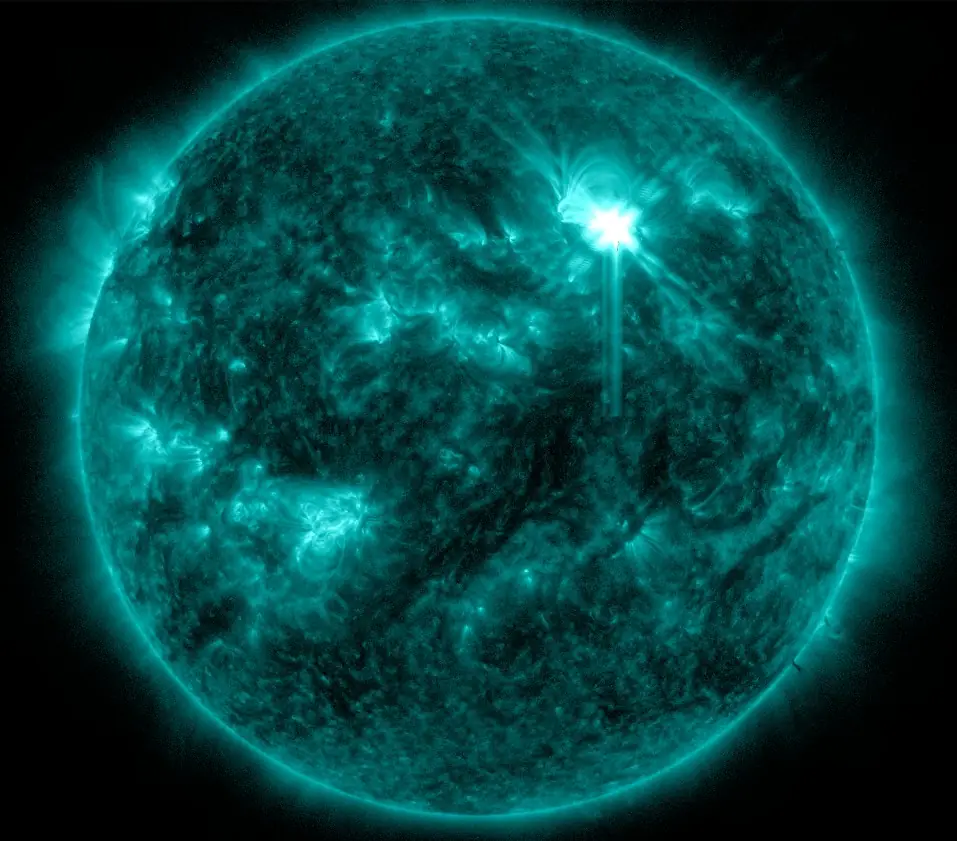
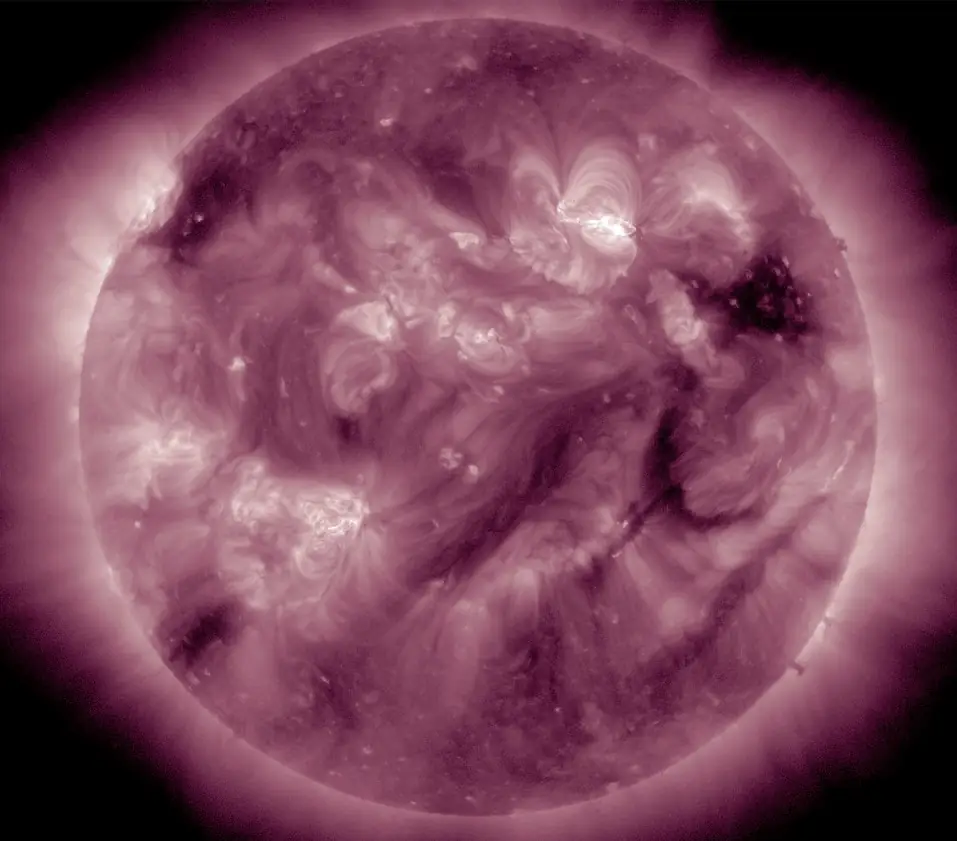
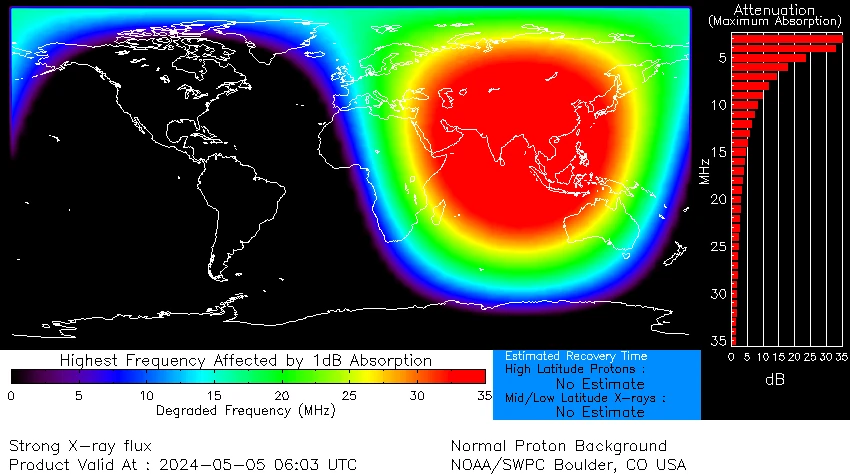
Solar activity was at moderate to high levels over the past 7 days, with multiple C- and M-class flares and 2 X-class.
| Max class | Time |
|---|---|
| M7.4 | 05/5, 10:00 UTC |
| M2.3 | 05/5, 09:38 UTC |
| M1.3 | 05/5, 08:19 UTC |
| X1.3 | 05/5, 06:01 UTC |
| M8.4 | 05/5, 01:27 UTC |
| M9.0 | 05/4, 23:48 UTC |
| M3.2 | 05/4, 22:37 UTC |
| M1.3 | 05/4, 18:20 UTC |
| M1.5 | 05/4, 07:07 UTC |
| M9.1 | 05/4, 06:19 UTC |
| M1.6 | 05/4, 00:36 UTC |
| M2.4 | 05/3, 23:30 UTC |
| M1.0 | 05/3, 23:16 UTC |
| M1.2 | 05/3, 22:47 UTC |
| M4.4 | 05/3, 08:11 UTC |
| X1.6 | 05/3, 02:22 UTC |
| M2.7 | 05/3, 00:15 UTC |
| M2.7 | 05/2, 20:57 UTC |
| M1.0 | 05/2, 02:17 UTC |
| M1.8 | 05/1, 22:31 UTC |
| M1.9 | 05/1, 14:44 UTC |
| M1.8 | 05/1, 14:32 UTC |
| M9.5 | 04/30, 23:46 UTC |
| M1.3 | 04/30, 16:33 UTC |
| M1.2 | 04/30, 15:11 UTC |
| M1.6 | 04/30, 01:14 UTC |
| M3.7 | 04/29, 01:11 UTC |
| M2.5 | 04/29, 00:48 UTC |
Region 3663 (beta-gamma-delta) produced an M9.1 flare at 06:19 UTC and M9.9 at 23:48 UTC on May 4. A Type II (estimated velocity 950 km/s) and Type IV radio sweep, along with a Tenflare, were observed with the M9.1 event.
A CME is suspected to be associated with the flare, however, coronagraph imagery has been unavailable since 23:37 UTC on May 3 due to an apparent outage.
Regions 3663 and 3664 (beta-delta) persist as the largest and most complex regions on the disk, with minor growth noted in both.
New Region 3667 (alpha) was numbered and the remaining regions were either stable or in decay over the past 36 hours.
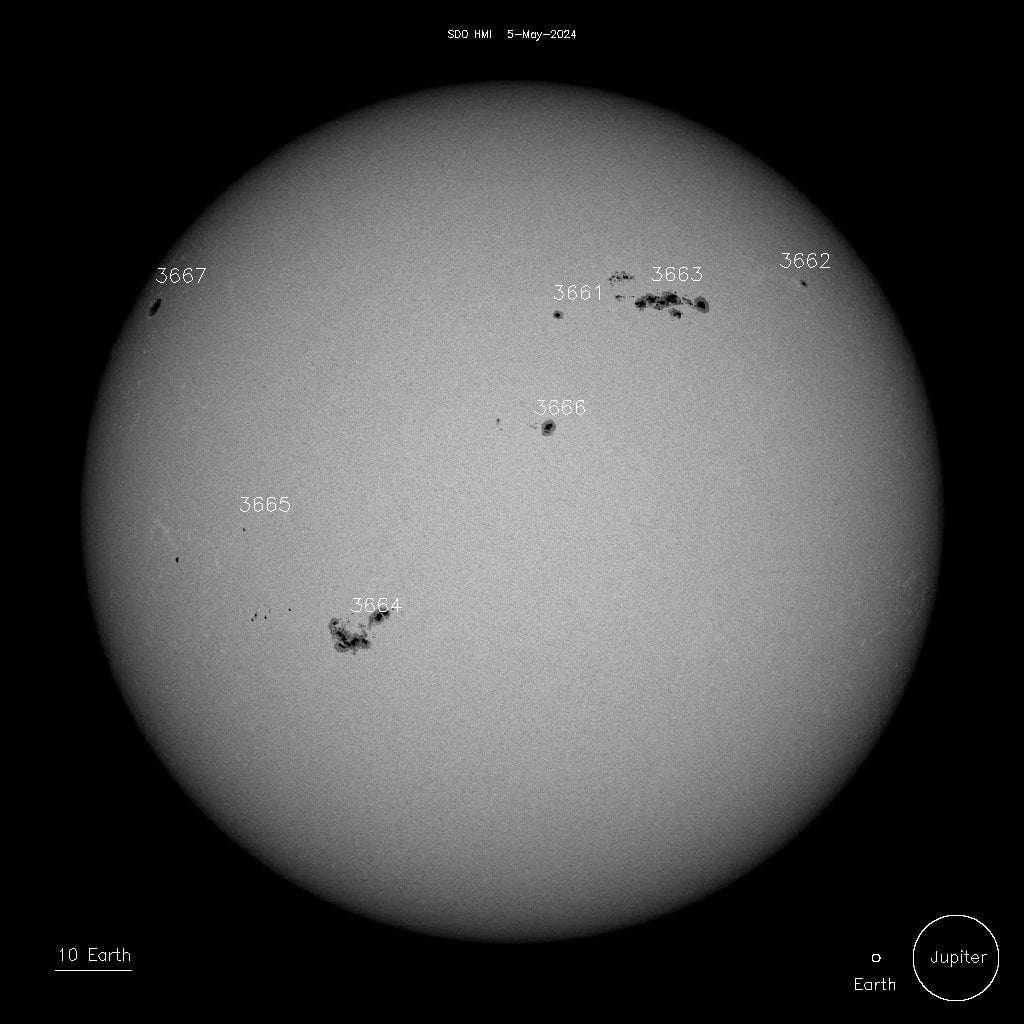
Other notable eruptive activity included a C3.9 flare at 20:37 UTC on May 03, with associated Type II (estimated velocity 392 km/s) and Type IV radio emissions, from an unspotted area to the east of Region 3666 (beta). The associated CME, first seen in SOHO/LASCO C3 imagery at 22:18 UTC on May 3, has been analyzed as a glancing blow hit on May 9.
Solar activity over the next 24 hours is expected to be at moderate levels (75% / M-class), with a chance for X-class flares (25%) through May 7.
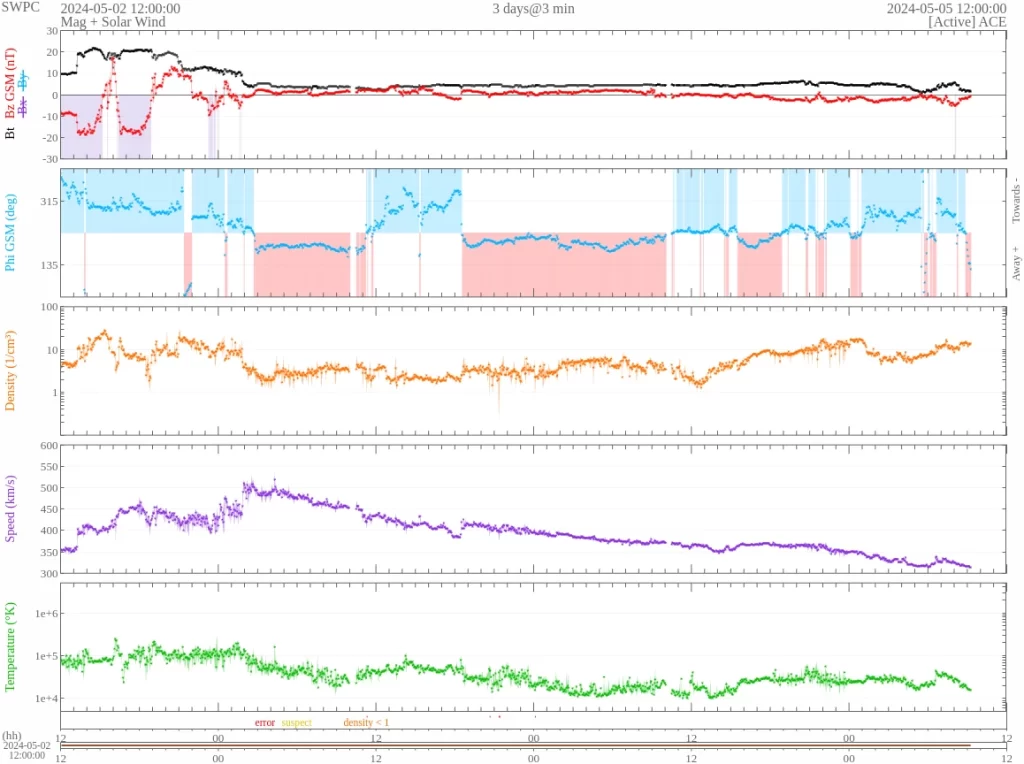
Solar wind exhibited ambient conditions over the past 24 hours. Total magnetic field strength was at or below 6 nT and the Bz component was between +/-3 nT. Solar wind speeds decreased throughout the period, from early readings near 400 km/s to around 350 – 370 km/s.
Mildly enhanced solar wind conditions and positive polarity coronal hole high speed stream (CH HSS) influences are likely to prevail through May 7. A stronger disturbance is expected late on May 5 and May 6 due to the anticipated arrival of the CME produced by the X1.6 solar flare on May 3.
References:
1 Forecast Discussion – Issued: 2024 May 05 0030 UTC – Prepared by the U.S. Dept. of Commerce, NOAA, Space Weather Prediction Center

Teo Blašković founded The Watchers in 2011 and edited it until 2026, covering seismic and volcanic activity, extreme weather, space weather and near-Earth objects. Articles on this page are his archive.
Earlier reporting
Nothing on Watchers was published in the last 24 hours. These are older articles.
- On October 22, 2017, a single flash of lightning stretched 515 miles from eastern Texas to near Kansas City, a distance that takes eight hours to drive, and nobody realized how far it had gone until scientists went back through the satellite data years later Epicenter
- CPC posts a slight risk of heavy rain from the Gulf Coast to the Northeast urban corridor November 25-29, and a moderate risk of West Coast wind and Sierra snow on November 25
- Florida's east coast faces a moderate flash flood risk Wednesday through Friday, with 4 to 8 inches of rain forecast and the St. Johns River near Cocoa already in major flood at 17.13 feet
- Cyclone Akvan to make landfall between Nellore and Visakhapatnam around noon on November 20, IMD forecasts 120-130 km/h winds gusting to 145
