
X-ray study confirms Betelgeuse’s faint companion star
Astronomers using NASA’s Chandra X-ray Observatory confirmed that Betelgeuse, the red supergiant blazing in Orion’s shoulder, hosts a faint, low-mass companion star, ending decades of speculation about the famous star’s solitary status.

Artist illustration of the Chandra X-ray Observatory. Credit: NASA/CXC/NGST
For more than a century, astronomers suspected Betelgeuse was part of a binary system. Subtle changes in its light and motion suggested an unseen partner, but its overwhelming brightness hid any trace of another star. Betelgeuse, located about 168 parsecs (550 light-years) from Earth, is roughly 700 times the Sun’s radius and tens of thousands of times more luminous. Any companion orbiting nearby would have been lost in the glare.
In late 2024, researchers at Carnegie Mellon University realized that Betelgeuse’s predicted orbital geometry offered a brief window of visibility. The companion would emerge from behind the supergiant in early December before disappearing again for two years. They quickly submitted proposals for emergency Director’s Discretionary Time on both NASA’s Chandra X-ray Observatory and the Hubble Space Telescope.
The proposals were approved, an outcome reserved for the most promising and time-critical astronomical opportunities. Within days, telescopes around the world were watching Orion’s shoulder, waiting for a flicker of light from the long-suspected second star.
When the data arrived, the team finally saw what generations of astronomers had missed. Betelgeuse’s companion had revealed itself.
What the X-rays did not show
The Chandra observations took place between December 9–15, 2024, using the High Resolution Camera (HRC-I) for a total of 41.85 kiloseconds (11.6 hours) of exposure. The data were processed using NASA’s CIAO 4.17 software and calibration database version 4.11.6. Seven individual exposures were combined to create the deepest X-ray image of Betelgeuse ever taken.
The team expected that if the companion were a compact object, a white dwarf or a neutron star, it would emit a clear signal of accretion. As Betelgeuse’s powerful wind flowed past the smaller object, it would produce bright X-rays visible even through dust. Instead, Chandra detected nothing. The faint counts recorded were consistent with background noise, not a real source.
From this absence of emission, the researchers calculated an upper limit of 2 x 1030 erg/s (4.7 x 10⁻⁴ solar luminosities) for a 10 million Kelvin plasma, or 5 x 1029 erg/s (1.2 x 10⁻⁴ solar luminosities) for a power-law spectrum. These values fall below what is typical for accreting white dwarfs or neutron stars, which range between 1030 and 1036 erg/s. Instead, they match the weaker signals produced by young stellar objects like T Tauri stars.
The silence in X-rays was a confirmation. Betelgeuse’s companion was not a dead remnant. It was alive, young, and still radiating softly, a solar-mass star orbiting inside the red giant’s dusty shroud.
Why decades of searches came up empty
Previous attempts to detect a companion all failed for simple geometric reasons. Between 2001 and 2007, Betelgeuse was observed repeatedly by Chandra as part of calibration tests totaling 58 kiloseconds. Those images were too shallow, and more importantly, they were taken when the companion was behind the supergiant. Even two short observations during the Great Dimming of 2020 yielded no trace, because the companion was completely eclipsed.
Betelgeuse’s orbital cycle is roughly six years long. During most of that time, the smaller star remains behind or within the outer dust shell. The shell itself extends to about 1.5 times Betelgeuse’s radius, roughly 8 astronomical units. Only during a brief portion of the orbit does the companion appear at maximum separation, far enough to be detected before slipping back into obscurity.
The 2024 alignment was the first in decades to allow a clear view from Earth. Astronomers used this window to collect both ultraviolet and X-ray data, knowing it would close again for years. The next opportunity will not arrive until late 2027, when Betelgeuse B re-emerges from behind its enormous primary.
Each attempt before 2024 lacked either the timing, sensitivity, or angular resolution required. This time, all three conditions aligned perfectly, and so did the stars.
Dust, dimming, and Betelgeuse’s strange rhythm
Betelgeuse is known for dramatic swings in brightness. Every six years, it brightens and fades in a cycle first noticed more than a century ago. The cause of that rhythm has been debated ever since. Some believed it was driven by pulsations within the star. Others suspected surface convection. But a third theory, involving a companion star interacting with dust, gained attention in recent years.
In 2024, Jared Goldberg and colleagues modeled how a small orbiting star could carve channels in the red supergiant’s dusty atmosphere. As the companion moves through, it pushes and heats the dust, temporarily clearing the line of sight. The star then appears brighter until new dust forms and dims it again.
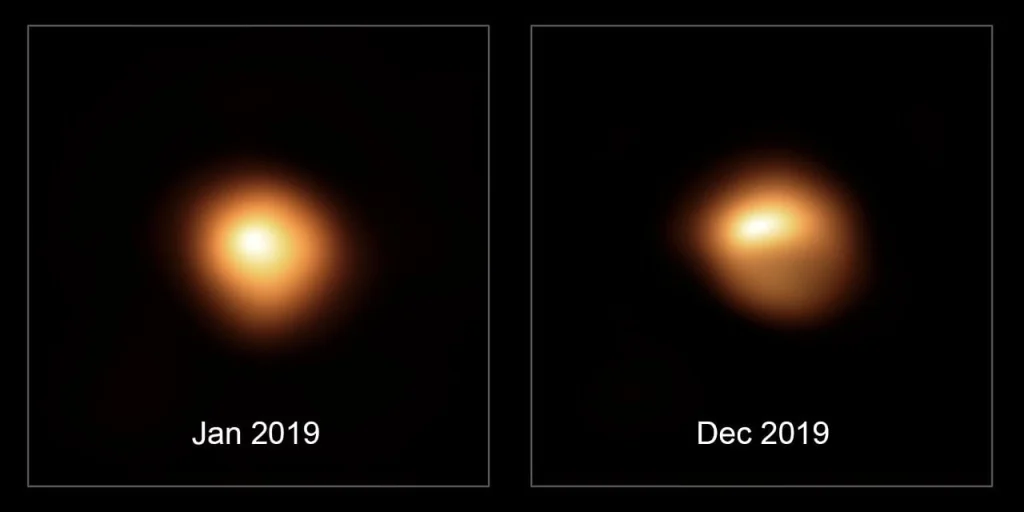
The discovery of Betelgeuse’s companion supports this theory directly. The Great Dimming of 2019–2020, when Betelgeuse lost nearly 40% of its brightness, was not a sign of an imminent supernova but rather a large dust ejection that blocked part of the disk. The smaller companion’s presence could explain how that material formed and why it later cleared.
This finding links the star’s long-term variability to a physical orbital process rather than random internal changes. Betelgeuse’s heartbeat, it seems, is controlled by the gravitational rhythm of its partner.
What this binary system means for stellar evolution
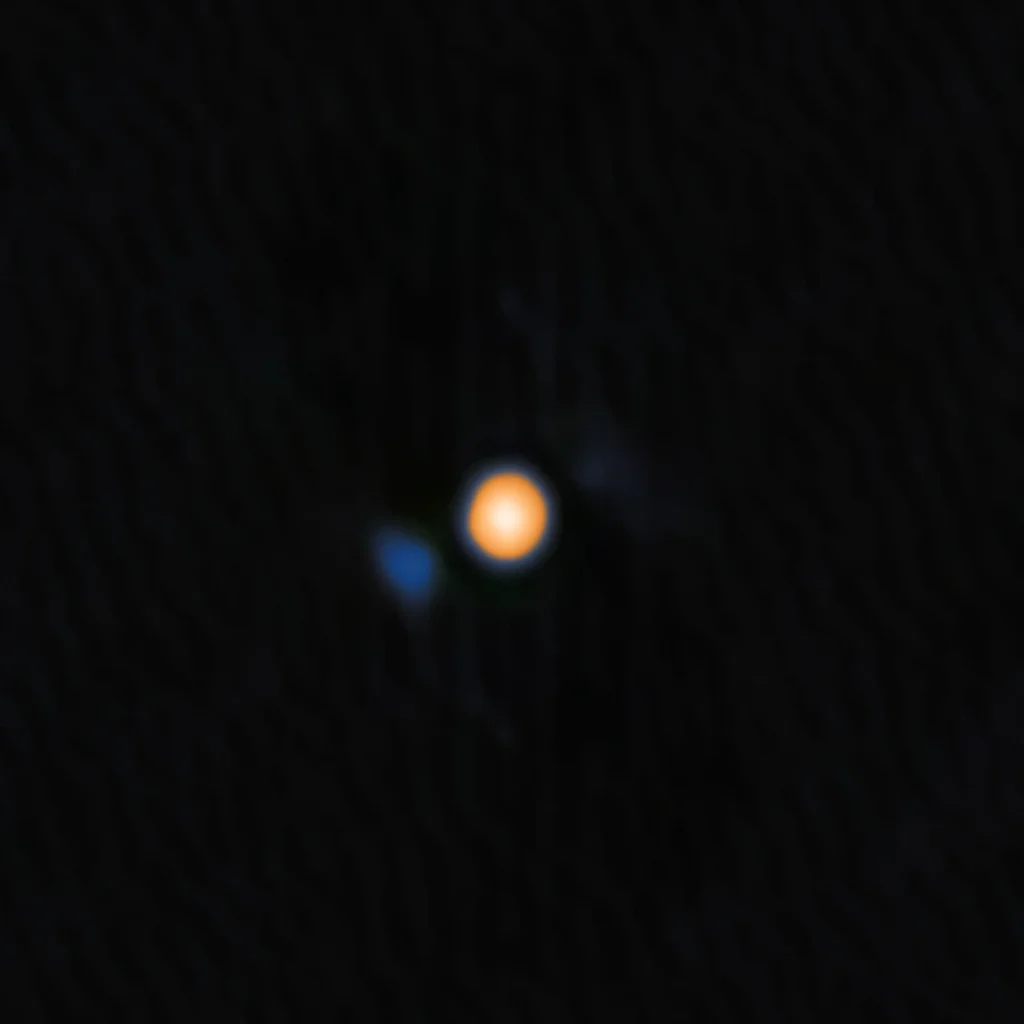
Binary systems are the rule, not the exception, in stellar formation, but most consist of stars of similar mass. Betelgeuse and its partner are not typical. The supergiant is about 16–17 times the Sun’s mass, while the companion is roughly one solar mass or slightly less. The mass ratio of about 17 to 1 makes it one of the most unequal binary systems ever directly observed.
This imbalance has major consequences for how the system will evolve. The massive star is already in its late life, having exhausted hydrogen in its core. It is shedding material that could one day accrete onto its smaller partner. When Betelgeuse eventually explodes as a supernova, the blast may be asymmetric because of that companion’s gravitational pull.
Studying such an extreme mass-ratio binary helps astronomers test theories about how stars transfer mass, lose angular momentum, and shape their surroundings. The discovery also suggests that many apparently single supergiants might hide small companions, influencing their behavior in subtle ways that only high-resolution instruments can reveal.
For astrophysicists, Betelgeuse has become a laboratory for understanding how massive stars live and die in binary pairs. Its companion offers a new way to probe the complex physics of stellar winds, dust formation, and supernova preparation.
What comes next for Betelgeuse
The companion, now identified as Alpha Orionis B, has already slipped behind Betelgeuse once more. It will not be visible again until the end of 2027, when it reaches its next point of maximum separation. Astronomers plan to observe it again using Chandra, Hubble, and the James Webb Space Telescope to measure how the pair interacts across wavelengths.
During the current hidden phase, researchers are refining orbital models and simulating how dust moves around both stars. These models will help predict how light curves and spectra change as the companion influences Betelgeuse’s envelope. When the next observing window opens, astronomers hope to capture the companion in infrared and ultraviolet simultaneously, providing a full picture of its temperature, size, and activity.
Betelgeuse has always been a favorite among stargazers, but this discovery cements its status as one of the most important stars in astrophysics. From the first direct image of its surface to the Great Dimming and now the revelation of its partner, Betelgeuse continues to surprise and educate.
Someday, the supergiant will end its life in a spectacular supernova. When that happens, the data gathered today will explain how one of the most famous stars in history lived its final centuries—and how its small, steadfast companion helped shape its fate.
References:
1 X-Ray Study Reveals New Details About Betelgeuse’s Elusive Companion Star – CMU – October 8, 2025
2 Betelgeuse’s Buddy: X-Ray Constraints on the Nature of α Ori B – Anna J. G. O’Grady et al. – The Astrophysical Journal – October 8, 2025 – https://iopscience.iop.org/article/10.3847/1538-4357/adff83 – OPEN ACCESS

I’m a science journalist and researcher at The Watchers, contributing to the Epicenter edition, where I cover peer-reviewed scientific research and emerging discoveries across Earth and space sciences. With a background in astronomy and a passion for environmental science, I’ve worked in shark and coral conservation in Fiji, conducting reef and shark-behavior research, contributing to mangrove restoration, and earning PADI Open Water and Coral Reef Certifications. I bring a blend of scientific rigor and storytelling to illuminate the discoveries shaping our planet and beyond.

Commenting rules and guidelines
We value the thoughts and opinions of our readers and welcome healthy discussions on our website. In order to maintain a respectful and positive community, we ask that all commenters follow these rules.