
Solar activity rising again after decades of decline
NASA analysis confirms the Sun’s activity, which had weakened since the 1980s and reached record lows in 2008, has been rising again through the past 17 years, a reversal with wide implications for space weather, Earth’s technology, and our understanding of long-term solar behavior.
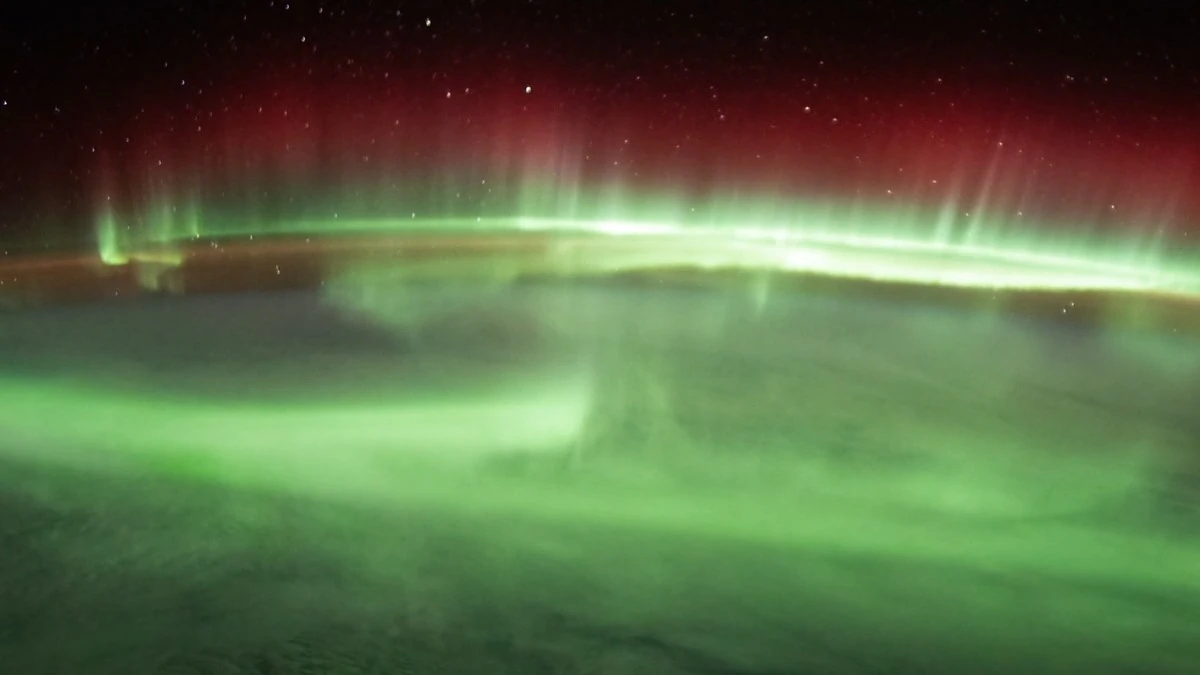
Aurora seen from ISS in August 2022. Credit: NASA/ISS
NASA analysis confirms the Sun’s activity, which had weakened since the 1980s and reached record lows in 2008, has been rising again through the past 17 years, based on data from multiple spacecraft and heliophysics databases.
The Sun’s output of solar wind, its magnetic field strength, and sunspot numbers all show a clear upward trend since 2008.
For decades before that point, heliophysicists observed steady weakening. By 2008, the Sun’s magnetic field dropped to its lowest level since measurements began in the space age. At the same time, cosmic rays entering the solar system surged, reflecting the diminished shielding power of the Sun.
The new peer-reviewed analysis, led by NASA scientist Jared M. Jasinski, shows that 2008 marked a turning point. The study, published in The Astrophysical Journal Letters in September 2025, concludes that the long-term decline has been replaced by strengthening activity.
This reversal challenges earlier predictions that the Sun was entering a “grand minimum,” a multi-decade phase of quiet conditions. Instead, the Sun appears to be recharging.
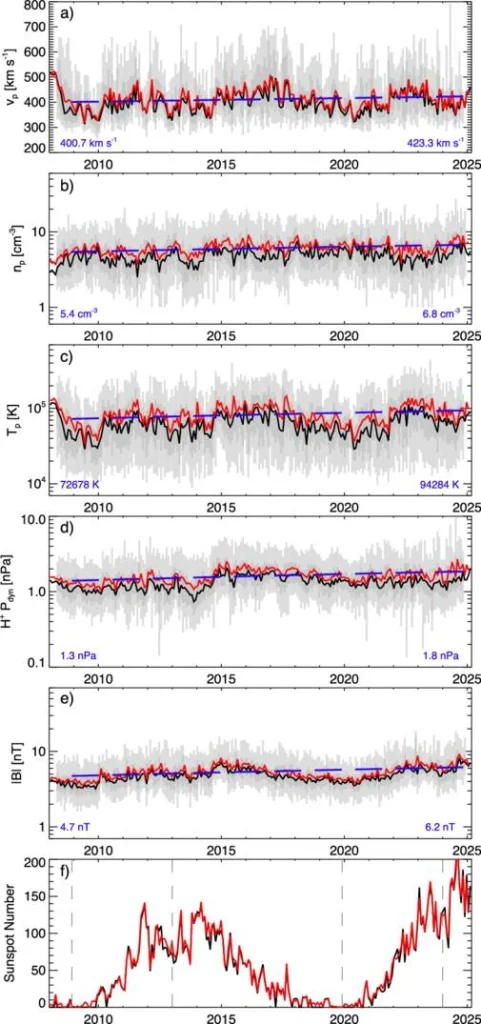
Solar activity follows a rhythm of roughly 11 years, measured by the waxing and waning of sunspots on the solar surface.
At cycle maximum, solar eruptions, including flares and coronal mass ejections, increase in frequency and at cycle minimum, the activity quiets down. This cycle is driven by the Sun’s magnetic dynamo, which flips polarity about every 11 years, creating a 22-year magnetic cycle.
The solar wind streams outward from the Sun at about 400 km/s (250 mi/s), carrying magnetic disturbances that interact with Earth’s magnetosphere, producing auroras and geomagnetic storms.
However, superimposed on this short cycle are longer-term trends. For example, from the 1980s until 2008, each cycle’s maximum was weaker than the last and many scientists suspected this pattern might continue into a grand minimum.
| Solar cycle | Approx. peak sunspot number | Trend |
|---|---|---|
| Cycle 21 (1976–1986) | ~233 | Strong |
| Cycle 22 (1986–1996) | ~213 | Weaker |
| Cycle 23 (1996–2008) | ~180 | Weaker |
| Cycle 24 (2008–2019) | ~116 | Weakest in a century |
| Cycle 25 (2019–present) | rising (expected 115–140) | Strengthening |
Historical records show that the Sun’s long-term behavior does not always align with the typical 11-year rhythm.
Between 1645 and 1715, the Maunder Minimum produced an extended period of unusually few sunspots. This coincided with the coldest part of the so-called Little Ice Age in Europe and North America. River Thames fairs in London became common as the river froze, and winters across the Northern Hemisphere were harsher.
A later episode, the Dalton Minimum from about 1790 to 1830, again brought lower solar activity. This period overlapped with notable cold spells and increased reports of spectacular auroras, sometimes seen as far south as 30° latitude (≈33°N).
During the Maunder and Dalton minima, activity collapsed for decades, reshaping expectations of what the Sun is capable of. The weakening trend observed after the 1980s raised similar concerns among scientists that a new prolonged minimum was beginning. However, the latest NASA analysis indicates that the Sun shifted course after 2008, entering a phase of renewed strength rather than extended quiet.

The reversal in activity raises questions about the mechanisms driving solar magnetism.
Solar physicists use magnetohydrodynamic (MHD) models to simulate how plasma flows inside the Sun generate magnetic fields. The models had difficulty reproducing the extended weakening trend and now they must also explain the sudden shift toward strengthening.
When the Sun is more active, geomagnetic storms triggered by solar eruptions become more likely. Such storms can disturb satellite electronics and GPS signals, and interfere with high-frequency radio communications.
Astronauts in orbit face increased exposure to radiation during strong solar particle events, and aviation at high latitudes, where the atmosphere offers less protection, can also be affected, but one of the most concerning risks is to power grids.
Geomagnetically induced currents during major storms can overload transformers, potentially leading to regional blackouts. The 1989 Quebec blackout, triggered by a solar storm, is a serious reminder of this vulnerability.
As the Sun ramps up, the likelihood of events similar to the 1859 Carrington storm, which caused telegraph system failures worldwide, becomes a greater concern. A comparable event today could damage satellites, disrupt communications, and cause widespread economic losses.
Modern estimates suggest that a Carrington-class geomagnetic storm could result in trillions of dollars in damages globally, with cascading effects on power grids, satellite constellations, aviation, and internet infrastructure. Vulnerabilities are greater now than in the 19th century, given the world’s dependence on interconnected systems and space-based technology.
Another strong reminder came in July 2012, when a massive coronal mass ejection narrowly missed Earth by just a few days. Had the ejection struck directly, it could have produced geomagnetic disturbances comparable to the Carrington event. NASA described that near miss as a “cosmic close call.”
Studies also indicate that the probability of a Carrington-level storm striking Earth within the next decade is between 5–12 percent, low in annual terms, but high enough to warrant serious preparedness. For comparison, the risk is greater than the likelihood of many natural hazards for which infrastructure is routinely hardened.
Governments and agencies now rank extreme solar storms among the highest-priority natural threats. National grid operators, aviation authorities, and satellite providers conduct scenario planning, while NOAA’s Space Weather Prediction Center (SWPC) issues real-time warnings to mitigate impacts.
Despite these efforts, resilience remains uneven across regions, making the potential consequences of the next ‘big one’ difficult to contain.
References:
1 The Sun Reversed Its Decades-long Weakening Trend in 2008 – Jasinski, J. M. et al. – The Astrophysical Journal Letters – September 2025 – DOI: https://doi.org/10.3847/2041-8213/adf3a6 – OPEN ACCESS
2 NASA analysis shows sun’s activity ramping up – NASA – September 15, 2025.

I'm a dedicated researcher, journalist, and editor at The Watchers. With over 20 years of experience in the media industry, I specialize in hard science news, focusing on extreme weather, seismic and volcanic activity, space weather, and astronomy, including near-Earth objects and planetary defense strategies. You can reach me at teo /at/ watchers.news.

Commenting rules and guidelines
We value the thoughts and opinions of our readers and welcome healthy discussions on our website. In order to maintain a respectful and positive community, we ask that all commenters follow these rules.