
Newly discovered crater reveals how impacts reshape the Moon
A newly discovered 222 m (728 feet) crater on the Moon is giving scientists a rare look at how a single impact can modify the lunar surface far beyond the crater itself. The crater, formed between April 11 and May 22, 2024, when an asteroid or comet fragment struck the Moon, is associated with changes in surface reflectance extending more than 100 km (62 miles) from the impact site and a broad thermal anomaly linked to disturbed regolith.
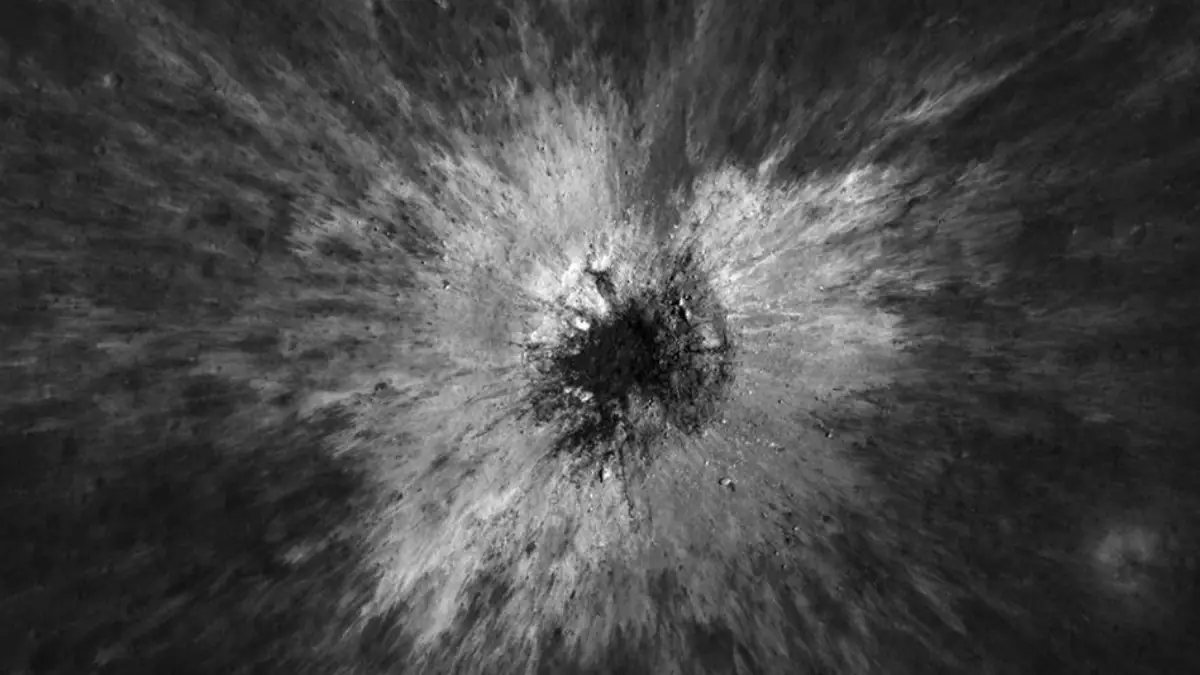
Close-up view of McGetchin crater captured by NASA’s Lunar Reconnaissance Orbiter (LRO) Narrow-Angle Camera on December 5, 2025. The image, with a resolution of about 0.9 m (3 feet) per pixel, shows the crater and surrounding impact-modified terrain across an area about 1.2 km (0.75 miles) wide. Credit: NASA/GSFC/Arizona State University
The observations show that a collision does more than excavate rock and scatter debris around a crater. It can also disturb the texture and physical properties of the surrounding regolith, the layer of fragmented rock and dust covering the lunar surface.
By documenting these changes soon after a large impact, researchers have obtained new evidence for understanding how repeated collisions reshape the Moon’s uppermost material, including regions far beyond the craters themselves.
Scientists identified McGetchin on October 24, 2025, while comparing images acquired by NASA’s Lunar Reconnaissance Orbiter Camera (LROC). The crater formed between April 11 and May 22, 2024, near the boundary between the Moon’s ancient highlands and the basaltic plains of a lunar mare. The collision was not observed directly, and its formation interval was reconstructed from images obtained before and after the impact.
The crater measures 222 m (728 feet) across and approximately 43 m (141 feet) deep. Robinson et al. (2026) describe it as the largest contemporary impact crater discovered in the solar system, exceeding the previous largest newly formed lunar crater identified during the LRO mission, which measured approximately 70 m (230 feet) across.
 Color-coded binned reflectance values. Credit: NASA/GSFC/Intuitive Machines
- Key geomorphic features of McGetchin crater. Credit: NASA/GSFC/Intuitive Machines
- Regional geologic context map. Credit: NASA/GSFC/Intuitive Machines
- WAC temporal ratio map (after/before). Credit: NASA/GSFC/Intuitive Machines


Impact-production models estimate that a collision capable of producing a crater of McGetchin’s size occurs on the Moon once every 132 years on average. The estimate describes the modeled frequency of comparable impacts, not a regular recurrence cycle.
The new crater also provides unusually detailed evidence of how an impact modifies different geological materials. It formed near a boundary between relatively loose highland regolith and basaltic mare deposits associated with ancient lava flows. The researchers interpret differences in the crater’s shape and ejecta distribution as evidence that the impact encountered contrasting subsurface properties.
High-resolution images show that the crater is not perfectly circular. Its measured diameter ranges from 213 m (699 feet) to 231 m (758 feet), while its walls have a median slope of 24° and reach 41° in some locations. The authors interpret the difference between its eastern and western rim geometry as consistent with excavation through material of differing strength and structure.
The collision deposited a continuous blanket of ejecta, consisting of rock fragments and granular material excavated during crater formation, around the immediate impact site. The researchers identified the approximate edge of this deposit using changes in surface reflectance and the preservation of older craters. Its median extent is approximately 146 m (479 feet) beyond the new crater’s rim.

Farther from the impact site, the orbital observations revealed a different type of disturbance.
Robinson and colleagues compared hundreds of Wide-Angle Camera observations acquired before and after the collision, correcting for differences in viewing geometry and illumination. The resulting image comparisons revealed a relatively bright disturbance zone extending approximately 15 km (9.3 miles) from the crater and a broader, discontinuous region of reduced reflectance extending more than 100 km (62 miles), with localized changes reaching approximately 140 km (87 miles).
The distant variations are subtle, in some locations changing the surface reflectance by only about 1%. They nevertheless show that the collision modified the optical properties of terrain far beyond the continuous ejecta blanket. The observations do not establish that the entire affected region was excavated, covered by thick ejecta, or modified to the same depth.
The researchers interpret the distant reflectance patterns as evidence of changes to the texture of the uppermost regolith. One proposed mechanism involves high-speed particles and vapor generated during the initial contact and compression stage of the impact, when the incoming object first strikes and rapidly compresses the lunar surface.
Such material can spread outward at high velocity and disturb the uppermost grains of regolith, changing how the surface reflects sunlight. The researchers discuss a process known as jetting, in which material is expelled at high speed during the earliest stages of impact.

The observed disturbance presents a problem for existing descriptions of that process. A ridge approximately 8 km (5 miles) west of McGetchin rises about 700 m (2 300 feet) above the impact site, yet reflectance changes are visible on terrain beyond it. Robinson and colleagues identify several possible explanations involving different ejection angles, interactions between particles and expanding gas, or distinct stages of material transport.
The available observations do not establish which mechanism produced the entire distant disturbance pattern. The authors identify detailed modeling of the initial impact and ejecta transport as necessary to explain how material reached the more distant locations.
A second study, led by Powell et al. (2026), examined how the same impact changed the thermal properties of the surrounding lunar terrain. Using the Diviner instrument aboard LRO, the researchers identified an approximately 7-km (4.3-mile) wide region around McGetchin that is 8–9°C (14–16°F) cooler at night than the surrounding surface.
The colder region does not represent heat remaining from the original collision. Diviner began targeted observations after the crater was discovered in October 2025, more than a year after the impact.
Instead, the temperature difference reflects changes in how the surrounding lunar material cools during the night. The central crater and nearby rocky ejecta remain relatively warm, while the disturbed regolith around them forms the colder region.
The researchers interpret the temperature anomaly as evidence consistent with regolith decompaction. When the uppermost material becomes more loosely packed, its density and thermal conductivity change, reducing its thermal inertia, or its ability to resist temperature changes as heat moves through the material.

The affected surface consequently loses heat more rapidly during the lunar night than adjacent, less disturbed terrain. Diviner measures the resulting thermal radiation, while the inferred changes in regolith density and subsurface structure are derived from thermal models rather than direct measurements of the soil.
Powell and colleagues compared observations of McGetchin with Diviner measurements of 20 other newly formed lunar craters larger than 20 m (66 feet). Every crater in the examined sample larger than approximately 30 m (98 feet) produced a detectable nighttime cold spot, while smaller craters showed weaker or less consistently detectable anomalies.
The study also found that larger craters generally produce stronger initial cold spots, indicating more extensive modification of the shallow regolith. However, the temperature difference does not continue increasing proportionally with crater diameter for craters larger than approximately 100 m (328 feet).
The authors investigated this behavior using two different models of subsurface density. One represents a gradual increase in density with depth, while the other assumes a distinct layer of loosened material overlying more compacted regolith.
Both models can reproduce aspects of the observed cooling but produce different estimates of the depth and structure of the disturbed material. Neither reproduces McGetchin’s complete nighttime cooling behavior, leaving the precise subsurface density profile unresolved.
The difference also reflects a limitation of orbital thermal measurements. Nighttime surface temperatures are most sensitive to the properties of material within the upper several centimeters, making it difficult to determine how far the disturbance continues below that layer.
The thermal anomaly surrounding McGetchin is substantially smaller than the region showing distant changes in visible-light reflectance. Powell and colleagues interpret the difference as evidence that the observations respond to different scales of disturbance: the visible-light changes can reveal alterations in the texture of the uppermost grains, while the nighttime temperature anomaly requires changes extending deeper into the regolith.
Daytime thermal observations revealed another distinct region of altered surface properties, approximately 14 km (8.7 miles) across. Its viewing-angle-dependent temperature pattern is consistent with increased roughness at millimeter to subcentimeter scales, providing additional evidence that the collision affected the lunar surface differently at different distances and depths.
The findings extend beyond the physical consequences of the McGetchin impact itself.
Using the observed relationship between crater size and cold spot properties, Powell and colleagues modeled the cumulative effect of repeated impacts on the lunar regolith. Their results indicate that cold spot formation may modify the shallow surface at rates comparable to direct excavation and overturn by primary impact craters, a process known as impact gardening.
Under the model assumptions, a typical point on the lunar surface experiences a cold spot associated with a crater larger than approximately 30 m (98 feet) on a timescale of about 10 million years. The modeled disturbance affects the upper several centimeters of regolith, although the estimated depth depends on the assumed subsurface structure and impact-frequency distribution.
The result indicates that the cumulative contribution of impacts to lunar surface evolution may extend well beyond the material directly excavated by individual craters. Decompaction does not necessarily involve complete mixing or overturn of the affected regolith, however, and the authors distinguish it from direct excavation when comparing the two processes.

The exact mechanism responsible for the formation of lunar cold spots remains unresolved. The researchers discuss several possible processes, including disturbance by secondary impacts and moving ejecta, gas-driven particle transport, and seismic shaking that temporarily lifts and loosens near-surface material.
The spatial correspondence between some of McGetchin’s thermal and visible-light disturbance patterns supports an association with ejecta-related processes, but does not establish a single formation mechanism. Repeated observations of the crater and direct measurements of the disturbed regolith would help distinguish between the proposed explanations.
The newly documented crater also provides an observational baseline for studying how impact-related surface changes evolve with time. Continued thermal monitoring can track the fading of the cold spot, while future measurements of subsurface density and structure would help determine which of the competing models most closely represents the material beneath the surface.
Those measurements would provide constraints on impact-related regolith modification and improve the interpretation of thermal observations of young craters elsewhere on the Moon and other regolith-covered planetary bodies.
References:
1 Robinson, M. S., Boyd, A. K., Mahanti, P., Manheim, M. R., Speyerer, E. J., Stopar, J. D., & Wagner, R. V. (2026). A new 222-m diameter lunar crater. Science Advances, 12(38), eaeh7812. https://doi.org/10.1126/sciadv.aeh7812
2 Powell, T. M., Greenhagen, B. T., Horvath, T., Williams, J.-P., Jhoti, E., Speyerer, E. J., Elder, C. M., & Paige, D. A. (2026). New lunar crater reveals extensive distal regolith modification. Science Advances, 12(38), eaeh9568. https://doi.org/10.1126/sciadv.aeh9568

I’m a science journalist and researcher at The Watchers, contributing to the Epicenter edition, where I cover peer-reviewed scientific research and emerging discoveries across Earth and space sciences. With a background in astronomy and a passion for environmental science, I’ve worked in shark and coral conservation in Fiji, conducting reef and shark-behavior research, contributing to mangrove restoration, and earning PADI Open Water and Coral Reef Certifications. I bring a blend of scientific rigor and storytelling to illuminate the discoveries shaping our planet and beyond.

Commenting rules and guidelines
We value the thoughts and opinions of our readers and welcome healthy discussions on our website. In order to maintain a respectful and positive community, we ask that all commenters follow these rules.